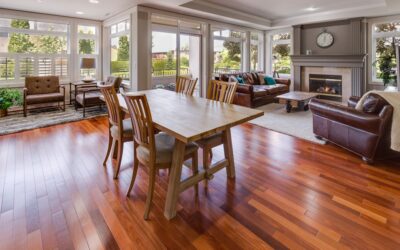
A well-installed solid oak wood flooring job can outlive the house it sits in, with plank sourced from oak trees that were already 80 years old before harvest. That longevity is the whole reason oak still dominates hardwood sales in the US despite cheaper engineered and vinyl alternatives flooding the market. Unlike a laminate that gets tossed at the first deep scratch, a 3/4-inch solid oak floor can be sanded back to bare wood five or six times over its life. Before you drop $8 to $15 per square foot installed, though, you need to know where oak shines and where it falls short.
- Red Oak vs White Oak: Pick the Right Species First
- Understanding Grades and What They Cost
- Solid vs Engineered Oak: When Solid Actually Wins
- The Real Pros of Solid Oak
- The Cons Nobody Mentions at the Showroom
- What Installation Actually Costs
- Caring for Solid Oak So It Lasts
- Pro Tips Before You Commit
Red Oak vs White Oak: Pick the Right Species First
Most homeowners assume “oak is oak.” It isn’t. Red oak and white oak are the two workhorses on the US market, and they behave differently underfoot and under stain.
Red oak runs pinkish with a wild, open grain and a Janka hardness rating of 1,290. It takes stain beautifully but the busy grain hides scratches and dents well, which makes it forgiving in a house with dogs and kids. White oak leans golden-brown with tighter grain, a slightly harder 1,360 Janka rating, and closed pores that resist water better. That water resistance is why white oak is standard on boats and wine barrels.
- Red oak: $3 to $6 per sq ft material, warm tone, hides wear, easiest to match to older homes
- White oak: $4 to $8 per sq ft material, cooler tone, better for gray and natural finishes, more moisture-tolerant
If you want the fashionable light gray or matte natural look, white oak is the move. Red oak’s pink undertone fights gray stains and pushes them muddy.
Understanding Grades and What They Cost
Grading has nothing to do with durability and everything to do with appearance. Every grade is the same hard oak; the difference is how much color variation, knots, and mineral streaking you accept.
- Clear/Select: Minimal knots, uniform color. Runs $5 to $8 per sq ft. Formal, clean look.
- #1 Common: Moderate color variation and small knots. $3.50 to $5.50 per sq ft. The best value for most homes.
- #2 Common / Character: Heavy variation, knots, streaks. $2.50 to $4 per sq ft. Great for rustic and farmhouse styles.
Do not overpay for Select grade if you plan a rustic finish. A #1 Common floor with a wire-brushed matte finish looks intentional and saves you $1.50 a foot.
Solid vs Engineered Oak: When Solid Actually Wins
Solid oak is a single piece of hardwood, typically 3/4 inch thick. Engineered oak glues a thin oak veneer over plywood layers. Solid oak earns its price in two situations: you want the floor to last generations, or you plan multiple refinishes.
Where solid loses is below grade and over concrete slabs. Solid oak expands and contracts with humidity, so it needs a wood subfloor and a nailed-down install. Put it in a basement or over a slab and you’re asking for cupping and gaps. In those cases, engineered oak is the correct choice, not a compromise.
The Real Pros of Solid Oak
Longevity leads the list. Retailers routinely pull up 60-year-old oak floors, sand them once, and sell them as reclaimed material. Refinishing costs $3 to $5 per sq ft and completely resets the surface, which no vinyl or laminate can match.
Resale value is measurable too. Real estate agents consistently report that solid hardwood adds to home value and speeds up sales, while carpet in a living room does the opposite. Oak’s neutral grain also works with almost any decor, so a floor you install today won’t look dated in 15 years the way a trendy vinyl pattern might.
The Cons Nobody Mentions at the Showroom
Moisture is oak’s enemy. A single dishwasher leak or a bathroom overflow can warp planks permanently, and warped solid oak usually means replacement, not repair. Keep it out of bathrooms and laundry rooms.
Then there’s the acclimation requirement. Solid oak must sit in the room for 5 to 14 days before installation so its moisture content equalizes with your home, usually to a 6 to 9 percent range. Skip this step and your gorgeous new floor develops gaps wide enough to lose a quarter in by winter. Dents are another reality. Drop a cast-iron skillet and you’ll leave a mark, though oak’s hardness makes it far more forgiving than pine or fir.
What Installation Actually Costs
Budget realistically. Professional installation of solid oak runs $4 to $8 per sq ft in labor on top of material, so a 400-square-foot living room lands between $4,800 and $9,200 all in.
- Material: $3 to $8 per sq ft
- Labor (nail-down): $4 to $8 per sq ft
- Subfloor prep or leveling: $1 to $3 per sq ft if needed
- Site-finish (sand and 3 coats of poly): add $2 to $4 per sq ft
Prefinished oak costs more per board but saves on labor and dust, and you can walk on it immediately. Site-finished oak looks more seamless because there are no beveled edges between boards, but you’ll live with dust and fumes for several days.
Caring for Solid Oak So It Lasts
Oak’s longevity depends on how you treat it. Grit is the biggest enemy of the finish, acting like sandpaper underfoot, so sweep or dust-mop regularly and place mats at every entry to catch tracked-in dirt.
- Damp-mop only, never wet, since standing water is oak’s worst enemy. Wring the mop nearly dry.
- Use a pH-neutral hardwood cleaner like Bona; skip vinegar and steam mops, which dull and can etch the finish.
- Add felt pads under furniture legs and lift heavy items rather than dragging them.
- Keep humidity between 35 and 55 percent year-round to minimize seasonal gapping and cupping.
- Trim pet nails and wipe spills promptly to protect the finish.
Follow this and the site-applied poly can go 7 to 10 years before it needs a screen-and-recoat, and the wood beneath stays sound for generations.
Pro Tips Before You Commit
Order 10 percent extra material for waste and cuts, and 15 percent if your room has lots of angles or you chose a character grade with rejects. Always request boards from the same production run so color and grain match.
For finish, an oil-based polyurethane in satin sheen hides scuffs better than a high-gloss finish, which telegraphs every scratch and dust mote. If you have kids or pets, ask about a commercial-grade aluminum-oxide finish on prefinished boards. It carries a 25- to 30-year wear warranty and shrugs off daily abuse that would dull a standard poly in five years. Buy solid oak once, install it right, and it becomes the last floor that room ever needs.
Prefer to explore on your own?
See how new flooring looks in your actual room in seconds — free, no signup.
Try the free Floor Studio →