If you love subway tile but crave something with more personality, there is a shape worth knowing. Picket tile, sometimes called elongated hexagon or fence-picket tile, takes the familiar rectangle and tapers the ends to a point, creating a pickets-of-a-fence look. The result is a backsplash or wall that feels fresh and current without being loud. This guide covers the shape, layout options, materials, grout strategy, and what to expect during installation.
Part of our Tile & Grout guide — explore the full guide →
What Picket Tile Is
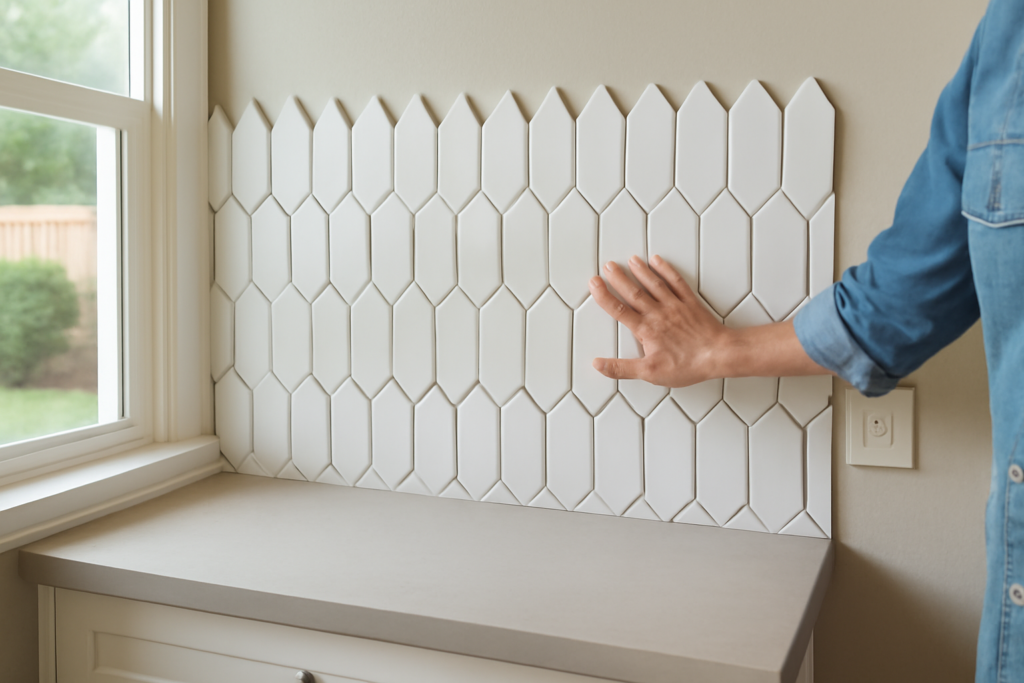
The name describes the shape exactly. A picket tile resembles a long, slim hexagon with pointed ends, like the top of a classic fence picket. It bridges the gap between a clean rectangle and a true hexagon, offering more visual movement than subway tile while staying calmer than a full hex mosaic. Picket tiles come both as individual pieces and as mesh-mounted mosaic sheets, with the sheet format making installation far faster and more consistent.
Popular Layout Orientations
The same tile looks dramatically different depending on how you set it. Consider these common layouts:
- Vertical (upright) orientation makes walls feel taller and is the most popular look for kitchen backsplashes
- Horizontal orientation visually widens a space and reads more relaxed
- Stacked vs. offset within either direction changes the rhythm, with stacked giving a tidy modern grid and offset adding interlock
Lay out a few pieces on the counter before committing, because the pointed ends create different patterns depending on how the rows nest together.
Materials and Finishes
Picket tile is available across most tile materials, so you can match the format to the room.
- Ceramic and porcelain are the most common, affordable and easy to maintain
- Glass picket tile adds shine and works well as a luminous backsplash
- Marble and natural stone bring an upscale, organic feel but require sealing
- Zellige-style handmade ceramics give a glossy, slightly irregular artisan look
Finishes range from high gloss to matte, and color options run from crisp white to deep saturated hues. Expect roughly $8 to $25 per square foot for the tile, with handmade and stone versions at the higher end.
Choosing the Right Grout
Grout color is where picket tile design lives or dies. The pointed shape creates a distinctive joint pattern, and grout either highlights it or hides it.
- Matching grout blends the joints so the surface reads as a soft, unified field
- Contrasting grout outlines every picket, emphasizing the geometric pattern and making it a feature
For a subtle, timeless look, match the grout to the tile. For a bold, graphic statement, go a few shades darker or lighter. In wet areas, consider a stain-resistant epoxy or a high-quality sealed grout to keep the joints clean over time.
Installation Considerations
Picket tile is more involved than standard subway tile because of the angled ends, but mesh-mounted sheets simplify things considerably. Keep these points in mind:
- Dry-lay a section first to confirm the pattern nests the way you expect and to plan your starting line
- Use tile spacers or the built-in sheet spacing to keep grout lines even, since uneven joints stand out on a pointed shape
- Cut edge pieces carefully with a wet saw, as the angled ends require precise cuts at the perimeter
- Finish exposed edges with metal trim or a finished border, since picket tile rarely comes with matching bullnose
If you are new to tiling, the mosaic-sheet format is much more forgiving than setting individual pickets one at a time.
Where Picket Tile Works Best
This shape shines in spaces where you want subtle visual interest. Kitchen backsplashes are the most common application, where a vertical white picket adds texture behind a range or sink. It also works beautifully as a bathroom accent wall, a shower niche, a powder room feature, or a laundry room backsplash. Because the shape is distinctive without being trendy in a way that dates quickly, it suits homeowners who want something current that will still look good in ten years.
How Much Tile to Order
Buying the right quantity prevents a frustrating shortage mid-project. Measure the area you plan to cover in square feet, then add waste for cuts and breakage. Because picket tile has angled ends that require careful perimeter cuts, plan for slightly more waste than you would with simple square tile, often around 15 percent. If you are using natural stone or handmade tile, order a little extra from the same lot, since color and texture vary between production runs and a future patch may not match. Keep a few spare tiles after the job for repairs down the road.
Design Ideas to Try
Picket tile lends itself to creative applications beyond a standard backsplash. A few ideas worth considering:
- A vertical accent strip behind open shelving for a pop of texture
- A shower niche tiled in a contrasting picket color to frame it
- A two-tone gradient using related shades that shift across the wall
- A glossy white picket with dark grout for a graphic, modern kitchen
- A marble picket in a powder room for understated luxury
Because the shape carries visual interest on its own, you rarely need a busy color scheme to make picket tile feel special. Often a single tone with a thoughtful grout choice is all it takes.
Final Thoughts
Picket tile gives you a way to step beyond the predictable rectangle while keeping a clean, livable look. Choose your orientation deliberately, let grout color do the design work, and lean on mesh sheets for an easier install. The payoff is a surface with quiet character that feels custom without shouting for attention.
Whether you set a crisp white picket behind a range or a warm marble version in a powder room, the shape carries a timeless appeal that bridges classic and contemporary. Plan your orientation, order enough tile from a single lot, and lean on mesh sheets if you are doing the work yourself. With those bases covered, picket tile gives you a backsplash or feature wall that looks considered, holds up to daily life, and still feels fresh years after the installer packs up.
Prefer to explore on your own?
See how new flooring looks in your actual room in seconds — free, no signup.
Try the free Floor Studio →