- Sandstone Flooring: A Complete Guide to This Natural Stone
- What Is Sandstone?
- Sandstone Colors
- Sandstone Finishes
- Indoor vs Outdoor Sandstone Flooring
- Sandstone Flooring Cost
- Sealing Sandstone Flooring
- Pros and Cons of Sandstone Flooring
- Sandstone vs Slate Flooring
- Caring for Sandstone Floors
- Frequently Asked Questions About Sandstone Flooring
Sandstone Flooring: A Complete Guide to This Natural Stone
Sandstone is one of the oldest building materials known to humanity, used for everything from ancient temples to modern patio floors. As a flooring material, sandstone flooring offers a warm, earthy aesthetic that connects interiors and exteriors to the natural landscape. Its layered, textured surface and range of natural colors make it a compelling choice for homeowners who want something beyond the polished uniformity of marble or granite.
In this guide, we explore what sandstone is, the colors and finishes available, where it works best, how much it costs, its strengths and weaknesses, and how it compares to slate flooring.
What Is Sandstone?
Sandstone is a sedimentary rock formed from compacted sand grains, primarily quartz, cemented together by minerals like silica, calcium carbonate, or iron oxide over millions of years. The type and concentration of these cementing minerals determine the stone’s color, hardness, and durability.
Unlike igneous stones (granite) or metamorphic stones (marble, slate), sandstone’s sedimentary origin gives it a distinctly layered, textured appearance. You can often see the individual sand grains and subtle banding that tell the story of the stone’s geological formation.
Key Properties
- Mohs hardness: 6 to 7 (moderately hard, softer than granite but harder than marble)
- Composition: Primarily quartz sand grains with mineral binders
- Porosity: Moderate to high (requires sealing)
- Weight: Similar to other natural stones, approximately 13 to 15 lbs per square foot at 1-inch thickness
- Texture: Naturally gritty, providing excellent slip resistance
Sandstone Colors
One of sandstone’s greatest appeals is its natural color range. Unlike manufactured tiles, sandstone’s colors come from the minerals present during its formation, creating organic, warm tones that are impossible to replicate artificially.
| Color | Mineral Source | Appearance | Best Setting |
|---|---|---|---|
| Buff / Tan | Silica and feldspar | Warm, golden, sandy tones | Patios, Mediterranean interiors |
| Brown | Iron oxide (moderate) | Warm chocolate and coffee tones | Rustic interiors, entryways |
| Red / Terracotta | Iron oxide (high) | Rich rust and sienna tones | Southwestern and desert-style homes |
| Gray | Mixed minerals, lower iron | Cool, neutral, contemporary | Modern interiors, outdoor paths |
| White / Cream | Pure quartz with minimal minerals | Light, clean, bright | Bright interiors, coastal homes |
| Multicolored / Banded | Multiple mineral layers | Dramatic striping and variation | Feature floors, accent areas |
Keep in mind that sandstone colors deepen when sealed and may shift slightly when wet. Always view samples both dry and sealed before making your final selection.
Sandstone Finishes
The finish you choose significantly affects sandstone’s appearance, texture, and performance:
Natural / Cleft
The stone is split along its natural layers, leaving a rough, textured surface that showcases the raw beauty of the material. This is the most slip-resistant finish and the best choice for outdoor applications like patios and pool surrounds.
Honed
The surface is ground smooth but left unpolished, creating a matte, velvety texture. Honed sandstone is the most popular choice for interior floors because it is comfortable underfoot while still looking refined.
Brushed / Tumbled
The surface and edges are softened through mechanical brushing or tumbling, giving the stone an aged, antique appearance. This finish works beautifully in rustic, Mediterranean, and old-world interiors.
Sandblasted
A high-pressure sand treatment creates a uniformly rough texture. Sandblasted sandstone is commonly used for outdoor flooring where slip resistance is the primary concern.
Indoor vs Outdoor Sandstone Flooring
| Factor | Indoor Use | Outdoor Use |
|---|---|---|
| Best finishes | Honed, brushed, tumbled | Natural cleft, sandblasted |
| Thickness | 1/2 to 3/4 inch tiles | 1 to 1.5 inch pavers |
| Sealing | Required (impregnating sealer) | Highly recommended |
| Slip resistance | Good with textured finish | Excellent with natural finish |
| Freeze-thaw | Not applicable | Choose dense sandstone for cold climates |
| Best applications | Entryways, kitchens, bathrooms | Patios, walkways, pool surrounds |
| Maintenance level | Moderate | Moderate to high |
Indoor Applications
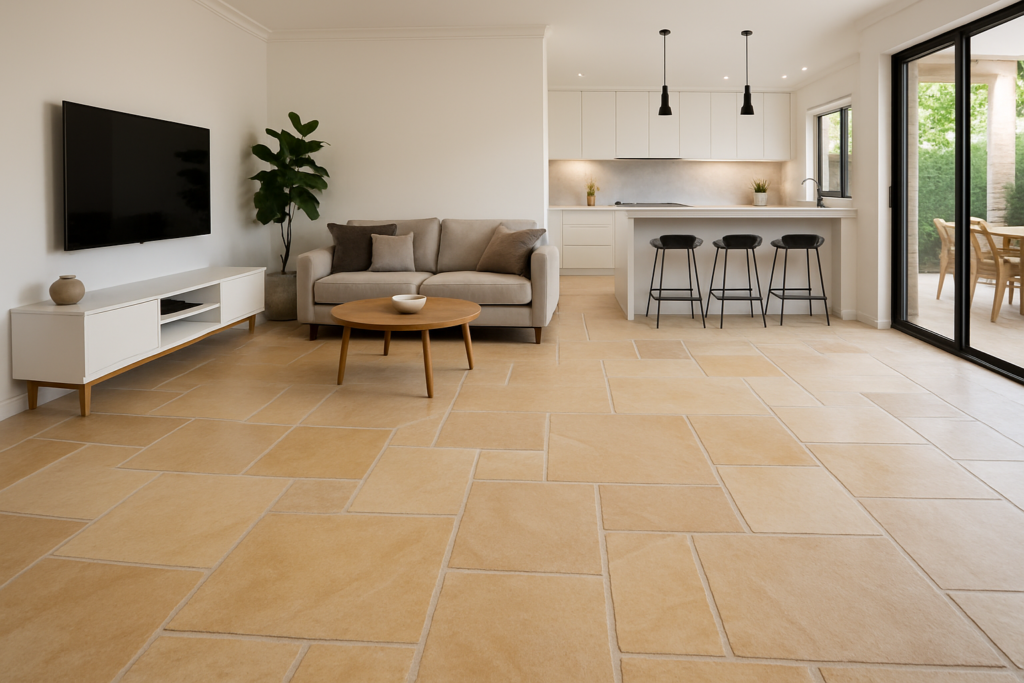
Sandstone works well as interior flooring in rustic, Mediterranean, Southwestern, and natural-style homes. It pairs beautifully with wood beams, plaster walls, and wrought iron. For indoor use, honed or brushed finishes provide a comfortable walking surface.
Popular indoor applications include:
- Entryways and foyers
- Kitchen floors (with proper sealing)
- Sunrooms and conservatories
- Fireplace hearths and surrounds
- Bathroom floors (with textured finish for grip)
Outdoor Applications
Sandstone truly shines as an outdoor flooring material. Its natural texture provides excellent grip even when wet, and its earthy colors blend seamlessly with landscaping:
- Patios and terraces
- Garden paths and walkways
- Pool surrounds (natural cleft finish)
- Outdoor dining areas
- Courtyard floors
For outdoor use in freeze-thaw climates, choose a dense sandstone variety and ensure proper drainage beneath the pavers to prevent ice damage.
Sandstone Flooring Cost
| Cost Component | Price Range | Notes |
|---|---|---|
| Sandstone tiles (material) | $5 – $15/sq ft | Varies by color, quality, origin |
| Installation | $6 – $12/sq ft | Includes mortar bed and grouting |
| Sealing | $1 – $3/sq ft | Initial application |
| Total installed | $12 – $30/sq ft |
Sandstone is mid-range in price among natural stone flooring options. It is typically more affordable than marble or travertine but similar in price to slate. Indian sandstone tends to be the most affordable, while domestic and European sandstone commands higher prices.
Sealing Sandstone Flooring
Sealing is essential for sandstone flooring, both indoors and outdoors. Sandstone’s porous nature means it will absorb liquids, stains, and even dirt without proper protection.
Sealer Types
- Impregnating sealer (recommended): Penetrates below the surface to repel water and oil while allowing the stone to breathe. Does not change the stone’s appearance
- Enhancing sealer: Penetrates and also deepens the stone’s natural color. Gives a “wet look” without surface shine
- Topical sealer: Creates a surface film that provides the highest protection but can make the surface slippery and may peel over time
Sealing Schedule
- Seal before first use after installation
- Reseal indoor sandstone every 1 to 2 years
- Reseal outdoor sandstone every 1 to 3 years depending on exposure
- Test by placing water drops on the surface; if the stone darkens within 5 minutes, it needs resealing
Pros and Cons of Sandstone Flooring
Pros
- Natural beauty: Warm, earthy colors and unique textures that manufactured tiles cannot replicate
- Slip resistance: Naturally textured surface provides excellent grip, especially outdoors
- Versatile: Works both indoors and outdoors across many design styles
- Moderate cost: More affordable than many premium natural stones
- Cool underfoot: Excellent for warm climates where a cool floor is desirable
- Eco-friendly: Natural material with minimal processing
- Pairs with radiant heat: Stone conducts and retains heat effectively
Cons
- Porous: Requires regular sealing to prevent staining
- Softer than granite: Can scratch and wear in very high-traffic areas
- Color variation: Natural stone means each tile is slightly different (a pro or con depending on preference)
- Maintenance: Requires more care than porcelain or ceramic tile
- Weight: Heavy; may require structural evaluation for upper-level installations
- Acid sensitivity: Some sandstones contain calcium carbonate and can be etched by acidic cleaners
Sandstone vs Slate Flooring
Sandstone and slate are often compared because both are natural stones with a rustic, textured appearance. Here is how they differ:
| Feature | Sandstone | Slate |
|---|---|---|
| Rock type | Sedimentary | Metamorphic |
| Mohs hardness | 6 – 7 | 5.5 – 6.5 |
| Porosity | Higher (more porous) | Lower (denser) |
| Water absorption | Higher | Lower |
| Color palette | Warm (buff, brown, red, tan) | Cool (gray, black, green, purple) |
| Texture | Gritty, sandy | Smooth, layered |
| Cost | $5 – $15/sq ft | $5 – $20/sq ft |
| Best climate | Warm, dry | Any (better freeze-thaw resistance) |
| Maintenance | Higher (more frequent sealing) | Moderate |
| Best use | Patios, rustic interiors | Entryways, bathrooms, outdoor paths |
In general, slate is the more practical choice for high-traffic and wet areas due to its lower porosity and better water resistance. Sandstone wins on warmth, color variety, and outdoor patio aesthetics.
Caring for Sandstone Floors
- Sweep or vacuum regularly to remove grit that can scratch the surface
- Mop with a pH-neutral stone cleaner (never acidic cleaners)
- Blot spills immediately, especially oil, wine, and citrus
- Use doormats at entrances to reduce dirt and moisture on indoor sandstone
- Avoid dragging heavy furniture across the surface
- Reseal according to the schedule recommended for your sealer type
Frequently Asked Questions About Sandstone Flooring
Is sandstone good for flooring?
Yes, sandstone is a good flooring choice for rustic interiors, patios, and outdoor living spaces. It offers natural beauty, excellent slip resistance, and a warm color palette. However, it requires regular sealing and more maintenance than porcelain or granite.
How much does sandstone flooring cost?
Sandstone flooring typically costs $5 to $15 per square foot for materials and $12 to $30 per square foot installed, including sealing. Indian sandstone is the most affordable option, while domestic and European varieties cost more.
Does sandstone need to be sealed?
Yes. Sandstone is porous and must be sealed before use and resealed every 1 to 3 years depending on location and traffic. Without sealing, sandstone will absorb liquids, stain easily, and deteriorate more quickly.
Is sandstone slippery when wet?
Natural cleft and textured sandstone finishes are among the most slip-resistant flooring surfaces available, even when wet. Honed sandstone has moderate slip resistance. Polished or topically sealed sandstone can become slippery when wet.
Can sandstone be used in bathrooms?
Yes, with proper sealing and a textured finish for slip resistance. Sandstone adds a spa-like, natural feel to bathrooms. However, it requires more maintenance than porcelain tile in wet environments. Reseal more frequently in bathrooms due to constant moisture exposure.
How do you clean sandstone floors?
Sweep regularly and mop with a pH-neutral stone cleaner. Never use acidic cleaners (vinegar, citrus-based), bleach, or abrasive scrubbers on sandstone. For stubborn stains, use a poultice designed for natural stone.
Is sandstone harder than marble?
Yes. Sandstone rates 6 to 7 on the Mohs scale compared to marble’s 3 to 5. However, sandstone is more porous than marble, so while it is harder, it requires more diligent sealing to prevent staining.
Prefer to explore on your own?
See how new flooring looks in your actual room in seconds — free, no signup.
Try the free Floor Studio →