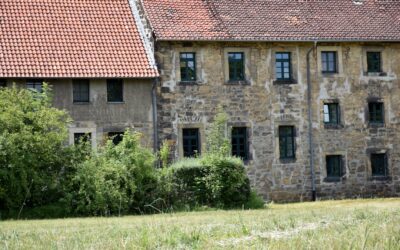
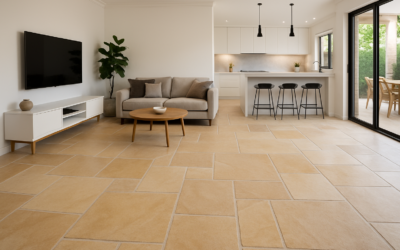
Real sandstone is gorgeous, but it’s also cold underfoot, heavy, porous, and a chore to seal and maintain. That’s exactly why sandstone vinyl flooring has become so popular: it captures the warm, earthy tones and subtle layered texture of natural sandstone while staying waterproof, warm to the touch, and almost maintenance-free. Modern luxury vinyl tile reproduces stone so convincingly, right down to the grout lines and beveled edges, that most people can’t tell it from the quarried material until they touch it.
For anyone drawn to the soft, sun-baked palette of sandstone but unwilling to live with cold, hard, high-maintenance flooring, this is one of the best compromises in the resilient flooring world.
What Gives Sandstone Vinyl Its Look
The appeal of sandstone is its warmth. Where slate and marble run cool gray and stark white, sandstone glows in honey, buff, tan, gold, and soft red tones, with gentle banding and fine grain that reads as natural and relaxed. Quality vinyl captures this through high-resolution photographic print layers, often using multiple plank patterns so the floor doesn’t show the same “stone” twice.
The best products add an embossed surface texture registered to the printed image, so the dimples and fine ridges you see line up with what you feel. Combined with painted-on grout joints and beveled tile edges, the effect across a whole floor is remarkably authentic.
Grout-Look Edges and Tile Realism
One detail separates convincing stone-look vinyl from the cheap stuff: how it handles the joints between tiles. Real sandstone is laid with grout lines, and the best sandstone vinyl flooring mimics this in a few ways.
- Painted grout lines: The simplest approach, with grout shading printed onto the tile so adjacent pieces form a continuous joint look.
- Beveled edges: A slight chamfer around each tile creates a real physical groove that catches shadow like a grout line.
- Groutable LVT: Premium tiles designed to be installed with real vinyl grout between them for a near-indistinguishable stone finish.
Groutable LVT takes the realism furthest but adds labor and cost. For most homeowners, beveled-edge planks or tiles strike the right balance of authenticity and easy installation.
Where Sandstone Vinyl Works Best
The waterproof, warm, and slip-resistant nature of vinyl makes sandstone-look LVT ideal for exactly the rooms where real stone is most appealing but least practical. Kitchens benefit from the spill resistance and the cushioned feel underfoot during long cooking sessions. Bathrooms and mudrooms get the spa-like stone aesthetic without grout that stains or stone that needs resealing.
It also pairs beautifully with rustic, Mediterranean, farmhouse, and southwestern interiors, where the warm sandstone palette ties together wood tones, terracotta, and natural fabrics. Because vinyl insulates rather than conducts cold, it suits these styles in any climate, even over a slab.
Formats: Sheet, Tile, and Rigid Core
Sandstone vinyl comes in the same construction types as any LVT, and the choice affects both feel and durability.
- Flexible LVT tiles: Glue-down squares that lie flat and stable, the most natural fit for a tile-look stone floor.
- Rigid-core (SPC) tiles: Click-together stone-look tiles with a dense composite core, more dent-resistant and easier to install over imperfect subfloors.
- Sheet vinyl: The budget option, printing a stone pattern across a continuous roll. Less realistic up close but fully waterproof and cheap.
For a stone look specifically, rigid-core tiles and glue-down LVT win because the harder surface and squared edges read more like real stone than flexible sheet goods.
Care and Cleaning
One of the quiet joys of sandstone vinyl over real stone is how little it asks of you. Real sandstone is porous and needs periodic resealing to resist stains, plus careful pH-neutral cleaning to avoid etching. Vinyl asks for none of that. Routine care is a quick sweep or vacuum to remove grit, followed by a damp mop with a pH-neutral floor cleaner when needed.
Avoid abrasive scouring pads and harsh chemicals, which can dull the wear layer over time, and skip the steam mop, which can force moisture into seams and degrade adhesive. If you choose groutable LVT with real vinyl grout, the grout itself is far more stain-resistant than cement grout but still benefits from an occasional wipe-down. For deeply embossed stone textures, an occasional pass with a soft-bristle brush lifts dust from the simulated cleft surface so the floor keeps its crisp, natural look.
Cost and Value
Sandstone vinyl typically runs $2.50 to $5.50 per sq ft for the material, a fraction of the $8 to $20 per sq ft you’d pay for real sandstone tile plus the cost of mortar, grout, sealing, and skilled tile setting. Installation is far simpler too, with no wet trades, no curing time, and far less weight on the structure.
Add in the savings on ongoing maintenance (no periodic resealing, no grout scrubbing) and the lifetime cost gap widens further. For the look of stone on a real-world budget, vinyl is hard to beat.
Choosing a Convincing Sandstone Floor
Always view a large sample, ideally several planks laid together, before committing. A single tile can’t show whether the product repeats its pattern too obviously across a floor; the better products use a dozen or more variations. Look for registered embossing, a wear layer of at least 12 mil for living areas, and beveled or groutable edges if realism is your priority.
Run the floor in good light and from a standing height, since that’s how you’ll actually see it day to day. A well-chosen sandstone vinyl flooring delivers the warm, earthy character of natural stone with the comfort, waterproofing, and low upkeep that make a floor genuinely livable, which is more than real sandstone can usually promise.
One last design tip: think about how the stone tone interacts with the rest of your palette. Warm sandstone hues bring out terracotta, cream, sage green, and natural wood beautifully, creating a cohesive, sun-warmed scheme. Against cool grays and stark whites, the same floor can feel slightly out of place, so coordinate your wall colors and cabinetry with the stone’s undertone. Lighter buff and gold sandstone shades open up small rooms and bounce light around, while deeper red and brown tones lend coziness and drama to larger spaces. Matching the shade to both the room size and the surrounding colors is what turns a good stone-look floor into one that looks genuinely designed rather than simply installed.
Prefer to explore on your own?
See how new flooring looks in your actual room in seconds — free, no signup.
Try the free Floor Studio →