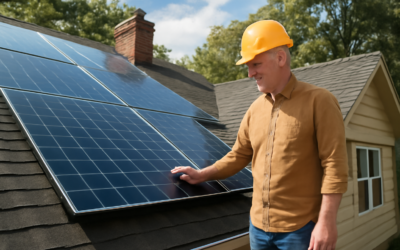
Most people picture bulky racks bolted to their roof when they think about going solar. Solar roof shingles flip that image on its head by building the photovoltaic cells directly into roofing material that looks, from the street, like ordinary asphalt or slate. That curb-appeal advantage is real, but so is the price tag, and the gap between the two is where solar roof shingles either make sense or don’t for your particular house.
Part of our Roofing guide — explore the full guide →
I’ve walked homeowners through both traditional panels and integrated shingle systems, and the decision almost always comes down to one question: are you replacing the roof anyway? Timing changes the entire math. Here is what to weigh before you sign anything.
How Solar Roof Shingles Actually Work
Each solar shingle is a small photovoltaic module, typically 12 to 15 inches wide and roughly 40 to 45 inches long, that overlaps its neighbor the same way a standard shingle does. Instead of sitting on top of your roof, the active shingles become the roof. They wire together beneath the surface and feed an inverter that converts the direct current into the alternating current your home uses.
Output per shingle is modest, usually 13 to 70 watts depending on the brand, so a working system uses dozens or hundreds of them. A typical residential install runs between 4 kW and 12 kW. The non-solar “dummy” shingles fill in shaded or north-facing sections where cells would underperform, giving you a uniform look across the whole plane.
Real Costs and What Drives Them
Budget honestly here. Installed solar shingle systems generally run $21 to $35 per square foot of roof, and total project costs frequently land between $30,000 and $75,000 before incentives. A Tesla Solar Roof on an average 2,000-square-foot home often quotes in the $45,000 to $60,000 range once the mandatory roof replacement is bundled in.
Compare that to conventional panels, which install at roughly $2.50 to $3.50 per watt, or about $18,000 to $26,000 for a 7 kW system before incentives. The federal Residential Clean Energy Credit currently returns 30 percent of the total cost, and many states layer on rebates or property-tax exemptions. Run your quote through that 30 percent before you compare anything.
- Roof complexity: Steep pitches, multiple dormers, and lots of penetrations raise labor and waste.
- System size: Larger arrays cost more up front but improve your cost-per-watt.
- Electrical upgrades: An older 100-amp panel may need a service upgrade running $1,500 to $4,000.
Leading Brands Worth Comparing
Tesla dominates the conversation, but it isn’t alone. GAF Energy’s Timberline Solar integrates nailable solar shingles that roofers can install with standard tools, which tends to lower labor costs and speed up the job. CertainTeed’s Solstice and Apollo lines offer lower-profile options, and SunTegra makes both shingle and tile-style products for homes with clay or concrete roofs.
When you gather quotes, ask each installer for the specific wattage per shingle, the total DC system size, and the estimated annual production in kilowatt-hours. Two systems that look identical on the roof can differ 20 percent in output. Also confirm whether the product carries a genuine roofing warranty, not just an electrical one, because these shingles are your weather barrier now.
Durability, Weather, and Warranties
Quality solar shingles are rated to withstand winds up to 130 to 166 mph and hail impacts around 1.75 inches, and most carry a Class A fire rating. Tesla advertises a 25-year weatherization, module, and power warranty on its glass tiles. GAF Energy backs its system with a comparable 25-year output guarantee plus roofing coverage.
Heat is the quiet enemy of any photovoltaic cell. Because integrated shingles sit flush against the deck with less airflow than rack-mounted panels, they can run 5 to 10°F hotter, which shaves a few percentage points off efficiency on peak summer days. Good installers mitigate this with proper attic ventilation, so ask how they handle it.
Solar Shingles Versus Traditional Panels
If aesthetics are your top priority and you are already tearing off an aging roof, integrated shingles can be worth the premium. You get one crew, one warranty, and a roof that neighbors won’t flag as an eyesore. HOAs that resist bolt-on panels often approve shingles without a fight.
But dollar for watt, standard panels still win decisively. They produce more power per square foot, cost 30 to 50 percent less, and are far easier to repair or replace individually. If a single integrated shingle fails in year eight, servicing it means pulling apart a section of your roof, which is neither quick nor cheap.
- Choose shingles if: you’re re-roofing now, appearance matters, and budget is flexible.
- Choose panels if: you want the fastest payback and maximum production per dollar.
Payback Period and Home Value
Payback stretches longer with shingles than panels because of the higher entry cost. Expect 10 to 16 years to break even on a shingle system versus 7 to 12 for panels, depending on your local electricity rate and sun exposure. In high-rate states like California, Massachusetts, and Hawaii, the timeline compresses meaningfully.
On resale, appraisers increasingly assign value to owned solar. Multiple market studies put the bump at roughly $15,000 to $25,000 for a mid-size owned system, and an integrated roof that reads as a premium upgrade rather than an add-on can help a listing stand out. Leased systems, by contrast, complicate a sale, so buy rather than lease if resale matters to you.
Installation, Timeline, and Long-Term Ownership
Buying the shingles is one decision; living with the project and the system afterward is another. A solar roof is a multi-week undertaking followed by decades of ownership, so it helps to know both what the install itself involves and what the years after look like. Neither part is difficult to plan for, but surprises here, a permitting delay or an overlooked inverter replacement, are exactly the kind that sour an otherwise sound investment.
The Installation Timeline
A solar shingle install is more involved than bolting panels to an existing roof because the crew is building your roof and your power system at once. Plan for the tear-off of the old roofing, deck inspection and repair, underlayment, then the methodical laying of active and inactive shingles from the eaves up. Most residential projects run five to ten working days, longer for steep or cut-up rooflines, and weather can stretch that.
Expect a few distinct phases and inspections along the way. Skipping or rushing any of these is where problems start, so a good contractor keeps you informed at each step.
- Permitting and utility approval: Two to eight weeks before work even begins, depending on your jurisdiction and utility interconnection queue.
- Roof tear-off and prep: One to three days, including replacing any rotted decking.
- Shingle installation and wiring: Three to six days for the roofing and electrical rough-in.
- Inverter, meter, and inspection: Final electrical tie-in, city inspection, and utility permission to operate.
That last step, permission to operate, trips people up. Even after the roof looks finished, you often can’t legally turn the system on until the utility signs off, which can add a couple of weeks. Ask your installer to spell out the full timeline in writing so you’re not surprised by the gap between a finished roof and a producing one.
Maintenance and Monitoring Over Time
The good news is that solar shingles need very little hands-on upkeep. There are no moving parts, and rain handles most of the cleaning. In dusty or pollen-heavy regions, a gentle rinse once or twice a year keeps production up, but never pressure-wash them or walk on them without your installer’s guidance. Snow generally slides off the smooth glass surface on its own.
Monitoring is where you stay engaged. Every quality system includes an app that tracks daily and lifetime production in kilowatt-hours, so you can spot a dip that signals a shaded, dirty, or failing section. Check it monthly. The inverter is the component most likely to need replacement within the system’s life, typically around year 10 to 15, at a cost of $1,500 to $3,000, so factor that into your long-term budget rather than treating the roof as truly zero-maintenance.
Is It the Right Move for Your Home?
Start with three checks: the age and orientation of your roof, your annual electricity spend, and your local incentives. A south-facing roof with less than 20 percent shade and a utility bill north of $150 a month is a strong candidate. If your roof has more than a decade of life left, the economics rarely justify tearing it off for shingles today.
Get at least three itemized bids, insist on production estimates in writing, and verify the installer is NABCEP-certified. Solar roof shingles are a long-term commitment measured in decades, so the quality of the crew and the honesty of the numbers matter as much as the technology itself. Done right, they turn a necessary roof replacement into a 25-year power plant that happens to look good doing it.