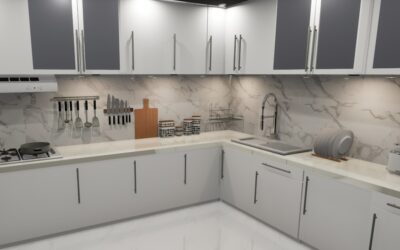
Walk through any new build or remodel from the past decade and odds are you are looking at it. Transitional cabinetry has quietly become the dominant kitchen and bath style in the United States because it sits in the sweet spot between traditional warmth and contemporary cleanliness. Done well, it ages slower than trend-driven designs and resells better than aggressively modern interiors. Done poorly, it reads as generic and forgettable. The difference comes down to door profile, hardware, and the small details most catalogs gloss over.
Part of our Kitchen Remodeling guide — explore the full guide →
What Defines the Style
Transitional design is not a single look. It is a balance. Traditional cabinetry leans on raised panels, ornate moldings, glazed finishes, and detailed corbels. Modern cabinetry strips everything down to flat slab fronts, push-to-open hardware, and high-gloss or matte lacquer. Transitional pulls one element from each side and lets the other do the heavy lifting.
The most common transitional combination is a Shaker-style door with simple recessed panel framing, paired with clean lines, minimal molding, and contemporary hardware. The painted finish is almost always white, off-white, soft gray, or a muted blue. Wood-stained transitional kitchens lean on rift-sawn white oak, walnut, or maple in matte sealed finishes rather than glossy high-build lacquer.
Door Profiles That Read Transitional
The door profile sets the tone. Three styles dominate the category:
- Shaker: Five-piece frame and recessed panel, 2 to 2.5 inch stile widths. The Shaker is the workhorse of transitional design.
- Slim Shaker: Same construction but with 1.5 inch stiles. Reads more modern while keeping warmth.
- Beaded Shaker: Standard Shaker with a single small bead inside the frame. Adds traditional softness without committing to raised panels.
Avoid arched cathedral doors, applied moldings, and heavy raised-panel profiles if you want a true transitional look. Avoid pure slab doors if you want any visible warmth — slabs read fully modern. The bullnose Shaker, with a soft eased edge instead of a square edge, is another option that softens the look without veering traditional.
Wood and Finish Choices That Last
Maple is the most common species for painted transitional cabinetry because it takes paint smoothly without grain telegraphing through. Soft maple costs about 15% less than hard maple and is functionally identical for cabinet faces. Most major brands use hard maple for doors and soft maple for face frames.
For stained transitional kitchens, rift-cut white oak is the design world’s darling and has been since 2019. The straight grain reads contemporary. Pricing is steep — expect 25 to 40% upcharge over standard maple. Walnut is the second favorite, with deeper brown tones and natural figure that softens harder design elements. Cherry has fallen out of favor because it darkens dramatically over the first three years and traps the kitchen in a 2005 aesthetic.
For finishes, conversion varnish (CV) is the durability standard. It outlasts standard catalyzed lacquer by a factor of two on real-world use, resists kitchen oils, and resists yellowing over time. The big box brands (Diamond, Schuler, Decora) use catalyzed lacquer; semi-custom brands (Wood-Mode, Plain & Fancy, Crystal Cabinet Works) typically use CV.
Hardware Pulls the Whole Look Together
Cabinet hardware is the single most impactful detail in transitional kitchens. The wrong handle turns a $35,000 kitchen into a tract-home renovation overnight.
The current sweet spot is matte black or unlacquered brass appliance pulls between 5 and 12 inches long for drawers, paired with 4 to 5 inch pulls on doors. Top Knobs, Emtek, and Rejuvenation make pulls in the $14 to $40 range that read custom. Brushed nickel and polished chrome still work but tilt the look toward generic builder grade. Avoid mixing finishes between cabinet hardware and plumbing fixtures unless you have a clear design intent.
For pulls under 4 inches, switch to knobs or skip the hardware entirely on smaller doors. Crown knob and pull combinations from Restoration Hardware run $30 to $90 per piece but elevate stock cabinetry significantly.
Pricing Tiers and Brand Spotlight
Transitional cabinetry spans every price point. Knowing where each brand sits helps you budget realistically.
- Stock ($90 to $250 per linear foot): IKEA SEKTION, Home Depot Hampton Bay, Lowe’s Kraftmaid Vantage. Quick lead times, limited size options.
- Semi-stock ($200 to $450/lf): Kraftmaid, Diamond, Schuler, Mid-Continent. Wide door style menus, 4 to 6 week lead times.
- Semi-custom ($400 to $800/lf): Wood-Mode Brookhaven, Decora, Yorktowne. Modify dimensions in 1/16 inch increments.
- Custom ($700 to $1,400/lf): Wood-Mode Custom, Plain & Fancy, Christopher Peacock, Bilotta. Full design flexibility, 12 to 20 week lead times.
A typical 10 by 12 foot kitchen with 25 linear feet of cabinets runs about $6,200 in stock, $12,500 in semi-stock, $18,000 in semi-custom, and $30,000-plus in custom. Add 15 to 25% for installation if you are not handling the install yourself.
Construction Quality Markers
Lift a cabinet door at the showroom and check the build before you commit. Cheap construction telegraphs through in months.
- Door joinery: mortise-and-tenon or cope-and-stick beats butt joints with biscuits. Stick your finger inside the joint and feel for tightness.
- Box construction: 3/4 inch plywood is the durability standard. Particleboard works but warps with any humidity. Avoid units sold with 1/2 inch plywood sides.
- Drawer construction: solid wood or plywood with dovetail joints. Avoid stapled MDF drawers under any price point.
- Hinges: Blum or Grass full-overlay soft-close hinges are the industry standard. Other hinges are penny-pinching.
- Drawer slides: Blum Tandem or Blum Movento full-extension undermount slides with a 75 to 100 lb capacity rating.
If a brand will not tell you who makes their hinges and slides, it is not transitional cabinetry — it is dressed-up RTA in a thicker box.
Pairing Countertops, Backsplashes, and Flooring
Transitional cabinets give you room to play with the surrounding materials. Quartz countertops in soft white, marble look (Caesarstone Statuario Nuvo, Cambria Brittanicca), or warm neutral patterns work in almost every transitional kitchen. Avoid heavy-veined exotic granites and high-contrast quartzite slabs unless they are a deliberate focal point.
For backsplash, 3 by 6 inch or 4 by 12 inch ceramic subway tile in matte white is the safe transitional choice. Handmade-look zellige in soft neutrals reads slightly more designer. Whichever you pick, keep the grout color within two shades of the tile. Heavy contrast grout fights with Shaker doors and dates the kitchen quickly.
On the floor, rift-cut white oak engineered hardwood at 7 inch widths is the current standard. Luxury vinyl plank from Karndean LooseLay or COREtec Pro Plus in oak visuals is the budget-friendly alternative that still reads custom.
What Will Date Quickly vs Hold Up
Two-tone kitchens (white uppers, navy or green lowers) have been popular since 2018. They still look fresh now but are starting to feel signature to the late-2010s. If you want the longest-lived design, stick with single-finish cabinetry and let your countertop and lighting provide visual interest. Bold accent islands in a contrasting color or wood are safer than full two-tone because you can swap the island finish in the future without redoing the perimeter.
Glass-front cabinets, open shelving over corner runs, and decorative range hood surrounds also fall in and out of style. Used sparingly they elevate the kitchen. Overused they make the kitchen feel like a magazine photo set rather than a place to cook dinner. Pick one accent and let the rest of the cabinetry do its quiet work.