Every December, paint brands roll out their “color of the year,” and every January, half of those picks vanish from real homes. The trending paint colors that actually move off the shelf in 2026 are quieter than the marketing campaigns suggest. Earthy mid-tones, warmer whites, and muddy greens are dominating actual paint sales data, while the high-saturation hero colors mostly stay in magazine spreads. Here is what is selling and what works in real rooms.
Part of our Paint & Walls guide — explore the full guide →
- The Big Shift: Warm Tones Are Back
- Earthy Greens Lead the Saturated Colors
- Cabinet Colors: Deeper and Moodier
- Warm White Is Replacing Bright White
- Exterior Trends: Muted, Not Loud
- Bedrooms: Soft and Plaster-Like
- What's Falling Out of Favor
- Sample Before You Commit
- Sheen Selection Often Matters More Than Color
- How to Pick Trending Without Looking Dated in 5 Years
The Big Shift: Warm Tones Are Back
Cool grays defined 2015 to 2022. The pendulum has swung hard the other way. Beige, taupe, and warm cream are outselling cool grays roughly 3 to 1 at major retailers in 2026. Sherwin-Williams Accessible Beige (SW 7036) and Benjamin Moore Edgecomb Gray (HC-173) are the workhorse warm neutrals showing up in real estate listings constantly.
The reason is partly LED lighting. Warmer tones look better under the 2700K to 3000K bulbs that have replaced the cold daylight LEDs popular five years ago. Cool grays under warm light read green and dingy.
Earthy Greens Lead the Saturated Colors
If you want a real color, not a neutral, the dominant 2026 trend is muddy, sage-leaning greens. Farrow and Ball Card Room Green, Benjamin Moore Saybrook Sage (HC-114), and Sherwin-Williams Evergreen Fog (SW 9130) are top sellers.
These work especially well on kitchen islands, built-in cabinetry, and accent walls in primary bedrooms. They pair with both warm white trim and unlacquered brass hardware, which is the cabinet pull of the moment.
Cabinet Colors: Deeper and Moodier
White Shaker cabinets are still installed in 60 percent of new kitchens, but the trend in remodels is darker. Inky navy, charcoal, and warm black cabinets paired with white perimeter cabinets is the most-requested kitchen palette of 2026.
- Sherwin-Williams Naval (SW 6244) for a true navy
- Benjamin Moore Hale Navy (HC-154) for a warmer, slightly green-leaning navy
- Benjamin Moore Black Beauty (2128-10) for a richer-than-black option
- Sherwin-Williams Iron Ore (SW 7069) for charcoal with brown undertones
The trick with dark cabinets is finish. Use a satin or semi-gloss enamel like Benjamin Moore Advance or Sherwin-Williams Emerald Urethane, not a flat wall paint. Cabinet doors get touched constantly and flat finishes will burnish in a year.
Warm White Is Replacing Bright White
Pure cool whites like Sherwin-Williams Extra White and Benjamin Moore Decorator’s White look stark under modern lighting. The replacement: warmer whites with creamy or yellow undertones.
Benjamin Moore White Dove (OC-17) remains the universal trim and ceiling color. Sherwin-Williams Alabaster (SW 7008) and Benjamin Moore Simply White (OC-117) are the go-to warm wall whites that work in rooms with both north and south exposure.
Exterior Trends: Muted, Not Loud
Black and dark gray exteriors had their peak around 2022. The trend now is desaturated earth tones: warm white, off-white, sage, and “greige” with creamy trim. Sherwin-Williams Peppercorn (SW 7674) and Benjamin Moore Revere Pewter (HC-172) are the two most-requested mid-tone exterior colors.
For coastal and Southern California homes, warm whites with terracotta or muted clay accents are dominant. For Pacific Northwest and Northeast climates, sage greens, mossy greens, and deeper “forest” tones suit the surrounding landscape.
Bedrooms: Soft and Plaster-Like
The viral trend of 2026 is the “limewashed plaster” look on bedroom walls. Brands like Portola Paints and JH Wall Paints sell true limewash in subtle pinks, blushes, and ochres. For a paint-grade alternative without the texture commitment, look at:
Farrow and Ball Setting Plaster, Benjamin Moore First Light (2102-70), and Sherwin-Williams Malted Milk (SW 6057). These muted, slightly pink-tinted off-whites read calm without being baby-pink.
What’s Falling Out of Favor
Cool gray is the obvious answer, but specific shades are aging worst. Repose Gray, Agreeable Gray, and Revere Pewter were dominant for a decade and now read dated to design-conscious buyers. They still work fine for resale because they are universally inoffensive, but they are no longer “current.”
Pure all-white kitchens with gray cabinets are being phased out in favor of layered, tonal kitchens with multiple finishes. Pure black accent walls in primary bedrooms are also fading, replaced by deep greens, dusty plums, and soft chocolate browns.
Sample Before You Commit
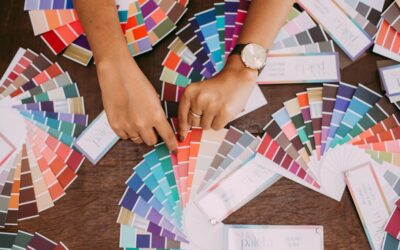
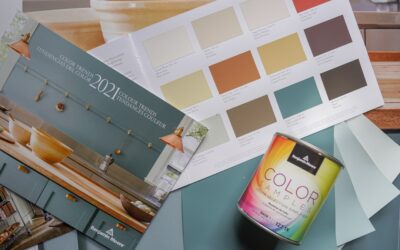
Buy quart samples and paint 2-foot squares on at least two walls in any room you are repainting. Live with the swatches for 48 to 72 hours, looking at them in morning light, midday light, and evening light. Trending paint colors that look great on Instagram can read entirely differently in your specific room because of window orientation, ceiling height, and flooring color.
Samplize and other peel-and-stick sample services charge $10 to $15 per sample but eliminate the painting step. The samples are large enough (12 by 12 inches) to read accurately and the adhesive does not damage walls.
Sheen Selection Often Matters More Than Color
The same color in flat, eggshell, satin, and semi-gloss reads as four different colors. Flat absorbs light and looks darker. Semi-gloss reflects and looks lighter. Most modern interiors use eggshell on walls, satin on trim and doors, and semi-gloss on cabinets and woodwork.
For trending paint colors with rich undertones (deep greens, warm browns, navies), choose a higher sheen than instinct suggests. Flat finishes mute the depth that made the color appealing in the first place. Sherwin-Williams Emerald and Benjamin Moore Aura both have eggshell finishes durable enough to use throughout a home.
How to Pick Trending Without Looking Dated in 5 Years
Trends become tired when they get over-applied. The safest play is to use a trending paint color on something semi-permanent (like a single room or the front door) rather than committing every wall in the house. A black front door with brass hardware will look current for 15 years; an entire interior in 2026’s hero color may not.
For maximum staying power, use neutrals in 80 percent of the home and reserve trending colors for accent moments: a kitchen island, a built-in bookcase, a powder room, or interior trim. Repainting one room costs $400 to $700; repainting a whole house in a trend you regret costs $4,000 plus.