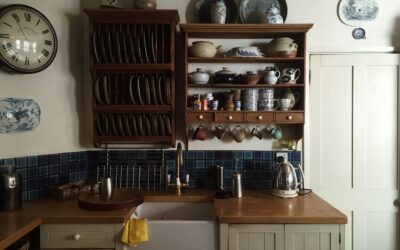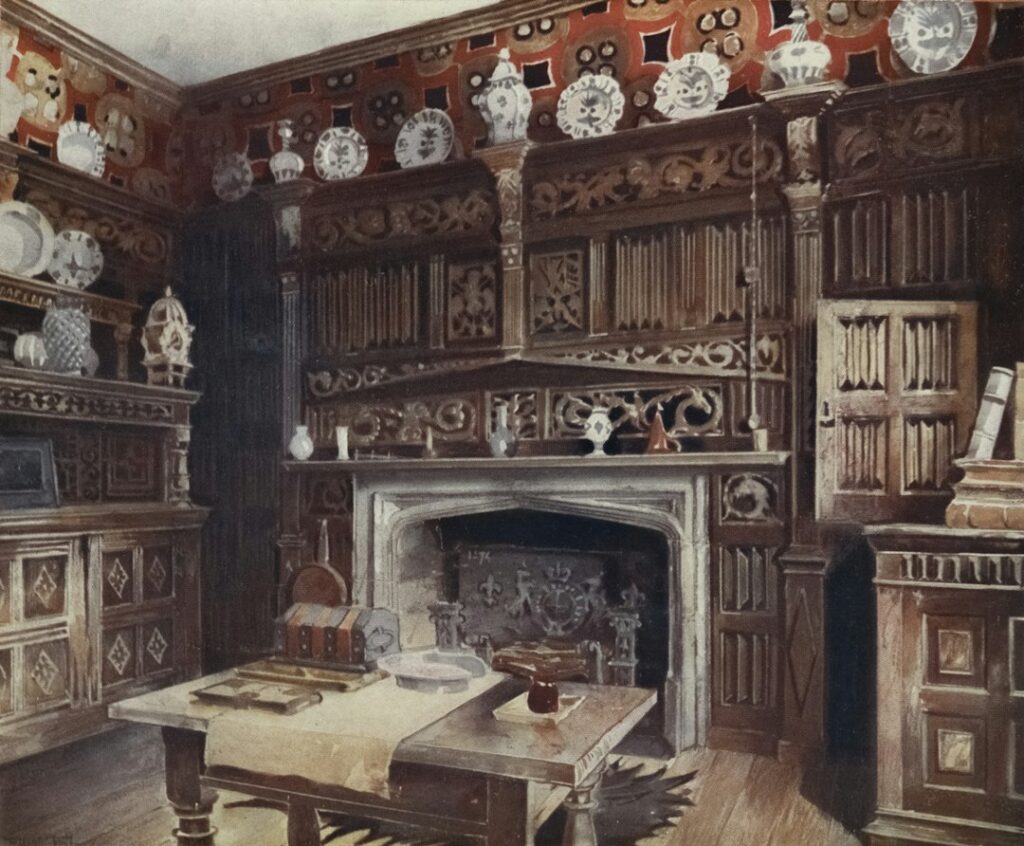
A real Victorian kitchen never had cabinets. It had freestanding pieces: a Hoosier cabinet for flour, a pie safe for cooled baking, a butler’s pantry off the dining room, and open shelving above a deep work counter. Modern Victorian kitchen cabinets are an interpretation, blending the dark stained woods, ornate hardware, and decorative trim of the era with the cabinetry layout we expect today. Done well, the look feels like an old townhouse in Boston or San Francisco. Done badly, it tips into haunted-house territory. The line between those outcomes is mostly about restraint, the right hardware, and accurate paint colors instead of generic flat black.
Part of our Kitchen Remodeling guide — explore the full guide →
Defining the Period Look
Victorian style ran from roughly 1837 to 1901 and went through several sub-periods. Early Victorian leaned toward Gothic revival with pointed arches and dark walnut. Mid-Victorian, the period most people picture, featured deeply carved wood, marble counters, and rich colors. Late Victorian moved toward the lighter Eastlake and Aesthetic Movement styles with cleaner lines.
For kitchens, late Victorian is the most livable interpretation. Doors stay rectangular, panels stay simple, and the period detail comes through in the hardware, the trim, and the finish rather than ornate millwork on every surface.
Cabinet Door Styles That Work
Five door styles read authentically Victorian. Flat slab with applied molding around the perimeter. Recessed panel with a beaded inside edge. Beadboard insert in a frame. Tall, narrow upper cabinets with multi-pane glass. And a small percentage of paneled glass-front display cabinets reserved for the most decorative pieces of china.
- Flat slab with molding: The simplest authentic option, easy to commission custom.
- Beadboard panel: Reads butler’s pantry, works well on lower cabinets.
- Glass-front upper: Mullion grid in 2-by-3 or 3-by-4 layout, never colonial 6-over-6.
- Beaded inset: Doors sit flush with the frame, not overlay. Most expensive option.
The Color Palette
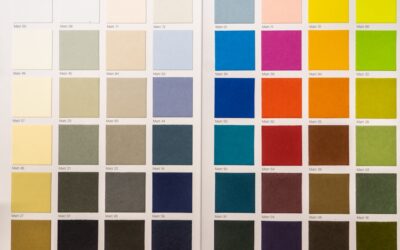
Authentic Victorian kitchens used deep, saturated colors. Hunter green, oxblood red, navy, mustard yellow, and chocolate brown all show up in period sources. White was reserved for trim and ceilings, not entire kitchens. Pure black is rare in the historical record but works in modern interpretations.
Sherwin-Williams Greenblack SW 6994, Benjamin Moore Hunter Green 2041-10, and Farrow and Ball Brinjal 222 are three colors designers reach for repeatedly when working a Victorian kitchen. Pair the dark cabinet color with a contrasting trim like Benjamin Moore Linen White or Sherwin-Williams Alabaster.
Hardware: The Detail That Carries the Room
Cabinet hardware sells or kills the period look faster than any other choice. Brass is the default Victorian metal, specifically unlacquered brass that develops a natural patina rather than the bright polished brass popular in the 1980s.
Knobs should be round, hexagonal, or octagonal at 1 to 1.25 inches diameter. Bin pulls or cup pulls work for drawers. Sources like House of Antique Hardware, Rejuvenation, and Schoolhouse carry accurate reproductions in the $15 to $40 per piece range.
Hinges matter too. Concealed hinges read modern. Exposed butt hinges in matching brass, or hand-forged iron H-hinges, reinforce the period feel. Plan on $8 to $15 per hinge for quality reproductions.
Counters and Backsplash
Marble is the period-correct counter material. Carrara honed at $45 to $75 per square foot installed gives the right look but stains noticeably. For practical kitchens, soapstone is the better Victorian-era choice. It darkens with mineral oil applications, resists acid, and was common in late-Victorian wealthy homes.
Quartz can fake it convincingly. Cambria Brittanicca Warm and Caesarstone Statuario Maximus both read as marble at a fraction of the maintenance.
Backsplash should be subway tile, 3-by-6 inch white ceramic with a slight cushioned edge. Skip beveled subway, which reads 2010s. Use a contrasting grout in light gray to define the joints. Above the range, consider a small ceramic mosaic panel or hand-painted Delft tile insert for a true period detail.
Floors That Match the Style
Three flooring options keep the look consistent. Original hardwood, ideally narrow-plank quarter-sawn oak, refinished to a medium walnut stain. Black-and-white checkerboard ceramic or vinyl. Or encaustic cement tile in a complex geometric pattern.
For checkerboard, lay 8-by-8 or 12-by-12 tile on the diagonal rather than square. Encaustic tile from Cement Tile Shop or Granada Tile runs $14 to $24 per square foot. The pattern itself becomes the design statement and lets cabinets stay quieter.
Hood, Sink, and Faucet
The range hood should disappear into the cabinetry or be wrapped in custom millwork that reads like a chimney breast. A modern stainless hood kills the look instantly.
For sinks, an apron-front fireclay sink in white is a sensible compromise. True Victorian kitchens often used a soapstone or copper sink, but fireclay reads authentic enough and handles daily abuse. Pair with a bridge faucet in unlacquered brass or polished nickel. Rohl, Waterstone, and Newport Brass all make accurate options in the $700 to $2,500 range.
Lighting Details
Skip recessed cans. Victorian kitchens used pendants, sconces, and a single ceiling-mounted fixture. Schoolhouse pendants over an island, opal glass sconces flanking the window over the sink, and a milk-glass schoolhouse ceiling light in the center of the room hit all the right notes.
Under-cabinet lighting is fine as long as it stays hidden. Use thin LED strips tucked behind a 1-inch valance built into the cabinet bottom. The light should be visible but the source should not be.
Trim and the Final Layer
What completes a Victorian kitchen is the architectural trim work around it. Tall baseboards at 7 to 9 inches, deep crown molding at the ceiling, and picture rail running about 12 inches below the crown. These details cost a few hundred dollars in materials and transform the entire room.
Add wallpaper in a small print between the picture rail and crown for a true late-Victorian feel. William Morris reproductions from Morris and Co. start around $200 per roll. The detail reads sophisticated rather than busy when applied just to that narrow band.
Done properly, a Victorian kitchen ranges from $25,000 for a simple refresh with new hardware and paint up to $80,000 or more for a full custom build with marble, true inset doors, and antique hardware. The investment holds value because the style has stayed quietly popular for 150 years and shows no sign of fading.