The difference between a shower that feels like a spa and one that feels like a gym locker room usually comes down to a single decision: the tile. Well-chosen walk in shower tile designs can make a small bathroom feel larger, turn a builder-grade box into a focal point, and hold up to daily moisture for decades. With frameless glass and curbless entries more popular than ever, the tile is more exposed and more important than it has ever been. This guide walks through the layouts, materials, and design combinations that actually work.
Part of our Bathroom Remodeling & Flooring guide — explore the full guide →
- Start With the Right Tile Material
- Large-Format Tile for a Seamless Look
- Popular Tile Layouts and Patterns
- Color and Contrast Strategies
- Designing the Shower Floor and Niche
- Curbless and Wet-Room Designs
- Budgeting Your Tile Project
- Bringing It All Together
- Grout: The Detail That Makes or Breaks the Look
- Matching Tile to Your Bathroom Style
Start With the Right Tile Material
Before you fall in love with a pattern, choose a material that can live in a wet environment. Not every beautiful tile belongs on a shower wall or floor.
- Porcelain: The workhorse of shower tile. It absorbs less than 0.5 percent water, resists staining, and comes in large formats and realistic stone or wood looks. Ideal for both walls and floors.
- Ceramic: More affordable than porcelain and fine for walls, though slightly more porous. Best kept off floors where water pools.
- Natural stone: Marble, travertine, and slate deliver unmatched character but need periodic sealing to fend off etching and staining.
- Glass mosaic: Beautiful as an accent band or niche liner, reflecting light and adding depth to smaller spaces.
For the shower floor specifically, prioritize slip resistance. Look for a coefficient of friction (DCOF) of 0.42 or higher, and lean toward smaller tiles or mosaics because the extra grout lines add grip underfoot.
Large-Format Tile for a Seamless Look
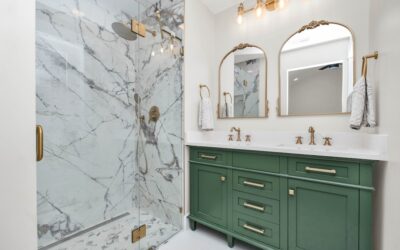
One of the strongest trends in modern showers is oversized tile, often 12 by 24 inches or larger, sometimes reaching full slab panels of 24 by 48 inches. Big tiles mean fewer grout lines, and fewer grout lines mean less cleaning and a calmer, more expansive feel. In a compact walk-in shower, running a 12-by-24 porcelain vertically can visually stretch the ceiling height. Marble-look porcelain in this format gives you the drama of natural stone with none of the sealing headaches.
Set large tiles with a minimal 1/16- to 1/8-inch grout joint and a color-matched grout so the surface reads as one continuous plane. Pair it with a linear drain so the floor can slope in a single direction, which large tiles handle far better than a traditional center drain.
Popular Tile Layouts and Patterns
The same tile can look completely different depending on how it is set. Layout is where you inject personality without spending more on materials.
Vertical Stack and Offset
A vertical stacked layout, where tiles align in clean columns, feels crisp and contemporary and draws the eye upward. A brick or 50-percent offset softens the look and hides minor wall imperfections, which is why it remains a reliable classic for subway tile.
Herringbone and Chevron
Nothing adds movement like a herringbone. A herringbone accent wall behind the shower head or a chevron mosaic on the floor turns plain rectangles into a designer statement. Reserve these for one feature area so the space does not feel busy.
Vertical Offset and Grid
A straight grid of square tiles reads clean and modern, especially in large format, while a vertical offset gives subtle rhythm. Both pair beautifully with frameless glass because the geometry stays visible.
Color and Contrast Strategies
Color sets the mood of the entire bathroom. White and light gray tile remain the most requested because they keep small showers feeling bright and open, and they never date. If you want warmth, greige and soft taupe stone-looks are having a moment. For drama, a charcoal or deep-green wall tile paired with brass fixtures reads luxurious.
Contrast is a designer’s best tool. Try light walls with a darker floor to ground the space, or a single accent wall in a bolder tile while the rest stays neutral. A vertical niche lined in glass mosaic or a contrasting marble adds a jewelry-box detail that costs very little relative to its visual payoff.
Designing the Shower Floor and Niche
The floor and the niche are the two spots where a thoughtful choice pays off daily. On the floor, penny rounds, hexagons, and 2-inch mosaics provide grip and let the surface follow the slope to the drain. Match or complement the wall tile rather than fighting it.
A recessed niche keeps bottles off the floor and becomes a natural design accent. Line it with a contrasting mosaic, add a slim shelf, and align the top or bottom of the niche with a grout line on the surrounding wall so it looks intentional rather than punched in. Aim for a finished opening around 12 to 14 inches wide and set it about chest height for comfortable reach.
Curbless and Wet-Room Designs
Curbless, or zero-threshold, showers are increasingly popular for their clean look and aging-in-place accessibility. Because the floor tile flows uninterrupted from the bathroom into the shower, tile continuity becomes the star of the design. Using the same large-format porcelain throughout, with a subtly sloped shower zone and a linear drain, makes a small bathroom feel like a single generous space. It requires careful waterproofing and slope work, so this is one area where hiring an experienced tile setter pays for itself.
Budgeting Your Tile Project
Tile prices span a wide range. Ceramic and basic porcelain run roughly $2 to $7 per square foot, quality porcelain and porcelain slabs $8 to $20, and natural stone or handmade tile $15 to $50 and up. For a standard walk-in shower you are usually tiling 80 to 120 square feet of wall and floor combined. Labor for a skilled installer typically adds $10 to $25 per square foot depending on tile size, pattern complexity, and your region. A herringbone or intricate mosaic costs more to install than a straightforward grid because it takes longer and wastes more material.
A smart way to control cost is to use an affordable field tile across most of the shower and splurge on a small run of premium accent tile in the niche or a single feature wall. You get the designer impact where the eye lands without tiling the whole space in $30-per-foot marble.
Bringing It All Together
Grout: The Detail That Makes or Breaks the Look
Tile gets all the attention, but grout quietly determines how your shower ages. In a wet environment, choose the right product and color. Epoxy grout costs more and is harder to install, but it is nearly stain-proof, waterproof, and resists the mildew that turns white cement grout dingy within a year. If you use cement grout, seal it and reseal it periodically. Color choice is a design tool as much as a maintenance one: a grout matched closely to the tile makes the surface read as one seamless plane and hides minor lippage, while a contrasting grout emphasizes the pattern and turns something like a herringbone or hexagon into a graphic feature. For shower floors, a slightly darker grout hides the inevitable soap and mineral residue better than bright white.
Matching Tile to Your Bathroom Style
The most cohesive bathrooms carry a consistent design language from the shower out into the rest of the room. For a modern space, large-format porcelain, stacked layouts, and monochrome palettes with matte-black or brushed-nickel fixtures create a clean, gallery-like feel. Traditional bathrooms lean on subway tile in a brick pattern, marble or marble-look accents, and warm metal finishes. Farmhouse and transitional styles pair a neutral field tile with a patterned or penny-round floor and a wood-look vanity. Coastal designs favor soft blues, sea-glass mosaics, and light, airy tones. Deciding on the overall style first, then choosing shower tile that supports it, keeps the whole room feeling intentional rather than like a collection of unrelated trends.
The most successful walk in shower tile designs balance three things: a material that survives constant moisture, a layout that flatters the room’s proportions, and a color story that ties into the rest of the bathroom. Pick a durable porcelain or a properly sealed stone, choose one pattern to be the hero, and let contrast and a well-placed niche do the finishing work. Do that, and your shower will look intentional and current for many years, not just until the next trend cycle turns.