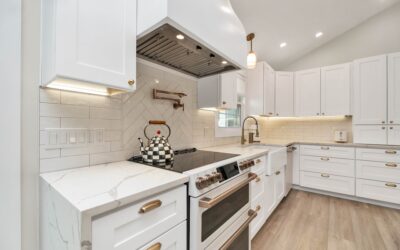
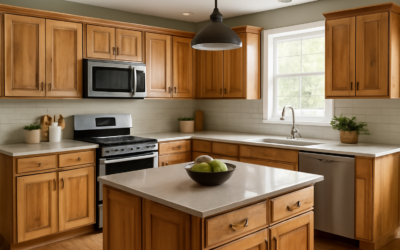
Hickory cabinets carry strong personality. The grain swings from cream sapwood to dark brown heartwood across a single door, and the color shifts under different lights. Matching flooring to that much movement is where most homeowners stumble. What flooring goes with hickory cabinets comes down to one rule: do not try to match the wood, contrast it. The right pairing reads as a designed kitchen rather than a lumberyard sample wall.
Part of our Kitchen Remodeling guide — explore the full guide →
The Core Rule: Contrast or Complement
Designers follow a 60-30-10 color guideline in kitchens. Cabinets and flooring together can take up 60 to 70 percent of the visible surface, so they need to relate without competing. With hickory cabinets, you have two safe directions: a flooring tone that contrasts in value (much lighter or much darker), or a tone in the same family but with smoother grain that lets the cabinets stay the visual focus.
Matching hickory to hickory rarely works. The two woods compete for attention, and the eye reads the room as busy. Step at least two value notches away from the cabinet color and you avoid that trap.
Best Flooring Options by Material
Luxury Vinyl Plank (LVP)
LVP is the most popular pairing for modern hickory kitchens because waterproof rigid-core planks like COREtec Pro Plus, Pergo Extreme, and Shaw Floorte Pro come in subtle wood-look colorways that complement without competing. Look for a 20 mil to 22 mil wear layer and a 5 mm to 8 mm SPC core. Pricing runs $3.50 to $6.50 per square foot for the product.
Stick to light oak, weathered gray, or smoked walnut visuals. Skip anything labeled hickory, rustic, or character grade.
Porcelain Tile
Wood-look porcelain planks in a light oak or pale gray-beige read as natural stone or quiet wood, letting the hickory cabinets carry the visual weight. Look for a DCOF slip rating above 0.42 for kitchen safety. Daltile, MSI, and Marazzi all offer 6 by 36 and 9 by 48 plank sizes at $3.00 to $7.00 per square foot.
Solid-tone porcelain in a warm greige works too. Tile pricing including thinset and grout typically runs $7.00 to $12.00 installed.
Hardwood (Not Hickory)
White oak in a natural or whitewashed finish complements hickory cabinets beautifully. The tighter, more uniform grain of white oak gives the eye a place to rest. Engineered white oak runs $5.00 to $9.50 per square foot. Walnut works for high-contrast pairings, though the cost climbs to $9.00 to $14.00 per square foot.
Maple is another quiet option. Janka 1450, lighter grain, and stains beautifully in natural or wheat tones.
Color Combinations That Work
- Hickory cabinets + light oak LVP: Bright, modern farmhouse feel.
- Hickory cabinets + weathered gray LVP: Transitional, slightly coastal.
- Hickory cabinets + travertine-look porcelain: Tuscan or Mediterranean traditional.
- Hickory cabinets + walnut hardwood: High-contrast craftsman or arts-and-crafts.
- Hickory cabinets + cream porcelain: Bright, airy, beachy.
Colors and Materials to Avoid
- Hickory-look anything: Same wood look on the floor and cabinets fights itself.
- Orange-toned oak: Amplifies the warm sapwood in hickory cabinets and reads dated.
- Red mahogany or cherry stains: Pushes the room into 1990s territory.
- Dark espresso wide planks with rustic cabinets: Too much contrast in busy grains creates visual noise.
Lighting Affects the Pairing
Hickory cabinets read warmer under 2700K bulbs and cooler under 4000K LEDs. Test flooring samples in the actual kitchen at the time of day you use the room most. Bring home 12 by 12 inch samples from at least three brands, lay them next to a cabinet door, and live with them for 48 hours before ordering.
Natural daylight changes everything. A north-facing kitchen may need a warmer floor tone to balance the cool light, while a south-facing kitchen can pull off cooler grays.
Practical Considerations Beyond Looks
Kitchens demand waterproof flooring or near-waterproof performance. Solid hardwood is the most vulnerable, especially under sinks and dishwashers. LVP, porcelain tile, and engineered hardwood with a waterproof finish all handle splashes better. If you have a dog or kids, a 20 mil wear layer LVP or a DCOF-rated porcelain is the safer call.
Continuity matters too. If hickory cabinets are in a kitchen that opens to a living room, the flooring needs to flow into both spaces. Transitions between materials at a doorway can work, but only when the rooms are visually separated by a wall or change in ceiling.
Brand Picks at Each Budget
- Under $4/sq ft: Shaw Matrix LVP in Driftwood, Pergo Extreme in Pacific Pine.
- $4 to $7/sq ft: COREtec Pro Plus in Coastal Oak, Mohawk RevWood Plus in Granbury Oak.
- $7 to $12/sq ft: Mannington Maison White Oak Natural, Karndean Korlok Country Oak.
- Tile: Daltile Emerson Wood in Brazilian Walnut Cream, MSI Glenwood Fog 6×36 porcelain.
Final Pairing Tips
Always sample at least three flooring options against the hickory cabinet door. Photograph the combinations under both daylight and evening kitchen lighting. Lean toward quieter floor visuals when cabinets are character-grade hickory, and toward bolder floors when cabinets are select-grade with calmer grain. Most kitchens benefit from a floor that is one to two shades lighter than the cabinets, which keeps the room feeling open and the cabinetry as the focal point.
Common Mistakes to Avoid
The single biggest mistake homeowners make is trying to match hickory cabinets with hickory flooring. The two woods will never match perfectly because of natural grain variation, and even if they did, the visual result is overwhelming. Pick a contrasting species or a quieter stain entirely.
The second common mistake is choosing a flooring color from a small sample chip without seeing it next to the cabinets in the actual kitchen. Lighting changes everything. A floor that looks like a great match in a showroom can read completely wrong at home. Always pull 12 by 12 inch samples and live with them for at least 48 hours before ordering.
The third mistake is buying the cheapest LVP just because the visual looks acceptable. Hickory cabinets last 25 to 40 years. A 6 mil wear layer LVP lasts 7 to 10 years. Plan the floor lifespan to match the cabinet investment, which usually means stepping up to a 20 mil wear layer LVP at $5 to $7 per square foot installed.
Frequently Asked Questions
What cabinets go with hickory flooring?
Painted cabinets are the easiest match for a hickory floor, since white, cream, soft gray, sage or navy let the busy grain stand out without competition. If wood cabinets are preferred, choose a smoother, tighter grain such as maple or cherry, stained clearly lighter or darker than the floor. Avoid hickory cabinets over hickory flooring, because the two strong grain patterns fight each other.
Does hickory flooring work with golden oak cabinets?
It can, but both woods are warm and grainy, so the room can turn very orange. A hickory floor with a cooler natural, gray-washed or darker brown stain keeps a clear value gap between floor and cabinets. Neutral walls, a quiet backsplash and a large rug help break up the wood, and testing full plank samples beside a cabinet door is essential before committing.
What wall color goes with hickory cabinets?
Warm whites, soft greige, muted sage and gentle blue-grays are the safest wall colors with hickory cabinets. They calm the strong grain and work with both light and dark floors. Avoid saturated yellows, oranges and reds, which amplify the warm sapwood tones. Test paint samples on the wall next to the cabinets in both daylight and evening light, since hickory shifts with bulb color.
What countertop color goes with hickory cabinets?
White or cream quartz with subtle veining is the most popular choice because it brightens the kitchen and gives the eye a rest from the cabinet grain. Solid black or deep charcoal counters suit a higher contrast look. Very busy granite with lots of movement tends to clash with hickory, so keep either the counter or the cabinets as the single patterned surface.
Prefer to explore on your own?
See how new flooring looks in your actual room in seconds — free, no signup.
Try the free Floor Studio →