When a customer asks me what is porcelain tile made of, they usually expect a one-word answer, but the real story involves refined clay, precise firing temperatures, and a manufacturing process that turns simple minerals into one of the hardest flooring materials on the market. Porcelain starts with a finer, denser clay body than standard ceramic, gets fired at much higher temperatures, and ends up with almost zero water absorption — which is why it survives bathrooms, mudrooms, and outdoor patios that would destroy a lesser tile. Understanding the actual composition helps you pick the right porcelain for your project and explains why prices swing so widely between a $2 big-box tile and a $12 imported slab.
Part of our Tile & Grout guide — explore the full guide →
- The Core Raw Materials
- How Pressing and Density Work Together
- The Firing Process That Sets Porcelain Apart
- Through-Body Versus Glazed Porcelain
- Additives That Change Performance
- Full-Body Versus Rectified Manufacturing
- Why the Composition Matters for Your Project
- Cutting and Handling Considerations From the Raw Material
The Core Raw Materials
Porcelain tile begins with kaolin clay, a fine white clay prized for its purity and low iron content, blended with feldspar, quartz, and sometimes ball clay to adjust plasticity during forming. Kaolin typically makes up 40% to 50% of the raw mix, giving porcelain its characteristic whiteness and fine grain compared to the coarser red or buff clays used in standard ceramic tile.
Feldspar acts as a flux, meaning it lowers the melting point of the other minerals during firing and helps the clay particles fuse into a dense, glass-like matrix. Quartz, ground to a fine silica powder, adds structural stability and helps control shrinkage as the tile dries and fires. Manufacturers blend these raw materials with water into a slurry, then spray-dry it into a fine powder ready for pressing — a process that ensures consistent particle size and moisture content across every batch, which matters enormously for dimensional consistency in large-format tile.
How Pressing and Density Work Together
The spray-dried powder gets pressed into tile shape under enormous hydraulic force, typically 2,500 to 6,500 pounds per square inch depending on the manufacturer and tile size. This pressure compacts the powder into a dense, low-porosity body before it ever sees a kiln, and it’s a major reason porcelain outperforms ceramic even before firing begins.
Higher pressing force produces a denser tile body, which directly affects two things buyers care about: breaking strength and water absorption. Industry standard ANSI A137.1 requires porcelain tile to absorb 0.5% or less water by weight, compared to ceramic tile’s allowance of up to 7% or more. That density difference is why porcelain resists frost damage in outdoor applications and why a porcelain tile dropped on a hard floor is far more likely to survive intact than a standard ceramic tile.
The Firing Process That Sets Porcelain Apart
After pressing, tiles pass through a kiln for firing at temperatures between 2,200°F and 2,500°F, roughly 200°F to 400°F hotter than the kilns used for standard ceramic wall or floor tile. This higher temperature vitrifies the clay body, meaning the minerals melt and fuse together at a molecular level rather than simply bonding as separate particles.
Firing cycles typically run 45 minutes to over an hour depending on the kiln design and tile thickness, with the tile passing through preheat, peak temperature, and controlled cooling zones on a continuous roller kiln. This vitrification is what gives porcelain its signature hardness — rated 7 to 8 on the Mohs scale, close to that of natural quartz — and its resistance to staining, since there’s almost no open pore structure left for liquids to penetrate.
Through-Body Versus Glazed Porcelain
Porcelain tile splits into two broad manufacturing types that change what “made of” really means for the finished product.
- Through-body porcelain — pigment gets mixed directly into the clay body before pressing, so the color runs consistently all the way through the tile. This makes chips and wear nearly invisible since the tile looks the same at the surface as it does an eighth of an inch down. Through-body porcelain typically costs $3 to $8 per square foot.
- Glazed porcelain — a colored glass coating is applied to the pressed clay body before firing, allowing for far more elaborate patterns, wood-look grain, and stone-look veining. The base clay body underneath is usually a plain gray or off-white, so a chip in glazed porcelain reveals the different-colored substrate beneath. Glazed porcelain ranges from $2 to $12 per square foot depending on the design complexity and country of origin.
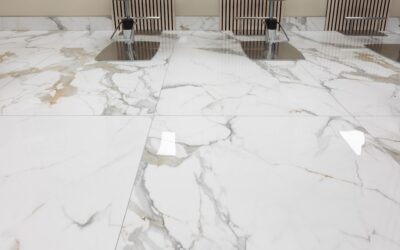
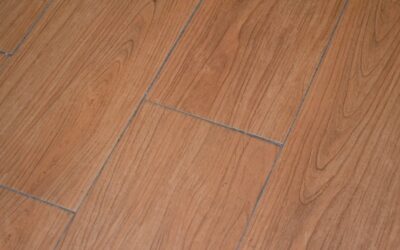
Most residential wood-look and marble-look porcelain plank on the market today is glazed, using high-definition inkjet printing technology to lay down photorealistic patterns before the glaze and final firing.
Additives That Change Performance
Beyond the core clay-feldspar-quartz mix, manufacturers blend in specialized additives depending on the tile’s intended use. Zirconium silicate gets added to some glazes to increase opacity and brightness. Aluminum oxide particles are sometimes fused into the surface glaze of porcelain rated for high foot traffic, boosting abrasion resistance measured under the PEI (Porcelain Enamel Institute) rating scale, which runs from PEI 0 for wall-only tile up to PEI 5 for heavy commercial floors.
Some outdoor porcelain pavers, increasingly popular for pool decks and patios, include additives that boost slip resistance, measured by a dynamic coefficient of friction (DCOF) rating. Tile intended for wet areas should carry a DCOF of 0.42 or higher per ANSI A326.3 to meet accepted slip-safety standards.
Full-Body Versus Rectified Manufacturing
Full-body porcelain, sometimes called technical porcelain, uses the same pigmented body throughout with no glaze at all, relying on the natural texture and color of the fired clay-and-mineral blend for its finished look. This type is common in large-format commercial and outdoor tile because it holds up to heavy equipment traffic without a glaze layer to wear through.
Rectified porcelain refers to a post-firing manufacturing step, not the raw material composition — tiles get precision-cut on all four edges after firing, producing perfectly square dimensions that allow for grout joints as narrow as 1/16 inch. This process adds roughly $0.50 to $1.50 per square foot to material cost but delivers a cleaner, more modern look increasingly favored in kitchen and bath remodels.
Why the Composition Matters for Your Project
Knowing what porcelain tile is made of helps explain real installation and maintenance decisions. Because the material has such low porosity, porcelain rarely needs sealing, unlike natural stone tile, which typically requires a penetrating sealer reapplied every one to two years. The density also means porcelain is heavier — roughly 3 to 4 pounds per square foot at 3/8-inch thickness — so subfloor and thinset selection matter more than with lighter ceramic tile; a modified thinset rated for porcelain, not an unmodified all-purpose mix, is essential for proper bond strength given the tile’s dense, low-absorption surface.
That same low absorption also explains why porcelain resists efflorescence, the chalky white mineral residue that sometimes appears on cementitious surfaces exposed to moisture. Because so little water can migrate through a fired porcelain body, salts dissolved in a concrete slab rarely find a path to the tile surface the way they can with more porous ceramic or natural stone. It’s one more reason contractors reach for porcelain in below-grade basements and slab-on-grade installations where a slight amount of residual moisture in the concrete is almost unavoidable.
Cutting and Handling Considerations From the Raw Material
The same hardness that makes porcelain durable underfoot also makes it harder to cut than ceramic. Because the fired body is dense and vitrified all the way through, a standard ceramic tile scoring cutter won’t reliably break porcelain cleanly. Installers instead reach for a wet saw fitted with a continuous-rim diamond blade, running water over the blade to control heat buildup and dust. Attempting to dry-cut porcelain with a standard blade tends to chip edges and shortens blade life dramatically, since the quartz and feldspar content is genuinely abrasive to cutting equipment.
Handling large-format porcelain slabs, which can now run 5 feet by 10 feet or larger in the premium segment, requires suction cups and sometimes a second or third set of hands, since a single crack from mishandling during transport means the whole panel gets scrapped. This is a direct consequence of the same dense clay-and-mineral composition that gives porcelain its strength once it’s set in place — rigid and strong under compression, but still brittle enough to fracture under an uneven point load before installation.
Prefer to explore on your own?
See how new flooring looks in your actual room in seconds — free, no signup.
Try the free Floor Studio →