Few materials transform a kitchen the way handmade Moroccan tile does. A white zellige tile backsplash delivers a glossy, watery, imperfect surface that catches light differently across every square inch—something no mass-produced ceramic can imitate. The subtle color variation, uneven edges, and glassy glaze give walls a depth that feels both ancient and thoroughly modern. This guide covers what zellige actually is, what it costs, how to install and seal it, and the design choices that make a white version sing.
Part of our Kitchen Remodeling guide — explore the full guide →
- What Zellige Tile Really Is
- Why Homeowners Love the White Version
- What It Costs
- Installation: Why It's Not a Standard Tile Job
- Sealing and Grout Choices
- Design Ideas With White Zellige
- Care and Maintenance
- Authentic Moroccan Zellige vs. Zellige-Look Ceramic
- Where White Zellige Works Best in the Home
- Common Mistakes to Avoid
What Zellige Tile Really Is
Zellige (also spelled zellij) is a centuries-old Moroccan tile hand-cut from natural clay dug near Fez, shaped by hand, dipped in glaze, and fired in wood-burning kilns. Because every piece is made individually, no two tiles are identical. You get slight bows, pinholes, glaze pooling, and color shifts that artisans consider features, not flaws. In white, these variations read as pearl, ivory, cream, and faint gray shadows rather than a flat sheet of paint.
The most common format is a 4×4-inch square, though 2×6 subway shapes and small mosaics exist. Thickness varies from tile to tile, another hallmark of the handmade process that installers must plan around.
Why Homeowners Love the White Version
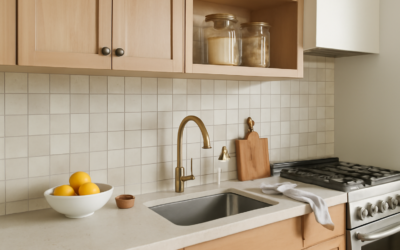
White zellige is popular because it works with nearly any cabinet color and countertop. Against white shaker cabinets it creates a tonal, textural look that stays interesting without adding contrast. Paired with walnut or oak, it brightens the space. With black hardware and brass fixtures, it feels curated and high-end. The glossy glaze bounces natural light around, making small kitchens feel larger and airier.
Because the color is subtle, the texture does the heavy lifting. Under-cabinet lighting turns a white zellige backsplash into a shimmering surface that changes throughout the day.
What It Costs
Zellige is a premium material, and the price reflects the handwork. Expect to pay roughly $18 to $50 per square foot for the tile alone, with imported authentic Moroccan zellige at the higher end and domestic or zellige-look ceramic at the lower end. A typical kitchen backsplash of 30 square feet therefore runs $540 to $1,500 in materials.
Installation labor adds $10 to $25 per square foot because zellige is slower and trickier to set than standard tile. Add thinset, grout, sealer, and trim, and a professionally installed white zellige backsplash commonly totals $1,200 to $3,000 for an average kitchen. Buying 15 to 20 percent extra is essential given the natural size variation and higher breakage during cutting.
Installation: Why It’s Not a Standard Tile Job
Zellige punishes installers who treat it like a uniform subway tile. Because thickness and dimensions vary, you cannot use tile spacers and expect straight, even lines. Experienced setters butt the tiles tightly together or leave a very thin grout line, adjusting each piece by eye and hand.
- Substrate: A flat, clean wall or cement backer board is essential; the reflective glaze exaggerates any lumps behind it.
- Thinset: Use a white polymer-modified thinset so the color of the mortar doesn’t show through the translucent glaze.
- Layout: Dry-lay a section first, sorting tiles to distribute the color and size variation evenly.
- Cutting: A wet saw with a fresh blade reduces chipping, but expect more waste than usual.
- Grout lines: Very tight, often 1/16 inch, to keep the handmade look and let the tiles nestle together.
Sealing and Grout Choices
Because zellige is porous natural clay, sealing matters. Apply a penetrating sealer before grouting to keep grout from staining the tile surface, then a final coat after grouting. This is especially important with white tile, where discoloration would show. For a white-on-white look, a bright white unsanded grout keeps things seamless; for definition, a soft gray grout outlines each handmade square and highlights the irregular edges.
Unsanded grout is the right choice for the narrow joints zellige demands. Sanded grout can scratch the delicate glaze and won’t pack into thin lines cleanly.
Design Ideas With White Zellige
The tile’s simplicity invites creative layouts. Consider these approaches:
- Stacked vertical: A modern grid that emphasizes the handmade texture.
- Classic offset (brick): Timeless and forgiving of size variation.
- Herringbone: Adds movement, though it increases cuts and cost.
- Full-height slab: Run the tile to the ceiling behind a range for a dramatic focal wall.
- Open-shelf backdrop: Zellige behind floating wood shelves showcases the glaze beautifully.
Pair white zellige with unlacquered brass faucets, matte black cabinet pulls, or natural stone countertops such as honed marble or soapstone to lean into its artisanal roots.
Care and Maintenance
Sealed white zellige is easy to live with. Wipe it with a soft cloth and mild pH-neutral cleaner; skip abrasive pads and harsh acidic products that can dull the glaze over time. The glossy surface resists grease well, which is why it earns its place behind a cooktop. Reseal every couple of years, or when water stops beading on the surface, to keep the porous clay protected.
Authentic Moroccan Zellige vs. Zellige-Look Ceramic
As the trend has exploded, manufacturers now sell “zellige-look” ceramic tiles that mimic the glossy, variegated surface at a fraction of the price. Understanding the difference helps you set expectations and budget. Authentic zellige is hand-cut natural clay from Morocco, with genuine thickness variation, wavy edges, glaze pooling, and true depth that shifts with the light. It costs more, installs slower, and demands an experienced setter, but nothing matches its living, handmade character.
Zellige-look ceramic, by contrast, is factory-produced with printed or glazed variation that imitates the effect. It’s uniform in size, so it installs like standard tile with spacers, costs roughly $8 to $18 per square foot, and suits DIYers and tighter budgets. The trade-off is that up close it reads as a reproduction—the variation repeats and the edges are machine-perfect. For a powder room or a rental you may be delighted with the look-alike; for a showpiece kitchen where you’ll see it daily, many homeowners feel the authentic tile is worth the premium.
Where White Zellige Works Best in the Home
While the kitchen backsplash is the classic application, white zellige earns its keep in several other spaces where its glossy, light-reflecting surface shines.
- Kitchen backsplash: The signature use, especially full-height behind a range or run to the underside of upper cabinets.
- Bathroom walls and shower surrounds: The moisture-resistant glaze suits wet areas beautifully, and the reflectivity brightens small baths.
- Fireplace surrounds: A white zellige surround adds subtle texture to a focal wall.
- Bar and coffee-station backsplashes: A small dose of artisanal texture in a niche or built-in.
- Laundry and mudroom walls: Durable, wipeable, and a cut above standard subway tile.
Wherever you use it, pair the tile with warm metals and natural materials to let its handmade quality feel intentional rather than accidental, and keep the surrounding palette calm so the shifting glaze remains the star.
Common Mistakes to Avoid
The biggest error is expecting factory perfection. If crisp, identical lines are your goal, zellige will disappoint you—buy a ceramic look-alike instead. The second mistake is under-ordering; with 15 to 20 percent variation and breakage, a tight order leaves you short mid-project with a dye lot you can’t rematch. Third, hiring a general handyman rather than a tile setter experienced with zellige often produces wavy, uneven results. Fourth, skipping the pre-grout sealer stains the white tile permanently.
Handled thoughtfully, a white zellige tile backsplash rewards the extra cost and care with a surface that feels alive—shifting with the light, telling the story of the hands that made it, and elevating an ordinary kitchen into something genuinely special. Order generously, hire the right installer, seal it properly, and it will look extraordinary for decades.
Prefer to explore on your own?
See how new flooring looks in your actual room in seconds — free, no signup.
Try the free Floor Studio →