
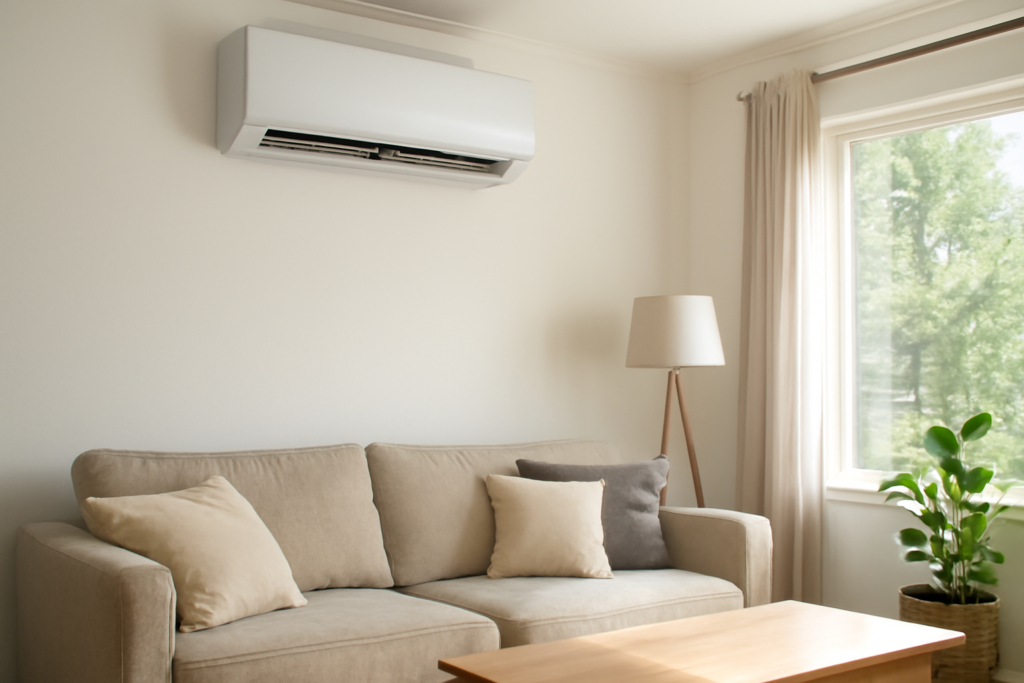
If you need to heat and cool a room or two without ductwork, a ductless heat pump is often the most efficient answer. An 18000 BTU mini split is one of the most popular sizes because it comfortably conditions a large room, an open-plan area, or a small addition. This guide explains what an 18000 BTU mini split covers, how to read the specs, what installation costs, and whether the size fits your space.
- What 18,000 BTU Actually Means
- Single-Zone vs. Multi-Zone
- Understanding SEER and Efficiency
- What You Get in the System
- Installation Cost
- Why You Need a Licensed Installer
- Electrical Requirements
- Pros and Cons of This Size
- Maintenance Basics
- Right-Sizing: Avoid Oversizing
- Heating Performance in Cold Weather
- Where an 18,000 BTU Unit Fits Best
- Quick Answers to Common Questions
- The Bottom Line
What 18,000 BTU Actually Means
BTU (British Thermal Units) measures cooling and heating capacity per hour. An 18,000 BTU unit equals 1.5 tons of capacity. As a rough guide, cooling needs about 20-25 BTU per square foot, so 18,000 BTU suits roughly 700 to 1,000 square feet, depending on climate, insulation, ceiling height, sun exposure, and how many windows the space has.
That range makes an 18,000 BTU unit a natural fit for a large living room, a master suite, a finished basement, a garage, or an open kitchen-dining area. For a small bedroom you would drop to 9,000-12,000 BTU; for a whole floor you would step up or add zones.
Single-Zone vs. Multi-Zone
An 18,000 BTU system comes in two configurations:
- Single-zone: one outdoor condenser paired with one indoor head, all 18,000 BTU serving a single space. Simplest and most efficient per dollar.
- Multi-zone: one outdoor unit feeding two or more smaller indoor heads (for example, two 9,000 BTU heads) to condition several rooms independently. More flexible but pricier and slightly less efficient.
Choose single-zone for one big room and multi-zone when you want independent control in multiple rooms from one outdoor unit.
Understanding SEER and Efficiency
Efficiency is measured by SEER (Seasonal Energy Efficiency Ratio) for cooling and HSPF for heating. Higher numbers mean lower energy bills:
- SEER2 16-18: budget-friendly, still far better than window units.
- SEER2 19-22: the popular midrange, a good balance of cost and savings.
- SEER2 23+: premium inverter units with the lowest operating costs.
Inverter-driven compressors, standard on modern mini splits, ramp up and down instead of cycling on and off, which keeps temperatures steady and cuts energy use. Many 18,000 BTU heat-pump models also heat efficiently well below freezing, with cold-climate versions rated to operate at -5°F or lower.
What You Get in the System
A mini split has three core parts:
- Outdoor condenser/compressor: sits outside on a pad or wall bracket.
- Indoor air handler (head): most commonly wall-mounted, but also available as ceiling cassette, floor-mounted, or concealed-duct styles.
- Line set: the insulated refrigerant lines, control wiring, and condensate drain connecting the two, running through a small (about 3-inch) wall penetration.
Installation Cost
Budget realistically, including labor:
- Equipment only: an 18,000 BTU single-zone unit runs roughly $1,000-$2,500 depending on brand and SEER.
- Professional installation: typically adds $1,500-$3,500, bringing the installed total to about $2,500-$5,500.
- Multi-zone systems cost more, often $4,000-$7,000+ installed for two or three heads.
DIY “quick-connect” mini splits with pre-charged line sets exist and can lower cost, but standard systems require a licensed HVAC technician.
Why You Need a Licensed Installer
This is not a typical weekend project. Connecting the line set involves handling refrigerant, and any technician who opens the refrigerant circuit must hold EPA Section 608 certification by law. A pro also pulls a vacuum on the lines to remove moisture, checks the charge, verifies the electrical, and confirms the correct dedicated circuit. Improper installation causes poor performance, refrigerant leaks, and voided warranties. Most manufacturers require professional installation to honor the warranty on standard units.
Electrical Requirements
An 18,000 BTU mini split needs its own dedicated circuit, typically 208/240V, with a properly sized breaker and an outdoor disconnect near the condenser. A licensed electrician should run the circuit if one is not already in place. Never tie a mini split into an existing shared circuit.
Pros and Cons of This Size
Advantages:
- Heats and cools one large space efficiently with no ductwork
- Quiet operation and precise, room-by-room temperature control
- Far more efficient than window ACs and electric baseboard heat
- Heats down to low outdoor temperatures with cold-climate models
Considerations:
- Higher upfront cost than a window unit
- Requires professional installation
- An indoor head is visible on the wall
- 18,000 BTU can be too much for a small room, causing short cycling and poor humidity control if oversized
Maintenance Basics
To keep it running efficiently, clean the washable indoor filters every few weeks, keep the outdoor coil clear of leaves and debris, ensure the condensate drain flows freely, and have a technician inspect the refrigerant charge and coils annually.
Right-Sizing: Avoid Oversizing
The temptation is always to buy bigger “to be safe,” but with mini splits that backfires. An oversized unit cools the space quickly, then shuts off before it has run long enough to pull humidity out of the air. The result is a room that feels cold and clammy, plus short-cycling that wears the compressor and wastes energy. Undersizing is a problem too, leaving the unit running flat-out and never quite catching up on the hottest days. This is why a proper load calculation matters more than a rule of thumb. For a genuinely large open space of 700-1,000 square feet with average insulation, 18,000 BTU is well matched. For a 400-square-foot bedroom, it would be far too much, and a 9,000 or 12,000 BTU unit would perform better.
Heating Performance in Cold Weather
Because most 18,000 BTU mini splits are heat pumps, they do double duty as efficient heaters. Standard models heat well into the 20s Fahrenheit, and cold-climate (hyper-heat) versions maintain strong output down to -5°F or lower. This makes an 18,000 BTU unit a viable primary heat source for a large room in many climates, often far cheaper to run than electric baseboard or resistance heat. In the coldest regions, look specifically for a cold-climate-rated model and check its rated capacity at low temperatures, since a heat pump’s output drops as the outdoor temperature falls. Pairing it with a backup heat source is wise where deep sub-zero cold is common.
Where an 18,000 BTU Unit Fits Best
This capacity is ideal for a specific set of spaces:
- A large living room or great room
- An open-concept kitchen and dining area
- A finished basement or bonus room
- A converted garage, workshop, or studio
- A master suite with a sitting area
- A small addition or sunroom with good insulation
If you want to condition several separate rooms rather than one big space, consider a multi-zone setup that splits the capacity among smaller heads instead of one 18,000 BTU head.
Quick Answers to Common Questions
What size room does 18,000 BTU cool? Roughly 700-1,000 square feet, depending on insulation, ceiling height, sun exposure, and window count. It suits a large living room, open-plan area, or small addition.
Is 18,000 BTU the same as 1.5 tons? Yes. Every 12,000 BTU equals one ton of capacity, so 18,000 BTU is 1.5 tons.
Can I install it myself? Standard units require a licensed, EPA Section 608-certified technician to connect and charge the refrigerant line set, plus a dedicated 208/240V circuit. DIY pre-charged kits exist but most warranties require professional installation.
Will it heat my room in winter? Yes, if it is a heat pump. Cold-climate models keep working efficiently down to -5°F or lower, often cheaper than baseboard heat.
What does it cost installed? About $2,500-$5,500 for a single-zone system, more for multi-zone setups.
The Bottom Line
An 18,000 BTU mini split is the right choice for conditioning a large room or open area of roughly 700-1,000 square feet, delivering efficient heating and cooling without ducts. Match the size honestly to your space to avoid oversizing, aim for SEER2 19 or higher for lower bills, and always use a licensed, EPA-certified installer on a dedicated circuit. Done right, it is one of the most comfortable and economical ways to condition a space.


