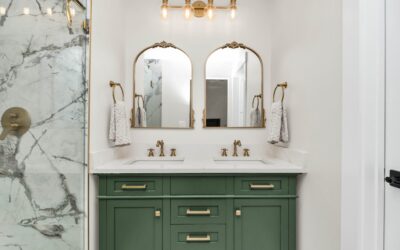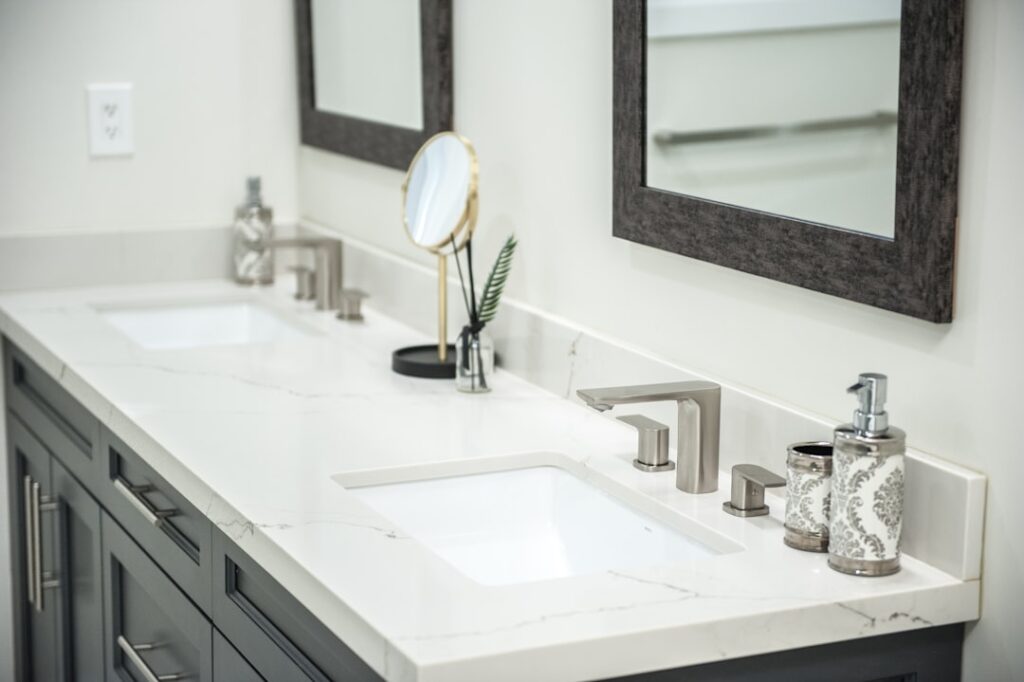
A double-sink master bath is one of those upgrades that quietly improves daily life, and a 72 inch double sink vanity top quartz surface is the material most designers now reach for to top it. At six feet wide, a 72-inch vanity gives two people their own basin, their own faucet, and enough counter between them to stop the morning traffic jam. Cap it with engineered quartz and you get a nonporous, rock-hard surface that never needs sealing and shrugs off the water, toothpaste, and cosmetics a bathroom throws at it.
Part of our Countertops guide — explore the full guide →
I have specified dozens of these tops, and the decisions that matter are surprisingly consistent: how the sinks are cut in, what edge and thickness to choose, how the faucets space out, what the cabinet has to support, and how quartz stacks up against granite and marble for a bath. This guide walks through each so you can order the right top the first time.
Why Quartz for a Bathroom Vanity Top
Engineered quartz is roughly 90 to 93 percent ground natural quartz bound with resins and pigments. That composition makes it nonporous, so unlike granite and marble it never needs sealing and will not absorb water, makeup, hair dye, or perfume that would stain a natural stone. In a bathroom, where standing water and cosmetic products are constant, that stain resistance is the headline benefit.
Quartz is also extremely hard and durable, resisting the chips, scratches, and daily wear a busy shared vanity endures. It comes in a vast palette of consistent colors and marble-look patterns, so you can get the crisp white or veined-marble aesthetic without marble’s fragility. The one caution is heat: the resin binder can scorch or discolor under a hot flat iron or curling wand left directly on the surface, so use a mat or trivet for hot styling tools.
Sink Cutout Options: Integrated, Undermount, and Drop-In
The sink strategy defines the whole top. The most popular choice for a quartz vanity is undermount sinks, where two porcelain or ceramic bowls are mounted beneath the quartz and the stone is cut with clean, polished openings above them. Undermounts look seamless, sit below the counter so you can sweep water straight into them, and are the cleanest to wipe around because there is no rim to catch grime.
You can also order integrated quartz sinks, where the basin is formed from the same material for a continuous, seam-free look, though these carry a premium and limit bowl shape. Drop-in (self-rimming) sinks, which sit on top of the counter with a visible rim, are the budget route and simplify installation, but the rim traps residue. For most 72-inch double vanities, two undermount rectangular or oval bowls hit the best balance of looks, cleanability, and cost. Decide bowl placement before fabrication, typically centered under each half with roughly even counter space at the ends and a shared stretch in the middle.
Thickness: 2cm Versus 3cm
Quartz tops come in two standard thicknesses: 2cm (about three-quarters of an inch) and 3cm (about an inch and a quarter). The 3cm slab is the premium, substantial-feeling option; it can be installed without a plywood support deck and lets the fabricator polish a thick, solid-looking edge directly on the material. Most higher-end bathroom vanities use 3cm for that reason.
A 2cm top is thinner and less expensive but usually needs a plywood subdeck for support and often gets a built-up (laminated) front edge to look thicker, which adds a glue seam at the edge. For a six-foot double vanity that will see daily leaning and weight, 3cm is my default recommendation for both strength and appearance, though 2cm with proper support is a legitimate way to trim the budget.
Edge Profiles and Backsplash Options
The edge profile sets the style. An eased or straight edge (a nearly square edge with a slightly softened corner) reads clean and modern and is usually the standard, no-upcharge option. A beveled edge adds a small angled cut for a crisper line. Rounded profiles like a bullnose or half-bullnose feel softer and more traditional, while an ogee edge with its S-curve is the most ornate and carries the highest fabrication cost. For contemporary baths, eased or beveled edges dominate; for traditional, a bullnose or ogee suits the look.
For the backsplash, you have three common routes. A short 4-inch quartz backsplash made from the same material is classic, easy, and hides the wall-to-counter joint. A full-height backsplash running up to the mirror or wall cabinets makes a bold, easy-clean statement and prevents water damage behind the vanity. Or you can skip the stone backsplash entirely and run tile up the wall for a decorative feature. Decide this before fabrication because a matching quartz splash is cut from your slab.
Faucet Spacing and Layout
Faucet drilling has to be planned with the sink layout. Each basin needs its faucet holes drilled in the correct configuration: a single-hole faucet needs one bore, a centerset needs holes on 4-inch centers, and a widespread faucet needs three holes on 8-inch centers. Tell your fabricator the exact faucet model so the holes match; quartz is drilled at the shop, not easily on site.
On a 72-inch top, the two faucets typically land centered over each undermount bowl, which places them roughly 18 inches from each end and about 36 inches apart. That spacing gives each person elbow room and leaves a usable shared counter zone in the middle. Confirm that your faucet’s spread and the bowl centerlines line up so a faucet is not crowded against the backsplash or hanging over the bowl edge.
Weight, Support, and Cabinet Prep
Quartz is heavy. A 72-inch 3cm top with two sinks can weigh well over 250 pounds, so the vanity cabinet has to be level, sturdy, and properly supported. Before the top goes on, the cabinet run must be shimmed dead level; any twist or dip can crack the stone or leave the top rocking. Long unsupported spans, such as over a knee-space or drawer bank, may need additional bracing or a support cleat.
Fabricators set the top on a bead of silicone across the cabinet tops and any center supports, then let the sinks hang from the underside for undermounts. Make sure your cabinet openings clear the sink bowls and that the plumbing rough-in lines up with each drain. Because the slab is heavy and rigid, it is delivered and set by the fabrication crew, not a one-person DIY job.
Cost and Color Choices
A quartz 72-inch double vanity top typically runs from about $600 to $2,000 or more installed, depending on the brand, color, edge, thickness, and whether sinks are included. Basic solid colors in 2cm land at the low end; designer marble-look patterns, premium brands, full-height splashes, and fancy edges push toward and past the top of that range. Undermount sinks add roughly $100 to $300 each, plus faucets and plumbing.
Color-wise, crisp whites and soft grays with subtle marble veining are the most popular for baths because they read clean and bright and pair with almost any cabinet finish. Warmer creams and taupes suit traditional and transitional spaces, while bold dark quartz makes a dramatic statement against light cabinetry. Because quartz color is engineered and consistent, what you see on the sample is what arrives, unlike natural stone that varies slab to slab.
Quartz Versus Granite and Marble for a Bath Vanity
Against granite, quartz wins on maintenance: granite is porous and needs periodic sealing to resist stains, while quartz never does. Granite offers one-of-a-kind natural patterns and slightly better heat tolerance, but for a bathroom the nonporous, consistent, seal-free nature of quartz usually makes it the easier long-term choice. Both are comparably priced and both are very durable.
Against marble, quartz is the clear practical winner for a vanity. Marble is stunning but soft and porous; it etches when it meets acidic products like certain cleaners, toothpaste, and cosmetics, and it stains easily. A quartz marble-look top gives you that same elegant veined appearance with none of the etching or sealing headaches. If you want genuine natural stone character and will maintain it, granite or marble can be beautiful, but for a low-fuss, stain-proof, durable surface on a busy 72 inch double sink vanity top quartz remains the smart default.