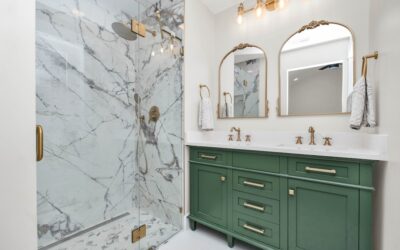
A bath next to shower configuration delivers the spa-like primary bath that real estate appraisers reward and homeowners actually use. Separating the soaker from the walk-in shower beats the old tub-shower combo on every metric except cost. Done right, you get a 5-foot freestanding tub and a 36×48-inch shower in roughly 80 square feet. Done wrong, you get a cramped wet zone with two drains that never drain properly.
Part of our Bathroom Remodeling & Flooring guide — explore the full guide →
- Why Separating Tub and Shower Pays Off
- Minimum Space Requirements
- Plumbing Costs You Should Budget
- Three Layouts That Actually Work
- Glass Partitions and Waterproofing
- Fixture Selection That Holds Up
- Ventilation and Heating Considerations
- Total Project Budget
- Common Layout Mistakes to Avoid
- Material Selection for the Wet Zone
Why Separating Tub and Shower Pays Off
The National Association of Home Builders reports that separated tub and shower layouts add roughly $4,200 to $7,800 in resale value compared to a single tub-shower combo, with the strongest premium in homes valued over $500,000. Two people can use the bathroom simultaneously without acrobatics. The shower glass stays cleaner because nobody fills bottles from the tub spout. And aging in place gets easier when you can step into a curbless shower without climbing over a tub wall.
You also avoid the constant compromise of tub-shower combos: shallow tub depth so the shower works, awkward shower curtain rod placement, and overspray on the toilet paper.
Minimum Space Requirements
You need 80 square feet minimum for a comfortable separated layout, and 100 to 120 square feet for a premium one. A 60-inch freestanding tub demands 6 inches of clearance on every side per most manufacturer specs, totaling 72 inches of wall length. Add a 36×48-inch walk-in shower with a 24-inch front clearance per IRC P2705.1 and you’re at 84 to 90 inches of run on one wall.
If the room is under 8 feet wide, the bath next to shower setup usually forces the tub against a side wall, which kills the freestanding aesthetic. In that case, consider a drop-in tub or stick with an alcove and put the shower on the opposite wall.
Plumbing Costs You Should Budget
Running new water and drain lines for a separated layout adds $2,800 to $6,500 to a remodel. Two drain assemblies, two supply runs, two thermostatic valves, and often a new vent stack per IPC 905. A Moen Velocity rainshower head plus Kohler Memoirs tub filler with floor-mount column runs $1,400 to $2,200 in fixtures alone. Add labor at $95 to $145 per hour for a licensed plumber and rough-in alone hits $4,500 fast.
Cheaper option: keep both fixtures close to existing supply lines. Every 4 feet of supply line relocation adds about $180 in materials and 90 minutes of labor.
Three Layouts That Actually Work
Layout one is the parallel run: tub and shower along one long wall, vanity opposite. Best for 9-foot-plus rooms. Layout two is the side-by-side: tub and shower share a back wall with a half-wall or glass between them. This is the showcase look but requires 7 feet of back wall. Layout three is the L-configuration: shower in one corner, tub on the perpendicular wall, vanity opposite the shower. Works in 8×10 rooms.
For each layout, verify door swing arcs don’t hit either fixture. A 30-inch door needs an unobstructed 30-inch radius. Pocket doors from Johnson Hardware ($140 to $220) recover that footprint when space is tight.
Glass Partitions and Waterproofing
A frameless half-wall glass panel between tub and shower runs $650 to $1,400 installed. Tempered safety glass at 3/8-inch thickness is the standard, with Cardinal CR-39 or Guardian SunGuard among the most-specified products. The bottom of the panel needs a sealed channel set in silicone to prevent water migration to the tub side.
Floor waterproofing matters more than ever with two wet zones. A Schluter Kerdi membrane system at $2.50 to $4 per square foot, properly heat-welded at seams, has become the industry standard. Older mortar-pan systems can leak within a decade.
Fixture Selection That Holds Up
The fixtures take a beating in a wet zone. Here’s what the pros specify:
- Tub filler: Floor-mount column type, Delta T4759 ($845) or Kohler K-922 ($1,150)
- Shower valve: Thermostatic, ASSE 1017 compliant, Moen TS3415 ($389) or Grohe Grohtherm 34614 ($425)
- Drain: Linear trench drain in shower, Schluter Kerdi-Line at $310 to $480
- Tub: 60×32-inch acrylic freestanding, Wyndham Soho at $1,180 or Kohler Memoirs at $2,400
Skip the chrome unless you love polishing. Brushed nickel and matte black hide water spots and last decades without spotting.
Ventilation and Heating Considerations
Two wet fixtures mean more moisture. HVI 2100 specs say 50 CFM minimum for bathrooms under 100 sq ft, but I always spec 80 CFM for separated layouts. The Panasonic FV-0811VF5 at $245 delivers 80 CFM at 0.3 sones and runs whisper quiet. Vent the duct outside through the roof or sidewall, never into the attic, or you’ll get mold within three winters.
Heated floors are no longer a luxury. A Schluter Ditra-Heat membrane system runs $11 to $16 per square foot installed and pays for itself in winter comfort. Set the thermostat to 78°F floor surface; that translates to a 68°F air temperature feeling like 73°F.
Total Project Budget
A mid-grade separated tub and shower remodel runs $22,000 to $38,000 in 2026 dollars. Premium spec with imported Italian tile and high-end fixtures can hit $65,000-plus. Get three written bids from licensed contractors, verify their workers’ comp and general liability insurance, and check that they’ve pulled permits in your jurisdiction recently. The cheapest bid is rarely the best value when waterproofing failures cost $9,000 to repair later.
Common Layout Mistakes to Avoid
The most common error in a bath next to shower layout is putting the tub against an exterior wall in cold climates. Soaking in a tub against an uninsulated wall feels chilly even with water at 104°F. Add R-13 insulation or move the tub to an interior wall when planning the rough framing.
Another frequent miss: forgetting to consider tub-filling time. A 60-gallon freestanding tub needs about 8 minutes to fill from a 5-gallon-per-minute spout. If your water heater holds only 40 gallons, you run out hot before the tub fills. Spec a 50-gallon water heater minimum, or install a Rinnai RU199iN tankless at $1,800 that delivers continuous hot water.
Material Selection for the Wet Zone
Both fixtures share the same waterproofing envelope, so material choice matters. Porcelain tile with a DCOF of 0.42 or higher per ANSI A137.1 is required for code-compliant slip resistance. Natural stone like marble looks luxurious but etches from soap residue within a few years; sealing every 6 months is mandatory.
Schluter Kerdi-Board panels at $48 per 4×8 sheet have largely replaced cement backer board for premium installs because they’re 100% waterproof, lightweight, and cut with a utility knife. Combined with Kerdi membrane at seams, the system carries a lifetime warranty when installed per spec.