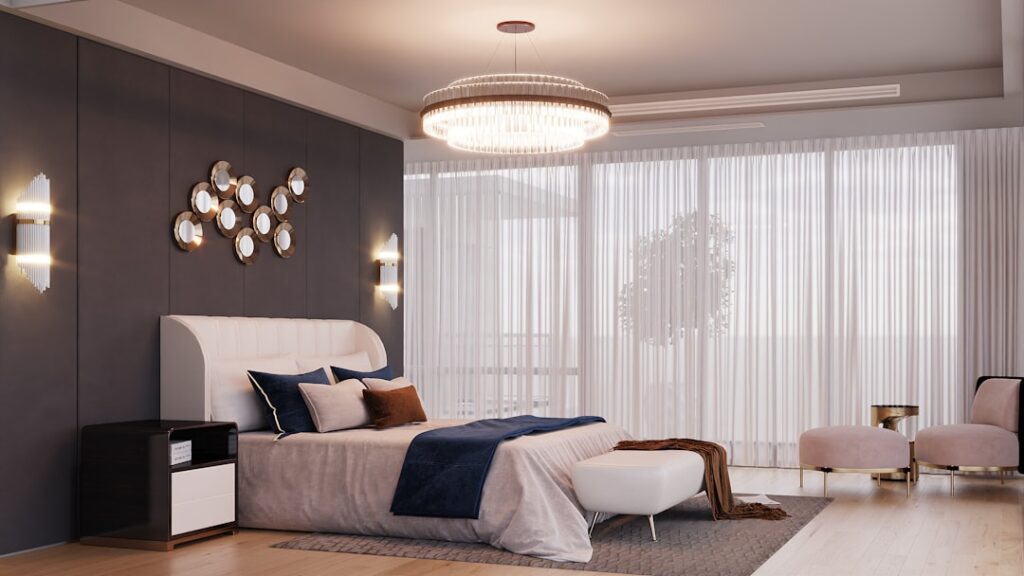
The bedroom is the one room where lighting has two jobs that fight each other: bright enough to find matching socks at 6 a.m., dim and warm enough to let your brain wind down at 10 p.m. Choosing a bedroom ceiling light is really about resolving that conflict — picking the right fixture type for your ceiling height, sizing it so it looks intentional rather than apologetic, and specifying the dimming and color temperature that make the room work at both ends of the day. This guide walks through all three decisions with the actual numbers.
Step 1: Let Ceiling Height Pick the Fixture Type
Headroom is the non-negotiable constraint, so start here:
| Ceiling height | Best fixture types | Why |
|---|---|---|
| 8 ft | Flush mount, low-profile fan-light | You need every inch; anything hanging reads cramped |
| 9 ft | Semi-flush, standard fan-light combo | Room for 6–12″ of drop without looming |
| 10 ft+ | Semi-flush, small chandelier, pendant pair, fan on downrod | Drop fixtures fill the vertical volume |
| Vaulted/sloped | Chandelier or fan on angled-canopy downrod | Fixture needs to hang plumb from the slope |
Flush mounts hug the ceiling and are the default for 8-foot rooms. Modern LED versions are far better than the “boob light” builders installed for decades — look for drum shades, slim discs, and caged designs. Semi-flush fixtures drop 4–12 inches on a short stem, adding shadow-line and presence without a swag of chain; they’re the sweet spot for most 9-foot bedrooms, and our semi-flush ceiling lights guide goes deep on the style options. Fan-light combos earn their place in warm climates — a bedroom fan improves sleep-temperature control more cheaply than any thermostat war — just size the fan to the room and keep the light kit dimmable. Rooms under about 145 square feet want a compact fan; our 42 inch ceiling fan guide covers that size class, and ceiling fan downrod math matters the moment your ceiling passes 9 feet.
Step 2: The Sizing Math
Two rules of thumb, both worth doing on paper:
Fixture diameter: add the room’s length and width in feet; that sum in inches is your target diameter. A 12×14 bedroom: 12 + 14 = 26, so a fixture roughly 24–28 inches across. Most people undersize — a 15-inch flush mount in a 12×14 room looks like a button on a blazer. If a single big fixture feels heavy, split the target between a modest center fixture and bedside pendants.
Hanging clearance: keep at least 7 feet from floor to the fixture’s lowest point in walking areas. Over the bed itself you can cheat lower — a chandelier centered over a king bed can drop to 6’6″ or so because nobody stands there.
Lumens: bedrooms want roughly 10–20 lumens per square foot of general light. A 12×14 room (168 sq ft) lands at 1,700–3,400 lumens total — say a 2,000-lumen ceiling fixture plus lamps. Err high and dim down; you cannot dim up past a fixture’s ceiling.
Step 3: Dimming and Warmth — the Sleep Science Part
Light is the main lever your circadian system listens to, and the two specs that matter are brightness and color temperature.
- Dimming is mandatory, not optional. A bedroom ceiling light without a dimmer is a design failure. Budget $25–35 for a quality LED-rated dimmer (Lutron Diva/Caséta are the reliable answers) and confirm the fixture or its bulbs are dimmable — many cheap integrated-LED flush mounts are not, and non-dimmable LEDs flicker or strobe on dimmers.
- Color temperature: 2700K is the bedroom default. This is the warm, incandescent-like white that keeps the room restful. 3000K is acceptable if you like a slightly crisper look; 4000K+ “daylight” bulbs in a bedroom fight your melatonin every single evening.
- Better still: warm-dim or selectable-CCT fixtures. Warm-dim LEDs shift from 3000K down toward 2200K candlelight as you dim — mimicking incandescent behavior — and selectable-CCT discs let you set the temperature with a switch at install. Both are now common under $100.
- Layer it. The ceiling fixture handles cleaning-and-dressing brightness; bedside lamps or sconces handle evening. If the ceiling light is your only source, you’ll always run it too bright too late.
Style Directions That Work
- Drum semi-flush — fabric shade, diffused glow, the safest handsome choice across traditional and transitional rooms.
- Natural-fiber shades — rattan and woven bamboo throw beautiful patterned shadow and read warm and calm; see our rattan ceiling light roundup for that lane.
- Slim LED disc — near-invisible, 1-inch profile for modern low rooms; buy only warm-dim versions.
- Small chandelier — over the bed in 10-ft-plus rooms, 20–26″ wide, dimmed deep for hotel-suite effect.
- Caged or lantern semi-flush — farmhouse and industrial rooms; use frosted bulbs to avoid glare from bed.
- Fan with integrated dimmable LED — the practical pick for hot climates; choose one with a warm (2700–3000K) light kit and a remote.
Placement Beyond Dead Center
Dead center of the room is the default and usually right — but consider centering over the bed instead when the bed wall is fixed and the room is long; the fixture then anchors the room’s real focal point. In large bedrooms, a center fixture plus two bedside pendants (hung 18–24″ above nightstands) both solves reading light and frees nightstand space. Walk-in closets off the bedroom deserve their own bright 4000K light — and if there’s no wiring there, a battery motion unit does the job; our wireless ceiling light guide covers those.
Installation Notes
- Swapping a fixture on an existing box is a standard DIY job: breaker off, verify dead with a tester, match wires (hot to hot, neutral to neutral, ground to ground). Budget an hour the first time.
- Fan-rated boxes matter: installing any fan-light combo requires a box rated for fan support — a standard plastic light box will eventually let a wobbling fan down, literally. Retrofit fan braces run $15–25 and install through the existing hole.
- Fixtures over about 50 lbs need independent support regardless of box type.
- No ceiling box at all? An electrician typically charges $150–350 to fish one into a first-floor-accessible ceiling — worth it over living with lamp-only lighting.
Mistakes to Avoid
- Undersizing the fixture — the #1 bedroom lighting error. Do the length-plus-width math.
- Skipping the dimmer to save $30 on a $200 fixture project.
- Daylight bulbs (5000K) because they were on sale. Your sleep is worth the right box off the shelf.
- Non-dimmable integrated LEDs — when that LED board ages out or you want dimming, the whole fixture goes. Prefer replaceable-bulb fixtures or name-brand integrated units with real warranties.
- Glare bombs over the bed: exposed clear-glass bulbs look great in photos and terrible from a pillow. Diffusion is your friend in this one room.
FAQ
What size ceiling light do I need for a bedroom?
Length plus width in feet, expressed in inches of diameter — a 12×12 room wants roughly a 24-inch fixture. Keep 7 feet of clearance under it in walking zones.
How many lumens should a bedroom ceiling light be?
Target 10–20 lumens per square foot from all sources: about 1,500–3,000 lumens for a typical bedroom, on a dimmer, at 2700–3000K.
Is a ceiling fan or a light fixture better in a bedroom?
In warm climates, a fan-light combo wins on sleep comfort; in cool climates, a dedicated fixture looks better and lights better. Either way, dimmable warm light is the requirement.
Are flush mount lights bright enough for a bedroom?
Modern LED flush mounts easily produce 2,000+ lumens — plenty. The historical dimness of flush mounts was a two-bulb-incandescent problem, not a form-factor problem.
Match the fixture to your ceiling height, size it with the simple math, and spend the last $30 on a dimmer and warm bulbs — that’s the whole formula for a bedroom that wakes you up and winds you down on command.