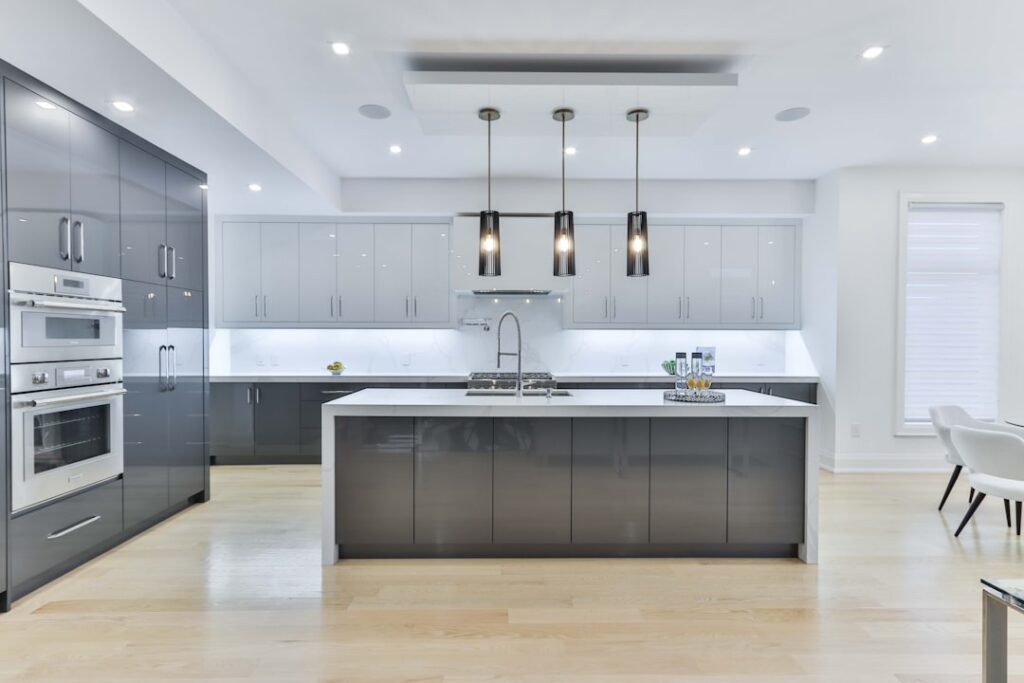
The contemporary kitchen has become the default aspiration for American remodels, and for good reason: it is clean, functional, and flexible enough to suit almost any home. Contemporary kitchen design emphasizes sleek horizontal lines, flat-front cabinetry, uncluttered surfaces, and a restrained material palette where function and simplicity lead. Unlike a strictly modern kitchen that can feel austere, the contemporary style borrows current trends freely, giving you a look that feels fresh without turning cold.
Achieving that look is less about spending the most money and more about making disciplined choices, in cabinetry, layout, materials, and color, that work together. This guide covers the design elements that consistently produce a genuinely contemporary kitchen.
Cabinetry: Flat Fronts and Handleless Looks
Nothing defines a contemporary kitchen faster than the cabinets. Flat-panel, or slab, doors with no raised detailing are the signature, creating the smooth, uninterrupted surfaces the style depends on. Where traditional kitchens use shaker or raised-panel doors, contemporary rooms favor plain fronts in matte or satin finishes, sometimes in wood grain, sometimes in solid color.
Hardware follows the same minimalist logic. Many contemporary kitchens go handleless entirely, using push-to-open mechanisms or integrated finger-pull channels routed into the door edge for a seamless facade. When hardware is used, it is long, slim, linear pulls in matte black, brushed brass, or stainless rather than ornate knobs. Full-height cabinets that run to the ceiling maximize storage and reinforce the clean vertical lines, eliminating the dust-collecting gap above standard uppers. These cabinet choices do more than any single element to establish the style.
Efficient, Open Layouts
Contemporary design prizes flow and openness, so the layout matters as much as the finishes. Open-concept kitchens that connect to living and dining areas suit the style, and the island has become the centerpiece, serving as prep space, casual seating, and a social hub. A well-designed island needs at least 42 inches of clearance around it, 48 is better, so two people can pass and appliance doors can open freely.
The classic work triangle between sink, cooktop, and refrigerator still applies, keeping the three primary stations within a comfortable few steps of each other. In larger contemporary kitchens, designers increasingly think in zones instead, dedicated areas for prep, cooking, cleanup, and storage, rather than a strict triangle. Whichever framework you use, the goal is efficient movement and generous, uncluttered counter space. Hidden storage, deep drawers, pull-out pantries, and appliance garages, keeps the countertops clear, which is essential to the minimalist look.
Materials and Countertops
Material selection carries the contemporary aesthetic. Quartz is the countertop of choice because it offers a smooth, consistent, low-maintenance surface that never needs sealing, available in crisp whites, concrete looks, and dramatic veined patterns that mimic marble without the upkeep. For a bolder statement, large-format porcelain slabs and waterfall edges, where the counter material runs vertically down the island sides to the floor, read distinctly high-end and modern.
Backsplashes trend toward simplicity: a slab backsplash matching the counter, large-format tile with minimal grout, or a clean subway tile in a stacked rather than offset pattern. Flooring is typically large-format tile, luxury vinyl plank, or wide-plank engineered wood in neutral tones to keep the floor quiet beneath the cabinetry. The unifying principle is restraint, a few well-chosen materials repeated consistently rather than a mix of competing finishes.
Color Palettes That Read Contemporary
Contemporary kitchens lean on neutral, low-contrast palettes with strategic accents. White, gray, greige, and black form the backbone, often in combinations, white uppers with a wood or dark lower, or an all-white kitchen grounded by a charcoal island. These neutral bases make the space feel bright, clean, and timeless, and they photograph and sell well.
Two-tone kitchens have become a defining contemporary move, pairing light upper cabinets with a contrasting island or lower run in navy, forest green, or wood grain. This adds depth and personality while keeping the overall scheme calm. When color appears, it is usually confined to one element, the island, a single accent, or the bar stools, against the neutral field. Natural wood tones are especially popular right now for warming up an otherwise cool palette, softening the contemporary look so it feels inviting rather than clinical.
Lighting and Appliances
Lighting is both functional and sculptural in a contemporary kitchen. Recessed ceiling cans provide even ambient light, under-cabinet LED strips illuminate the counters for prep work, and a row of pendant lights over the island adds a design focal point, often in matte black, brass, or a simple geometric form. Layering these sources lets the kitchen shift from bright task mode to a softer evening ambiance, ideally on dimmers.
Appliances in contemporary kitchens are typically stainless steel or, increasingly, panel-ready units that hide behind cabinet fronts for a seamless built-in look. Integrated refrigerators and dishwashers that disappear into the cabinetry reinforce the clean, uninterrupted lines. A striking range or a bold matte-black hood can serve as an intentional focal point. The overall effect should feel curated, appliances that either blend in completely or stand out deliberately, never a random mix.
Backsplash, Hardware, and the Finishing Details
The details that seem minor are often what push a contemporary kitchen from ordinary to polished. The backsplash sets the tone behind the counters, and contemporary kitchens favor either a full slab of the counter material carried up the wall for a seamless monolithic look, or a large-format tile with tight, color-matched grout so the joints nearly disappear. If you want subtle texture, a stacked-bond subway tile, laid in straight vertical or horizontal columns rather than the traditional offset brick pattern, reads distinctly modern. Busy mosaics and heavily patterned tile fight the clean aesthetic, so keep the backsplash quiet and let the cabinetry and counters lead.
Hardware and fixtures tie everything together and should be coordinated as a set. Choose one metal finish, matte black, brushed brass, or stainless, and carry it consistently across the cabinet pulls, faucet, and lighting so the room reads as designed rather than assembled. The faucet itself is worth a splurge: a tall, gracefully arced single-handle model or a sleek pull-down sprayer in your chosen finish becomes a small sculpture at the sink. Sinks trend toward large single-bowl undermount designs in stainless or matte composite, which suit the clean lines and handle real cooking. These finishing touches cost a fraction of the cabinetry but carry a disproportionate share of the visual impact, so choose them with the same care you give the big-ticket surfaces.
Flooring That Grounds the Design
The floor is a large surface that either reinforces or undermines a contemporary kitchen, so keep it quiet and cohesive. Large-format porcelain tile in a neutral tone, warm gray, greige, or a soft concrete look, suits the style and stands up to spills, dropped pans, and heavy traffic, though it is hard and cold underfoot. Luxury vinyl plank offers a warmer, softer, quieter surface that is fully waterproof and forgiving to stand on during long cooking sessions, and modern wood-look and stone-look prints read convincingly current. Wide-plank engineered wood brings genuine warmth for kitchens open to living areas where you want flooring continuity. Whatever you choose, favor larger formats and understated, low-contrast tones so the floor recedes and lets the cabinetry and counters lead. Running the same flooring from the kitchen into adjacent open-plan spaces makes the whole area feel larger and more intentional, a small decision with an outsized effect on how contemporary and pulled-together the room reads.
Budget and Bringing It Together
A contemporary kitchen can be built at many price points, and the look depends more on coherence than cost. A mid-range remodel typically runs $25,000 to $50,000, with cabinetry consuming the largest share, often 30 to 40 percent of the budget. Splurge on the elements that define the style and get used daily, flat-panel cabinets, a quality quartz counter, and good lighting, and economize on easily changed pieces like bar stools and accessories.
You do not need every element to achieve the aesthetic. Flat-front cabinets, a neutral palette with one accent, quartz counters, and layered lighting alone read unmistakably contemporary. The secret to great contemporary kitchen design is discipline: choose a restrained palette, keep surfaces clear, repeat a few quality materials, and let clean lines and good light do the work. Execute those fundamentals and the kitchen will feel modern and welcoming for many years.