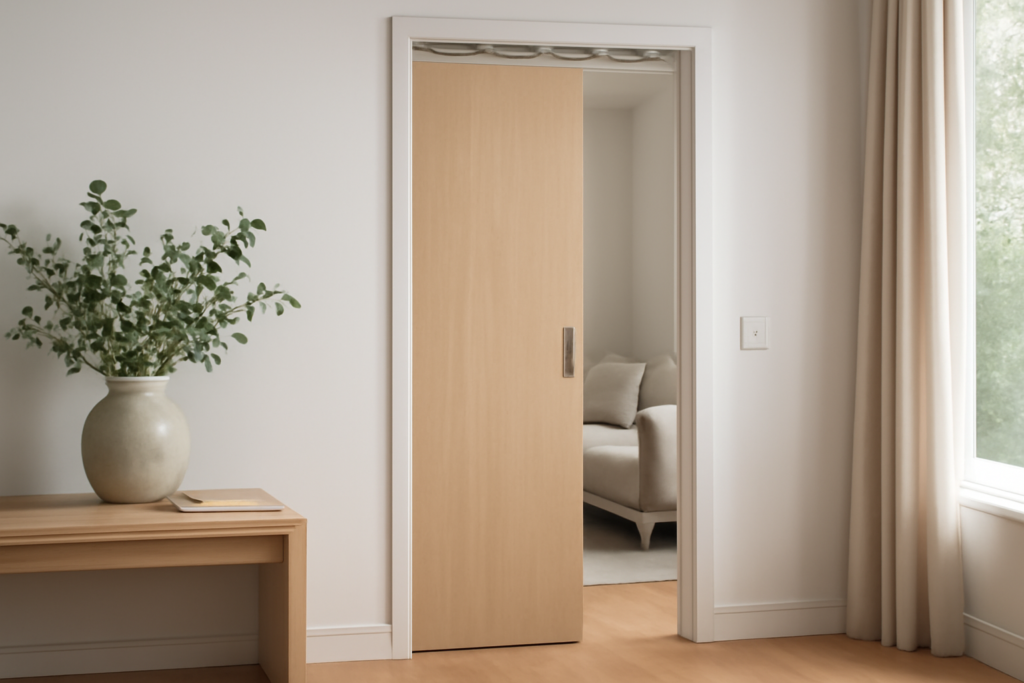
An Eclisse pocket door is a premium sliding-door system that disappears completely into the wall, reclaiming the floor space a swinging door wastes. Eclisse is an Italian manufacturer widely regarded as the gold standard for pocket door frame kits, and its systems solve the reputation problem that has long dogged pocket doors: flimsy frames, rattling doors, and rollers that fail. For homeowners planning a bathroom, closet, laundry, or tight hallway, an Eclisse kit delivers the space savings of a pocket door with hardware that actually lasts.
Part of our Windows & Doors guide — explore the full guide →
This guide explains how the system works, the main Eclisse models, sizing and wall requirements, installation basics, realistic costs, and why the extra investment over a hardware-store kit is often worth it.
Why Choose a Pocket Door at All
A standard hinged door needs a clear arc of floor, roughly 10 square feet, to swing open. In small bathrooms, powder rooms, closets, and narrow hallways that arc collides with fixtures, furniture, and traffic. A pocket door slides sideways into a cavity built inside the wall, freeing that entire swing zone. That makes it ideal wherever every inch counts, and it also creates cleaner sightlines in open-plan and modern interiors where a wall of swinging doors would feel cluttered.
What Makes Eclisse Different
The knock against cheap pocket doors is that the in-wall frame flexes, the track sags, and the door eventually drags or jumps its rollers. Eclisse engineers around all of that. Its frames use a galvanized steel structure with cross-braced studs that resist twisting, a heavy-duty aluminum track, and quality nylon roller carriages rated for tens of thousands of cycles. The kit arrives as a complete, pre-assembled cage that installers set into the rough opening, so the geometry is correct out of the box rather than cobbled together on site.
Main Eclisse Systems
Eclisse offers several systems for different situations.
- Eclisse Classic (single): The core single-door kit for one door sliding into one side of the wall.
- Eclisse Classic double (telescopic): Two doors that meet in the middle and slide into opposite pockets, ideal for wide openings.
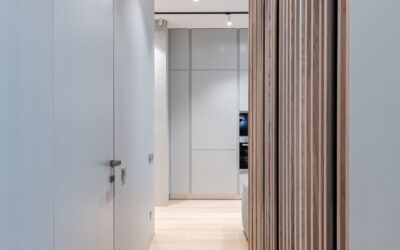
- Eclisse Syntesis Line: A frameless, flush design with no visible jambs or architrave, the door sitting perfectly flush with the plaster for a minimalist look.
- Eclisse Circular and specialty kits: Curved and other custom applications for high-end projects.
The Syntesis Line is especially popular in contemporary remodels because the finished wall shows no trim at all, just a clean rectangle where the door hides.
Sizing and Wall Requirements
The critical planning fact is that a pocket door needs a wall roughly twice the door width to house the cavity. A 30-inch door requires about 60 inches of wall, since the door must slide fully into the pocket. Standard door widths of 24, 28, 30, 32, and 36 inches are all available, along with matching heights.
Wall thickness matters too. Eclisse kits are made for specific finished wall thicknesses, commonly 4.5 inches for a single-layer drywall wall on 2×4 framing. The pocket wall becomes non-structural where the cavity sits, so plan the opening away from load-bearing walls or use a header to carry the load above. You also cannot run plumbing or most electrical through the pocket cavity, which affects where switches and pipes can go.
Installation Overview
Installing an Eclisse kit is more involved than hanging a standard door because it happens during framing or a wall rebuild, before drywall goes up.
- Frame a rough opening sized per the Eclisse instructions for your door width.
- Set the pre-assembled steel cage plumb and level, anchoring it to the floor and header.
- Hang drywall over the cage using the special short screws provided so they do not protrude into the pocket and scratch the door.
- Hang the door on its roller carriages and adjust the height and alignment.
- Fit the jamb, guides, and any flush trim, then install the pull hardware.
Because the frame is buried in the wall, this is not a quick swap for an existing hinged door unless you are already opening that wall. Most installs happen during a renovation or new construction.
What an Eclisse Pocket Door Costs
The frame kit alone typically runs $300 to $700 depending on model and size, with the flush Syntesis systems at the higher end. The door slab is separate and can be $100 to $500 or more for a solid-core or designer door. Professional installation, because it involves framing and drywall, usually adds $400 to $900. All told, a finished Eclisse pocket door commonly lands between $800 and $2,000. That is more than a basic builder pocket kit, but the difference buys a door that slides smoothly and quietly for decades instead of one that binds within a few years.
Pros and Cons
The advantages are significant space savings, a smooth and durable slide, a clean modern look, and, with the Syntesis line, a truly flush finish. The tradeoffs are higher cost, the need to build it into the wall, restrictions on running utilities through the pocket wall, and slightly reduced sound insulation compared with a tightly sealed hinged door. For bathrooms and closets, the sound tradeoff is usually minor.
Eclisse vs. Standard Pocket Door Kits
The clearest way to understand the value proposition is to compare an Eclisse kit against the generic split-jamb pocket door kits sold at home centers for a fraction of the price. The budget kits use a lighter track and a wood-frame cage assembled on site, which leaves more room for error and a frame that can flex. Over time, that flex lets the door rub the pocket walls, the rollers wear unevenly, and the door begins to drag or jump. Many homeowners who install a cheap pocket door end up frustrated within a few years.
Eclisse addresses each of those failure points with its galvanized steel cage, robust aluminum track, and quality roller carriages, and it arrives pre-built so the geometry is right from the start. The door glides with a light touch and keeps doing so for decades. If you plan to open the door many times a day, in a busy bathroom or a primary closet, the Eclisse premium buys reliability that the budget kits simply cannot match. For a rarely used closet, a cheaper kit may suffice, but for daily-use doors the upgrade is easy to justify.
Planning Around Utilities and Structure
The most common planning oversight with any pocket door is forgetting that the pocket wall cannot easily house plumbing, electrical, or ductwork, because the door slides through that cavity. Before committing to a location, map out where light switches, outlets, pipes, and vents need to run, and keep them out of the pocket wall or reroute them to an adjacent wall. A switch that has to sit right where the door pocket lands is a headache that surfaces late in construction if you do not plan for it.
Structure matters too. The wall that houses the pocket becomes largely non-load-bearing along the cavity, so if the wall carries weight from above, you need a properly sized header to transfer that load around the opening. This is why pocket doors are easiest to place in interior partition walls rather than load-bearing walls. Confirming the wall’s role and the utility routing early keeps the Eclisse install smooth and avoids expensive surprises once the framing is open.
Is It Worth It?
For homeowners already opening a wall during a remodel, or building new, an Eclisse pocket door is one of the best space-saving upgrades available, and the quality difference over generic kits is immediately obvious in how the door glides. If your goal is a bathroom or laundry that feels larger, a hallway free of swinging doors, or a minimalist flush wall, the Eclisse system delivers a result that looks and feels custom. Plan the wall thickness and utility routing early, budget for professional framing, and you will have a disappearing door that performs flawlessly for the life of the home.