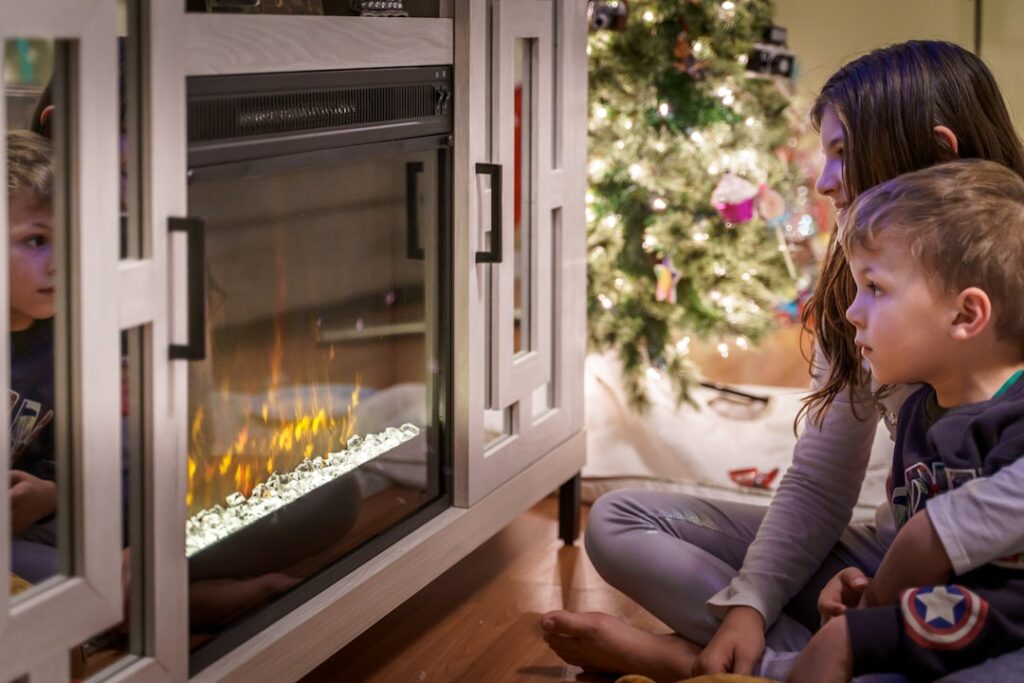
You want the warmth and the glow, but you’re stuck on which technology to buy. The electric vs gas fireplace decision comes down to five things: how much you’ll spend upfront, how much heat you actually need, what it costs to run, how hard it is to install, and the kind of ambiance you’re after. Get clear on those, and the electric vs gas fireplace question usually answers itself for your specific room and budget.
Upfront Cost
This is where the two diverge hardest. An electric fireplace is cheap to buy and cheaper to install. A quality electric insert or wall-mount unit runs $300 to $1,500, and installation is often just plugging it into a standard 120-volt outlet or having an electrician add one — call it $100 to $500 if any wiring is needed at all.
A gas fireplace is a bigger commitment. The unit itself runs $1,500 to $4,500, but installation is the real expense. You need a gas line run to the firebox, venting (direct-vent through an exterior wall or up a chimney), and often framing and finish work. Installed, a gas fireplace typically lands between $4,000 and $10,000. If there’s no existing gas line, add several hundred to a couple thousand more.
- Electric: $300-$1,500 unit, $100-$500 install
- Gas: $1,500-$4,500 unit, $4,000-$10,000 installed total
Heat Output
If you’re heating a real room, gas wins decisively. A gas fireplace puts out serious warmth — typically 20,000 to 40,000 BTU — enough to heat a large living room or act as a genuine zone-heating source that lets you turn down the furnace.
An electric fireplace is limited by the wall outlet. A standard 120-volt model draws about 1,500 watts and produces roughly 5,000 BTU, enough to take the chill off a 400-to-500-square-foot room but not to heat a big open space on a truly cold day. It supplements; it doesn’t replace a furnace. The heat is also delivered by a fan-forced blower rather than radiant fire, so it feels different — more like a space heater than a hearth.
Running Cost
Electric is simple to calculate and moderate to run. A 1,500-watt unit burns 1.5 kWh per hour; at the U.S. average of about 16 cents per kWh, that’s roughly 24 cents an hour with the heater on. Run it four hours an evening and you’re looking at about a dollar a day. Flame-only mode with no heat costs pennies.
Gas running cost depends on fuel price and BTU output, but natural gas is usually cheaper per unit of heat than electricity. A 30,000 BTU gas fireplace burns roughly 0.3 therms per hour; at about $1.50 per therm, that’s around 45 cents an hour — but you’re getting six times the heat of the electric unit for less than double the hourly cost. For actual heating, gas delivers far more warmth per dollar. Propane runs more expensive than natural gas.
Installation and Flexibility
Electric is the clear winner on ease. No gas line, no venting, no combustion, no chimney. You can hang a wall-mount unit yourself in an afternoon, and because there’s no exhaust, you can put it in a bedroom, basement, condo, or apartment where gas would be impractical or prohibited. Renters can even take it with them.
Gas requires professional installation — a licensed installer for the gas line and venting, plus a permit and inspection. Direct-vent models need an exterior wall; older-style units need a chimney or flue. The upside is permanence and a built-in look, but you’re locked into the location and the project is measured in days, not hours.
Ambiance and Realism
For die-hard fire lovers, gas is more convincing. You get real dancing flames, radiant heat you can feel on your skin, the glow of ceramic logs, and even a faint crackle on some models. It reads as a genuine fireplace because, well, something is actually burning.
Electric flame technology has come a long way — LED and reflected-light effects on premium units look genuinely good, and many let you run the flame with the heat off for summer ambiance. But look closely and it’s still a simulation. Budget electric units in particular can look cartoonish. If the fire itself is the centerpiece of the room, gas has the edge; if you mostly want a warm glow and easy operation, a good electric unit satisfies most people.
Safety and Maintenance
Electric is about as low-maintenance as it gets. No combustion means no carbon monoxide, no gas leaks, and the glass stays cool to the touch — a real advantage with small kids or pets. Maintenance is basically dusting the unit and occasionally replacing an LED.
Gas is safe when properly installed and maintained, but combustion demands respect. You need a carbon monoxide detector, annual servicing to check the burner and venting, and the glass front gets hot enough to burn. Direct-vent models exhaust safely outside, but the venting has to stay clear and the system inspected periodically.
When to Pick Each
Choose an electric fireplace if you want low upfront cost, a simple plug-in install, flexibility to place it anywhere or move it later, no venting or gas line, and you’re mainly after ambiance with some supplemental heat. It’s ideal for bedrooms, basements, apartments, condos, and rentals.
Choose a gas fireplace if you want real, substantial heat to warm a large room or cut your heating bill, prefer the realism of true flames, are renovating or building where running a gas line and vent is feasible, and you’re comfortable with the higher upfront investment for a permanent, high-value feature that appeals to buyers at resale.
Side-by-Side Comparison
Here’s the whole decision at a glance:
- Upfront cost: Electric $300-$2,000 installed; gas $4,000-$10,000 installed. Advantage: electric.
- Heat output: Electric ~5,000 BTU; gas 20,000-40,000 BTU. Advantage: gas.
- Running cost: Electric ~24 cents/hour with heat; gas ~45 cents/hour for six times the heat. Advantage: gas per unit of warmth, electric for ambiance-only.
- Installation: Electric plug-in, DIY-friendly; gas needs a pro, gas line, venting, and a permit. Advantage: electric.
- Ambiance: Electric is a good simulation; gas is real flame and radiant heat. Advantage: gas.
- Safety and maintenance: Electric has no combustion and cool glass; gas needs a CO detector and annual service. Advantage: electric.
- Resale value: Electric adds little; a built-in gas fireplace is a selling feature. Advantage: gas.
Lifespan and Long-Term Value
A well-built gas fireplace is a 15-to-20-year fixture, and because it’s permanently installed and adds real heating capacity, appraisers and buyers treat it as a feature of the home. Electric units are more disposable — expect 10 to 15 years, and when the flame effect or heating element fails, you often replace the whole unit rather than repair it. That’s not necessarily a knock; a $600 electric fireplace you swap out twice a couple decades still costs a fraction of one gas install. Just weigh it into the long view: gas is a capital improvement, electric is more like a nice appliance.
What About Efficiency?
Efficiency cuts differently depending on how you frame it. An electric fireplace converts nearly 100 percent of the electricity it draws into heat in the room, with nothing lost up a vent — but electricity itself is often a pricey way to make heat. A direct-vent gas fireplace loses some heat through its exhaust, typically running 70 to 85 percent efficient, yet natural gas is usually cheaper per BTU, so it can still heat a room for less. The old-fashioned vented gas or wood-burning fireplace is the worst of both worlds, pulling warm room air up the chimney. For actual heating value, a modern direct-vent gas unit or a sealed electric insert both make sense; an open, drafty hearth doesn’t.
The Bottom Line
If your priority is cheap, easy, flexible ambiance, go electric — you’ll spend a few hundred dollars and be watching flames the same day. If your priority is real heat, realism, and a permanent upgrade that adds resale value, go gas and budget for the professional install. Match the fireplace to what you actually want out of the room, and either choice will earn its keep through the cold months.