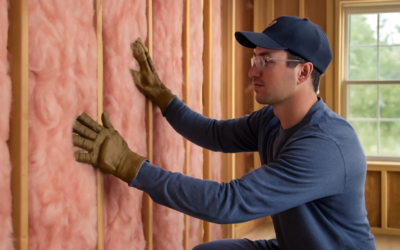
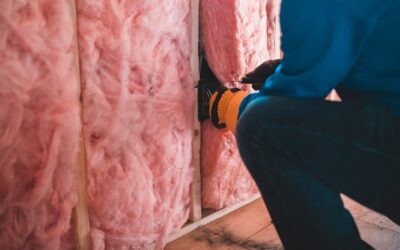
Fiberglass batt insulation is the pink (or yellow, or white) blanket that insulates more American walls than every other material combined — pre-cut panels of spun glass fiber sized to friction-fit between studs and joists. It is cheap, DIY-friendly, and genuinely effective when installed well, which is the catch: batts lose a huge share of their rated performance to sloppy fitting. This guide gives you the R-value-by-thickness numbers, the faced-versus-unfaced decision, and the cutting technique that separates a quality job from a lumpy one.
R-Value by Thickness
R-value measures resistance to heat flow — higher is better. Standard fiberglass batts run roughly R-3.1 to R-3.4 per inch; “high-density” batts reach R-3.7 to R-4.3 per inch by packing more glass into the same depth. The common products:
| Batt thickness | R-value | Fits | Typical use |
|---|---|---|---|
| 3.5″ | R-11 / R-13 | 2×4 wall (3.5″ cavity) | Standard walls; R-13 is the modern default |
| 3.5″ high-density | R-15 | 2×4 wall | Code-driven upgrades in 2×4 framing |
| 5.5″ | R-19 | 2×6 wall (5.5″ cavity) | 2×6 walls, floors |
| 5.5″ high-density | R-21 | 2×6 wall | Better 2×6 wall performance |
| 6.25″ | R-19 | Lofts to 6.25″ open | Floors, attics (compresses to R-18 in 5.5″ cavity) |
| 8.25″ | R-25 | 2×8 joists | Floors over unconditioned space |
| 9.5″ | R-30 | 2×10 joists / attic | Attic floors, cathedral ceilings |
| 12″ | R-38 | Attic | Attic layer or 2×12 rafters |
| 13″–14″ | R-49 (layered) | Attic | Cold-climate attic target; usually two layers |
Note the R-19 asterisk: a 6.25-inch R-19 batt squeezed into a 5.5-inch 2×6 cavity compresses to about R-18. Compression always costs R-value — a batt only delivers its rating at full loft. Climate-zone attic targets range from R-38 in the South to R-49 or R-60 in the North; hitting R-49 with batts means layering (for example, R-30 between joists plus R-19 crosswise on top) — our R49 insulation guide covers the layering math, and the broader attic insulation guide compares batts against blown-in for that job.
Faced vs Unfaced
- Faced batts carry a kraft-paper (or occasionally foil) layer on one side that acts as a vapor retarder and provides stapling flanges. Rule one: the facing goes toward the living space in most US climates — toward the warm-in-winter side. Rule two: never stack two vapor retarders (a faced batt over existing faced insulation traps moisture between them); use unfaced for second layers.
- Unfaced batts are pure friction-fit fiberglass — the choice for adding attic layers, interior walls (sound control), and anywhere a separate vapor strategy exists. The vapor question has real regional nuance — see our vapor barrier insulation guide before facing decisions in mixed-humid climates.
- Cost difference is small — facing adds roughly $0.05 to $0.10 per square foot. Kraft facing is flammable and must never be left exposed; cover it with drywall or use unfaced/FSK-faced product where insulation stays visible.
What Fiberglass Batts Cost
Materials run about $0.40 to $0.80 per square foot for R-13, $0.80 to $1.20 for R-19/R-21, and $1.00 to $1.80 for R-30/R-38 — the cheapest R per dollar of any mainstream insulation. Professional installation roughly doubles the numbers. For comparison, damp-spray cellulose and blown fiberglass walls cost more installed, and spray foam runs 3 to 6 times batt pricing (our closed cell foam insulation guide covers when that premium pays). Batts also install with zero special equipment — the entire toolkit is a utility knife, straightedge, tape, and PPE.
Cutting and Fitting: Where Jobs Are Won
Lab R-value assumes a perfect fit. Real-world studies grade batt installs (RESNET Grade I–III), and a Grade III job — gaps, compression, voids — can underperform its rating by 10 to 30%. Technique matters more than brand:
- Cut on a board, compress with a straightedge. Lay the batt on plywood, compress the cut line under a 4-foot level or scrap 1×4, and slice with a sharp utility knife in one or two passes. Extend the blade fully and change blades often — dull blades tear.
- Cut 1/2 inch oversize in width and length so the batt springs against framing. A batt cut short leaves an edge gap; a 1-inch gap along one side of a stud bay can cut that cavity’s performance dramatically because air convects around the batt.
- Split, don’t stuff, around wires. Peel the batt’s thickness apart like a book and slide one layer behind the cable, one in front. Stuffing the whole batt in front of a wire leaves a compressed void behind it.
- Cut around boxes, don’t wrap them. Notch the batt to fit snugly around electrical boxes; jamming full-thickness batt behind a box compresses it to near-zero R.
- Fill odd bays with cut pieces, not folded-over scraps. Narrow bays beside windows and corners get measured, cut pieces — this is exactly where builders leave voids.
- No air gaps behind the batt. The batt should touch the back of the cavity (exterior sheathing in walls, drywall below in attic floors). A batt bridging across a gap lets convection loop behind it.
Safety and Handling
Fiberglass is an irritant, not the hazard old rumors suggest (modern biosoluble formulations were removed from carcinogen listings decades ago), but treat it seriously: long sleeves, gloves, safety glasses, and an N95 respirator, especially overhead. Cool water rinse — not hot — washes fibers off skin. Keep batts dry: wet fiberglass loses R-value until fully dried and can feed mold on adjacent framing if it stays damp.
Where Batts Are the Right (and Wrong) Choice
- Right: Open framing — new walls, garages being finished, floors over crawlspaces, attic joist bays with straight, regular spacing, interior walls for sound (see sound insulation for the acoustics-specific products).
- Wrong: Closed existing walls (blown-in wins without demolition), irregular framing and obstruction-heavy attics (blown-in conforms; batts leave gaps), rim joists and moisture-prone basements (foam products belong there), and anywhere air-sealing has not been done first — batts slow heat but do not stop air. Caulk and foam the penetrations before insulating; fiberglass is not an air barrier.
Mistakes to Avoid
- Compressing R-19 into 2×4 walls “for extra R” — you get about R-14 and a bulging wall.
- Leaving kraft facing exposed in a garage or basement — it is a code-cited fire issue.
- Covering recessed lights that are not IC-rated — maintain 3-inch clearance or replace with IC-rated fixtures.
- Blocking soffit vents at the attic eaves — install baffles first to preserve airflow.
- Skipping the vapor-retarder rules when double-layering.
How Much to Buy: Estimating a Job
Batts sell by the bag, with coverage printed on the label — typically 40 to 106 square feet per bag depending on thickness and width. Estimate wall jobs at net cavity area: wall length times height, minus 10 to 15% for framing (studs occupy real estate batts do not fill), minus windows and doors. A 24-by-24-foot garage with 8-foot walls, one door, and two windows nets out around 600 square feet of cavity — roughly eight bags of R-13 at $45 to $65 per bag, or $360 to $520 in material. Buy width to match your framing: 15-inch batts for 16-on-center studs, 23-inch for 24-on-center. Attic estimates use the full floor area with no framing deduction if you are cross-layering. Keep receipts and buy one extra bag; unopened bags return easily, while a Sunday-evening shortage stalls the job a week.
FAQ
How long does fiberglass batt insulation last?
Effectively the life of the building — 80-plus years — if it stays dry and unsettled. It does not degrade chemically; performance loss comes from moisture events, pest disturbance, and compression.
Can I install batts over existing attic insulation?
Yes — lay unfaced batts perpendicular to the joists over the old layer. Crosswise layering covers the joist tops, which are thermal bridges.
Is R-13 or R-15 worth it in 2×4 walls?
R-15 high-density costs 20 to 30% more for about 15% more R. In cold climates and for new builds chasing code points, yes; for a garage refresh, R-13 is fine.
Batt vs mineral wool — which should I buy?
Mineral wool costs more but adds fire resistance, water repellency, and better sound blocking, with easier friction-fit (no facing). Our mineral wool insulation guide runs the full comparison; for pure R per dollar in a dry wall cavity, fiberglass batts still win.
Bottom line: fiberglass batt insulation delivers the cheapest R-value in construction, and the installer — not the product — determines whether you actually get it. Buy the thickness your cavity depth allows, face it toward the living space, cut generously, split around wires, and treat every gap as the enemy.