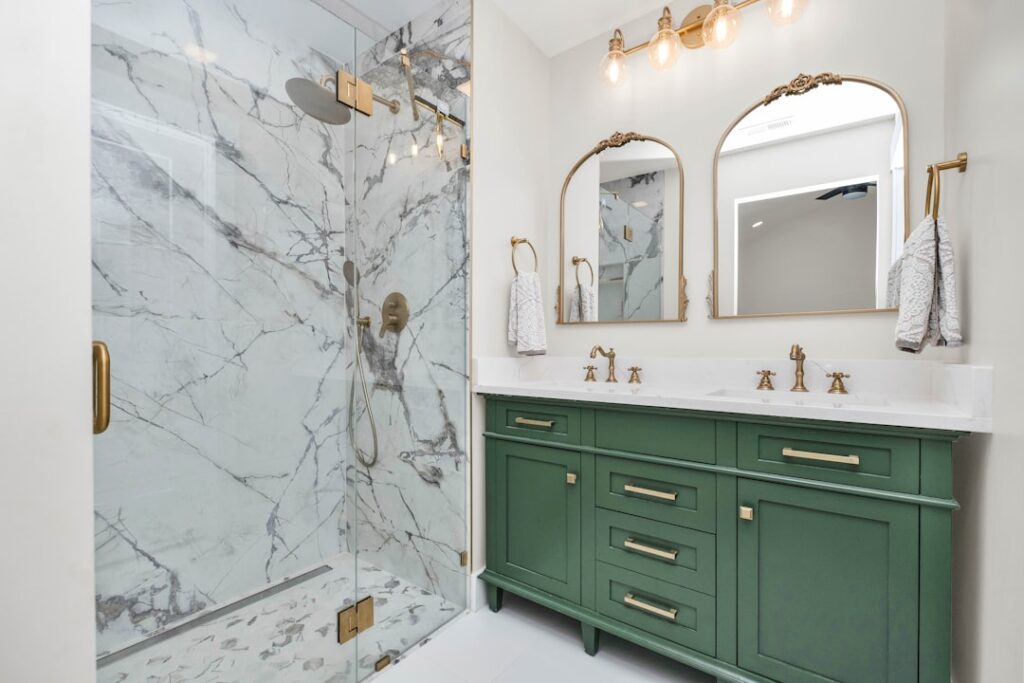
Nothing turns a daily rinse into a spa-like ritual quite like a large shower head that showers you in a broad, rainfall-style cascade. But bigger is not automatically better, and the wrong choice can leave you with weak pressure or a soaked bathroom. This guide covers sizes, flow rates, mounting styles, water-pressure requirements, materials, and costs so you can choose wisely.
Part of our Bathroom Remodeling & Flooring guide — explore the full guide →
- What Counts as a Large Shower Head
- Rainfall vs High-Pressure Designs
- Understanding Flow Rates
- Water Pressure Requirements
- Mounting Styles
- Materials and Finishes
- Typical Costs
- Installation Considerations
- Combining With a Handheld
- Water Efficiency Tips
- Common Mistakes to Avoid
- Spray Patterns and Settings
- Cleaning and Preventing Mineral Buildup
- Matching Head Size to Shower Space
- Boosting Weak Water Pressure
- Frequently Asked Questions
- The Bottom Line
What Counts as a Large Shower Head
Standard shower heads measure around 4 to 6 inches across. Large or oversized heads typically start at 8 inches and range up to 12, 16, or even 20 inches in diameter for luxury rainfall models. The larger the face, the wider the water spray pattern and the more it envelops your whole body rather than hitting a single spot, creating that immersive rainfall sensation.
Rainfall vs High-Pressure Designs
Large heads generally fall into two camps. Rainfall heads mount overhead and let water fall gently straight down under gravity, prioritizing coverage and a soft, drenching feel over force. High-pressure large heads use engineered nozzles and pressure chambers to deliver a stronger spray from a big face. If you love a powerful massage-like stream, look for pressure-boosting designs; if you want a gentle downpour, choose a classic rainfall head.
Understanding Flow Rates
Flow is measured in gallons per minute, or GPM. Federal law caps shower heads at 2.5 GPM, and many water-efficient models run at 1.8 or 2.0 GPM. A large head spreads that same limited flow across a wider area, which is why some oversized rainfall heads can feel weaker than a compact head. Look for models engineered to maintain a satisfying feel within the legal flow limit rather than assuming a big face means more water.
Water Pressure Requirements
Large rainfall heads need adequate household water pressure to perform well, ideally 45 to 60 psi. Because the water falls under gravity across a wide face, homes with low pressure, below about 40 psi, may find the flow disappointingly soft. Before buying an oversized ceiling-mount head, test your home’s pressure with an inexpensive gauge on an outdoor spigot, and consider a pressure-optimized model if your supply is weak.
Mounting Styles
Large heads mount three main ways. Ceiling-mount heads drop straight down for the most authentic rainfall directly overhead, requiring plumbing run through the ceiling. Wall-mount heads on an extended arm angle the head outward and are the easiest retrofit. Some use a long gooseneck arm to position a large head over the center of the shower without ceiling plumbing. Choose based on your bathroom layout and renovation scope.
Materials and Finishes
Quality large heads use stainless steel, solid brass, or durable ABS plastic with a metal-look finish. Stainless and brass resist corrosion and feel substantial but weigh more, which matters for the mounting arm. Popular finishes include chrome, brushed nickel, matte black, and brushed gold. Silicone or rubber nozzle tips are a practical feature because you can rub away mineral buildup with a fingertip, keeping the spray clean.
Typical Costs
Basic 8-inch large shower heads start around 30 to 60 dollars. Mid-range 10-to-12-inch rainfall heads in quality finishes run 60 to 150 dollars. Premium oversized heads of 16 inches or more, or those with multiple spray modes and LED features, range from 150 to 500 dollars or higher. Adding ceiling plumbing or a shower valve upgrade during installation can add several hundred dollars in labor.
Installation Considerations
A wall-mount large head that replaces an existing one is a simple DIY swap: unscrew the old head, wrap the threads with plumber’s tape, and thread on the new one. Ceiling-mount installation is more involved, requiring plumbing rough-in through the ceiling and secure blocking to support the head’s weight, which is best handled during a remodel. Always support heavy heads with proper backing so the arm does not sag.
Combining With a Handheld
Many homeowners pair a large overhead rainfall head with a separate handheld sprayer on a diverter valve. This combination gives you the luxurious downpour for relaxing plus the practicality of a handheld for rinsing, cleaning the shower, or bathing children and pets. A dual setup requires a diverter to switch between heads and slightly more complex plumbing, but it dramatically increases everyday usefulness.
Water Efficiency Tips
Because a large head can use its full flow quickly, choosing a WaterSense-certified model, which meets a 2.0 GPM or lower standard while maintaining performance, keeps water and energy bills in check. Some heads include a pause or trickle setting to reduce flow while you lather. Efficient large heads prove you can enjoy generous coverage without wasting water or spiking your water-heating costs.
Common Mistakes to Avoid
Buyers often choose an oversized rainfall head without checking their water pressure and end up with a weak, drizzly stream. Others mount a heavy head on an unsupported arm that sags over time. Forgetting to match the finish to existing fixtures creates a mismatched bathroom, and skipping plumber’s tape on the threads causes leaks at the connection.
Spray Patterns and Settings
While classic rainfall heads offer a single gentle downpour, many large heads now include multiple spray modes selectable by a dial on the face. Common settings include a full rainfall drench, a concentrated massage jet, a softer rain-mist, and a mixed mode. These multi-function large heads give you variety, letting you switch from a relaxing soak to a more invigorating massage. If you value flexibility, choose a large head with several patterns rather than a single fixed spray.
Cleaning and Preventing Mineral Buildup
Large heads have many nozzles, and in hard-water areas mineral deposits can clog them, weakening and distorting the spray. Heads with flexible silicone nozzle tips let you rub away buildup with a finger. For deeper cleaning, unscrew the head, soak it in white vinegar for a few hours to dissolve limescale, then scrub the nozzles with an old toothbrush. Doing this every few months keeps a large head spraying evenly and prevents the patchy, splitting streams that clogged nozzles cause.
Matching Head Size to Shower Space
An oversized head only makes sense in a shower large enough to accommodate it without soaking the whole bathroom. A 16-inch rainfall head in a compact stall will spray beyond the enclosure and onto the floor, while an 8-inch head suits most standard showers. Measure your shower footprint and consider the glass or curtain position before choosing a size. For walk-in showers and wet rooms, the largest heads look and feel spectacular; for a tub-shower combo, stay modest.
Boosting Weak Water Pressure
If you love the idea of a large rainfall head but have low household pressure, several fixes can help. A shower pump or pressure-boosting system raises whole-house pressure, though it is a larger investment. Removing a restrictive flow limiter, where local codes allow, increases volume but should be done thoughtfully to respect water conservation. Choosing a large head specifically engineered for low-pressure homes, with fewer, larger nozzles, is often the simplest solution. Testing your pressure with a gauge first tells you which path makes sense.
Frequently Asked Questions
Does a large shower head reduce water pressure?
It can feel softer because it spreads limited flow wider; pressure-optimized models help.
What size is best?
Eight to ten inches balances luxury and performance for most bathrooms.
Do I need special plumbing?
Ceiling-mount heads do; wall-mount swaps do not.
Can I combine it with a handheld?
Yes, with a diverter valve for the best of both.
The Bottom Line
A well-chosen large shower head transforms an ordinary bathroom into a personal spa, provided you match the size to your water pressure and mounting options. Check your psi, pick an efficient pressure-optimized model in a finish that suits your fixtures, and consider pairing it with a handheld. Do that, and every shower becomes an indulgent, drenching escape.