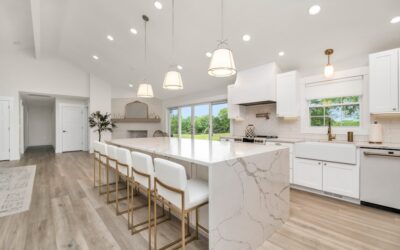
White countertops look simple on a sample board, yet the wrong white can make a kitchen feel cold, busy or dingy within a week. MSI white quartz colors cover a surprising spread, from near-solid sparkling whites to marble-look slabs with soft gray veins. All five covered here belong to MSI’s Q Premium Natural Quartz range, and all five list a cool white as their primary color, so the real choice comes down to pattern, sparkle, veining and thickness.
Part of our Countertops guide — explore the full guide →
Frost White, Iced White and Sparkling White sit in MSI’s modern style group, with low variation and a speckled or shimmering surface. Alabaster White and Calico White sit in the marble look group with subtle veins. If you want a countertop that disappears into a bright kitchen, start with the modern group. If you want something that reads as stone from across the room, start with the marble-look pair.
- MSI White Quartz Colors Compared
- The Modern Group: Frost White, Iced White and Sparkling White
- The Marble-Look Group: Alabaster White and Calico White
- How to Choose the Right White
- Care and Cleaning
- Fabrication and Silica Dust Safety
- Troubleshooting Common White Quartz Problems
- Cost Ranges and When to Call a Pro
- Frequently Asked Questions
Each color is profiled with its published specs, then paired with cabinet and backsplash ideas, care tips and practical notes on fabrication safety and cost.
MSI White Quartz Colors Compared
The specs in this table come from MSI’s own product pages. MSI lists every one of these as a polished finish with a cool white primary color. Slab sizes are given as MSI’s Jumbo and Super Jumbo categories rather than exact dimensions, and availability by thickness can change by region, so confirm with a local fabricator.
| Color | Look and pattern | Accent | Thickness options | Slab size |
|---|---|---|---|---|
| Frost White | Modern; shimmery white tones with a touch of sparkle, low variation | None listed | 1.5, 2 and 3 cm | Jumbo and Super Jumbo |
| Iced White | Modern; soft shades of white with delicate gray accents | None listed | 1.5, 2 and 3 cm | Jumbo and Super Jumbo |
| Sparkling White | Modern; whites with icy speckles, low variation | None listed | 1.5, 2 and 3 cm | Jumbo and Super Jumbo |
| Alabaster White | Marble look; soft white background with long, wispy gray veins | Light gray | 2 and 3 cm | Super Jumbo |
| Calico White | Marble look; snowy white with subtle veining, low variation | Light gray | 2 and 3 cm | Jumbo |
Two points stand out. First, the modern trio offers a thin 1.5 cm option, which can be useful for overlays, backsplashes and vanity tops. Second, Alabaster White is the only one listed in Super Jumbo alone, which helps on long islands where you want fewer seams through the veining.
The Modern Group: Frost White, Iced White and Sparkling White
These three suit kitchens where the countertop should support the cabinets and backsplash rather than lead the room. All three have low pattern variation, so seams are easier to hide and a remnant from one slab will usually match another closely.
Frost White
MSI describes Frost White as an elegant mix of shimmery white tones with a touch of sparkle. In person it reads as clean, bright and slightly reflective, with fine flecks that catch under-cabinet lighting. It is a forgiving choice for busy family kitchens because crumbs and light drips do not jump out the way they do on a flat, solid white. MSI also lists a 2 cm version made with less than 1 percent crystalline silica in limited availability, worth asking about if you prefer a lower-silica product.
Iced White
Iced White uses soft shades of white with delicate gray accents. It sits a touch calmer than Frost White because the gray specks soften the overall brightness. That small amount of gray helps it pair with gray cabinets, stainless appliances and cool-toned tile without looking stark.
Sparkling White
Sparkling White is the most reflective of the group, built around whites and icy speckles. It works well in powder rooms, bars and contemporary kitchens with flat-panel cabinets. In a traditional kitchen with raised-panel doors, the sparkle can feel out of place, so test a sample next to your door style before committing.
The Marble-Look Group: Alabaster White and Calico White
Homeowners who want the look of natural marble without the etching and staining risk often land on these two. Both use a cool white background with light gray accents, but the veining character differs.
Alabaster White
Alabaster White has long gray veins that MSI’s design notes describe as soft and wispy. The veins run across the slab rather than appearing as scattered dots, which gives it more movement than Calico White. That movement makes seam placement more important. Ask your fabricator to lay out the templates on the actual slab so veins flow across joints where possible.
Calico White
Calico White is a snowy white with subtle veining and low variation. It is the quieter of the two marble looks and a smart middle ground for buyers torn between a plain white and a veined slab. Because the veining is light, it pairs comfortably with patterned backsplash tile without creating visual competition.
How to Choose the Right White
Start by deciding how much pattern the room can handle. Then check undertones against the cabinets and floor. A short decision process:
- Count the patterned surfaces. If the floor, backsplash or cabinets already carry strong pattern or wood grain, pick one of the low-variation modern whites.
- Check cabinet undertones. All five are cool whites. Next to creamy or yellow-toned cabinets, they can look bluish. Hold a sample against an open cabinet door in daylight.
- Decide on veining. If you want stone character, choose Alabaster White for bold movement or Calico White for subtle movement.
- Plan seams. Long islands and L-shaped runs benefit from larger slabs and low-variation patterns.
- Choose thickness. Use 3 cm for most kitchen counters without a plywood subtop; 2 cm works with a built-up edge or for vanities; 1.5 cm suits overlays and wall cladding.
- View full slabs. Small samples cannot show vein spacing. Visit a slab yard and photograph the exact slabs you plan to use.
For cabinets, white quartz pairs easily with navy, sage, charcoal, black, natural oak and walnut. Gray cabinets work best with Iced White or Calico White because the gray accents tie the two together. Warm white or cream cabinets are the trickiest match, since cool white quartz can make them look yellow.
Care and Cleaning
Quartz is nonporous, so it does not need sealing. Daily care is warm water, a soft cloth and a little mild dish soap. A pH-neutral quartz countertop cleaner helps with fingerprints and streaks on the sparkling and shimmery colors, which show smudges more than matte surfaces.
- Use trivets for hot pans; high heat can scorch or discolor the resin in engineered quartz
- Avoid abrasive powders, scouring pads, bleach and harsh solvents
- Wipe up dyes, turmeric, coffee and red wine promptly on white slabs
- Use cutting boards; quartz resists scratches but dulls knives and can show marks from heavy impacts
- Do not stand or kneel on overhangs or unsupported sections
Fabrication and Silica Dust Safety
Engineered quartz typically contains a high percentage of crystalline silica. Cutting, grinding or polishing it releases fine respirable dust that can cause serious lung disease, including silicosis, with repeated exposure. That is the main reason quartz countertops should be cut and finished by professional fabricators who use wet cutting, local dust extraction and proper respirators.
If you need a small field modification, such as enlarging a sink or cooktop cutout, have the fabricator do it on site with water-fed tools and HEPA dust collection. Homeowners should not dry-cut quartz with a grinder or circular saw. If any cutting or drilling happens in your home, wear an N95 or better P100 respirator, keep children and pets out of the room, and clean up with a HEPA vacuum and damp wiping rather than sweeping. Ask your fabricator about lower-silica options such as the limited Frost White version if this concerns you.
Troubleshooting Common White Quartz Problems
Yellowing near the stove. This usually comes from heat exposure or a cleaner reacting with the resin. Use trivets every time and switch to a pH-neutral cleaner. Heat damage cannot be scrubbed off and may need professional repair.
Visible seams. Seams on low-variation colors should be tight and color-matched. A wide or uneven seam is an installation issue, so call the fabricator back while the job is still under their workmanship warranty.
Countertop looks blue or gray. Cool whites shift under cool LED lighting. Try warmer bulbs around 2700K to 3000K before deciding the color was wrong.
Haze or streaks. Residue from spray cleaners builds up on polished surfaces. Wipe with warm water, then buff dry with a microfiber cloth.
Cost Ranges and When to Call a Pro
Installed quartz countertops commonly fall in a broad range of about $50 to $120 per square foot, depending on region, slab size, thickness, edge profile and the number of cutouts. Marble-look colors with bookmatching or careful vein layout sometimes cost more than plain whites because of slab yield and fabrication time. Thicker 3 cm slabs usually cost more than 2 cm material.
Templating, fabrication and installation should always be handled by a professional fabricator. Quartz slabs are heavy, brittle across narrow sections and difficult to transport. A pro also confirms that base cabinets are level and strong enough, and that overhangs over roughly 10 to 12 inches have proper support brackets. Plumbing reconnection for the sink and faucet should be done by the installer or a licensed plumber.
Frequently Asked Questions
What is the whitest MSI quartz?
Among these five, Frost White and Sparkling White read as the brightest because they have no listed accent color and a reflective, speckled surface. Iced White and the marble-look colors carry light gray accents that soften the white.
Is MSI Calico White or Alabaster White better for a marble look?
Choose Alabaster White for long, wispy gray veins with more movement. Choose Calico White if you want a quieter, snowy white with subtle veining that is easier to pair with patterned tile.
Do MSI white quartz colors stain?
Quartz is nonporous and resists most stains, but strong dyes, turmeric and some markers can leave marks on white surfaces if left for long periods. Wipe spills promptly and avoid harsh chemicals.
Are MSI white quartz colors warm or cool?
MSI lists all five as cool white primary colors. Next to cream or yellow-toned cabinets they can look slightly blue, so compare samples in your own lighting.
What thickness should I choose for kitchen counters?
Most kitchens use 3 cm slabs because they need no plywood subtop. A 2 cm slab works for vanities or with a built-up edge, and 1.5 cm is best for overlays and backsplashes.
Can I cut quartz myself?
It is not recommended. Cutting quartz releases crystalline silica dust that can cause serious lung disease. Leave cutting and polishing to professional fabricators who use wet cutting and dust controls.