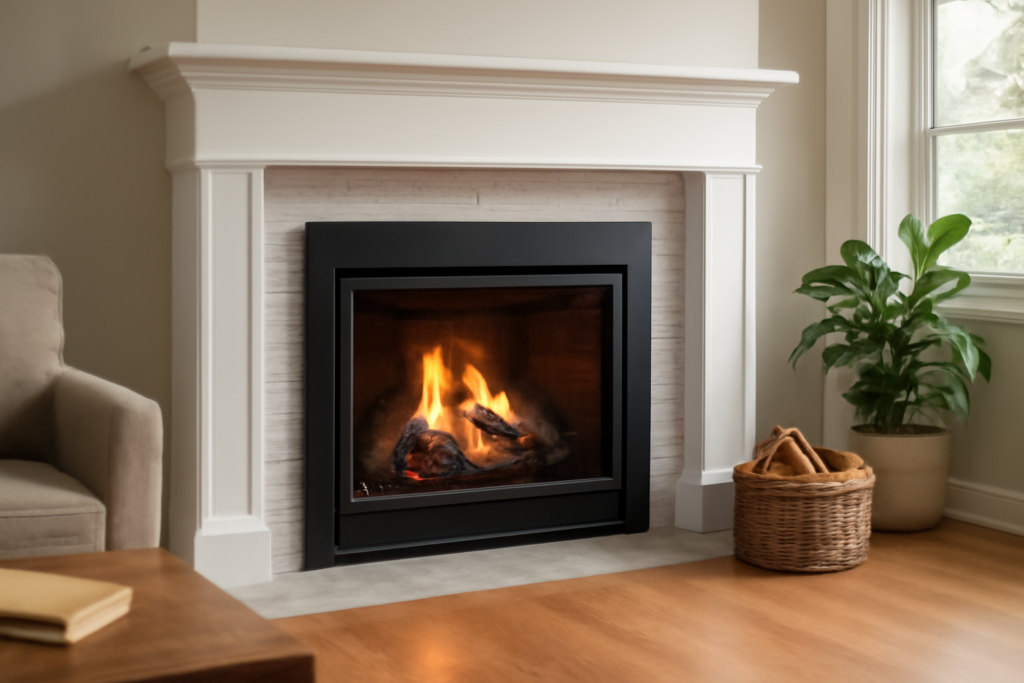
A Napoleon fireplace insert drops a sealed, high-efficiency firebox into your existing open masonry fireplace, turning a heat-losing hole in the wall into a 20,000-to-40,000-BTU heater. Napoleon is a Canadian manufacturer with a strong US dealer network, and its inserts split into two real appliance categories — gas and wood — each with its own venting, fuel, and maintenance.
Because a gas Napoleon fireplace insert is a genuine combustion appliance, it needs a gas line, direct-vent liner, a CO detector nearby, and annual professional service. This guide walks the real model lineups, BTU ranges, venting, and honest installed costs so you can spec the right unit.
- Gas vs. Wood: Pick Your Fuel First
- Napoleon Gas Insert Models
- Napoleon Wood Insert Models
- Venting: The Part People Skip
- Sizing to Your Opening and Your Room
- What It Costs Installed
- Installation and Who Should Do It
- Efficiency, Ratings, and Running Cost
- Design, Surrounds, and Finish Options
- Warranty and Buying From a Dealer
- Annual Maintenance
Gas vs. Wood: Pick Your Fuel First
Everything downstream depends on this choice. Gas inserts (natural gas or propane) light with a wall switch or remote, run 20,000 to 40,000 BTU, and hit 70 to 80 percent efficiency with direct-vent sealed combustion. Wood inserts burn cordwood, push 40,000 to 65,000 BTU, heat 1,200 to 2,500 square feet, and keep working in a power outage.
Go gas if you want convenience, a thermostat, and clean operation. Go wood if you want maximum heat, lower fuel cost where firewood is cheap, and off-grid capability. Napoleon builds strong options in both camps.
Napoleon Gas Insert Models
The gas lineup covers a wide firebox range. Common models worth knowing:
- Napoleon Inspiration ZC / GDIZC — a zero-clearance-friendly gas insert around 20,000 BTU, good for smaller openings and bedrooms.
- Napoleon 1101 / GDI3 series — mid-size direct-vent inserts in the 25,000 to 30,000 BTU range for typical 30-to-36-inch masonry openings.
- Napoleon XIR3 / XIR4 (Infrared X series) — larger inserts pushing 30,000 to 40,000 BTU with big viewing glass, sized for great rooms.
Most gas inserts ship with a millivolt or electronic ignition, a variable flame control, and an optional blower kit (110 to 150 CFM) that pushes warm air into the room. Confirm the fuel type — units are configured for natural gas or LP propane, and conversion kits must match the model.
Napoleon Wood Insert Models
On the wood side, Napoleon’s EPA-certified inserts are the draw:
- Napoleon 1101 / 1402 wood inserts — mid-to-large fireboxes taking logs up to 18 to 20 inches, heating roughly 1,000 to 2,000 square feet.
- Napoleon Timberwolf 2200i / 2100 — value-line EPA wood inserts with lower emissions and long burn times.
- Napoleon S-series (S20i, S25i) — cast-iron traditional-look inserts with large glass and 60,000-plus BTU peak output.
EPA 2020-certified units run cleaner (under 2.5 grams of particulate per hour on many models) and stretch burn times to 6 to 10 hours on a full load of seasoned hardwood.
Venting: The Part People Skip
You cannot drop an insert into an open flue and call it done. Both fuel types require a stainless liner run up your existing chimney:
- Gas direct-vent: a co-axial or twin-flex aluminum/stainless liner carries combustion air down and exhaust up, fully sealed from room air. This is what makes 70-to-80 percent efficiency possible.
- Wood: a rigid or flexible stainless liner (typically 6-inch diameter) runs from the insert flue collar to the chimney top, then gets insulated and capped.
Liner kits add $300 to $900 in materials plus labor. Skipping a proper liner causes poor draft, condensation, and — with gas — a real CO risk. A carbon monoxide detector within 10 feet of the appliance is required and just plain smart.
Sizing to Your Opening and Your Room
Measure the masonry opening: width and height at the front, depth to the back wall, plus width at the rear (fireboxes taper). Napoleon publishes minimum opening dimensions for each insert — a mid-size gas unit often needs about 28 inches wide, 21 inches tall, and 15 inches deep. Undersize the opening and the insert won’t fit; oversize it and you’ll rely on a flush or bay surround panel to close the gap.
For heat sizing, rough-figure 20 to 30 BTU per square foot in a moderate climate. A 25,000-BTU gas insert comfortably warms a 900-to-1,200-square-foot open zone; a 60,000-BTU wood insert can carry a 2,000-square-foot floor if the layout is open.
What It Costs Installed
Budget the whole project, not just the box:
- Gas insert unit: $1,800 to $4,500
- Wood insert unit: $1,500 to $4,000
- Stainless liner kit + insulation: $300 to $900
- Gas line run (if needed): $300 to $800
- Surround panel / trim kit: $150 to $400
- Professional installation + permit: $800 to $2,500
All-in, expect $3,500 to $8,000 for a fully installed gas or wood Napoleon fireplace insert. Get an itemized quote from a Napoleon dealer and confirm the liner and permit are included — those are the line items shady bids leave off.
Installation and Who Should Do It
This is not a DIY afternoon. A gas insert ties into a fuel line and must be leak-tested; a wood insert needs a code-compliant liner and clearance verification. Use a NFI- or WETT-certified installer (a licensed gas fitter for gas). A typical install runs 4 to 8 hours: liner drop from the roof, insert set and connected, gas or draft test, blower wiring to a nearby outlet, and surround trim. Pull the permit — insurance companies ask, and it protects resale.
Efficiency, Ratings, and Running Cost
Efficiency is where an insert earns its keep. An open masonry fireplace is often a net heat loss — it pulls warm room air up the chimney faster than it radiates heat back. A direct-vent gas insert flips that math, delivering steady-state efficiency of 70 to 80 percent and holding a room at a set temperature with a thermostat or remote. EPA-certified wood inserts reach 70-plus percent combustion efficiency while cutting particulate emissions dramatically.
On running cost, natural gas is usually the cheapest convenient fuel. A 30,000-BTU gas insert burning at full output uses roughly 0.3 therms per hour; at $1.20 per therm that’s about $0.36 an hour, or a few dollars an evening. Propane costs more per BTU. Cordwood varies wildly by region — cheap or free if you have a woodlot, pricey if you buy seasoned hardwood by the cord ($200 to $400 delivered). Factor a blower’s modest electric draw (under 100 watts) into either.
Design, Surrounds, and Finish Options
Napoleon inserts aren’t just a heat box — the face changes the room. Most models accept multiple surround sizes (small, medium, large flush kits) to close the gap between the insert and your masonry opening. You can dress the face with:
- Traditional cast-iron surrounds in black, or porcelain finishes.
- Contemporary flush fronts with clean rectangular glass.
- Interior media on gas units — driftwood-look logs, glass beads, or river rock.
- Optional LED accent lighting and interior brick or reflective panels.
Pick the surround before install so the dealer orders the right trim kit; retrofitting a larger surround later means pulling the unit.
Warranty and Buying From a Dealer
Napoleon backs its inserts with strong warranties — many gas and wood models carry a limited lifetime warranty on the firebox and heat exchanger, with shorter coverage on electrical components, blowers, and glass. That coverage generally requires purchase and installation through an authorized dealer with a documented professional install. Buying a gray-market unit online to self-install can void it. Work with a local Napoleon dealer: they size the unit to your opening, handle the permit, verify liner and clearance code, and register the warranty. The price premium over a bare online box usually disappears once you account for the liner, gas work, and the coverage you keep.
Annual Maintenance
Keep it safe and efficient with a yearly service before the heating season:
- Gas: a technician cleans the burner and pilot assembly, checks the thermocouple/thermopile, inspects the glass gasket, verifies venting, and confirms the CO detector works. Budget $150 to $250.
- Wood: sweep the liner, inspect the door gasket and baffle, and burn only seasoned wood under 20 percent moisture to prevent creosote. A chimney sweep runs $150 to $350.
Do that every year and a Napoleon insert delivers reliable, efficient heat for 15 to 20 years. Match the model to your opening and fuel, insist on a proper liner, and keep the CO detector fresh — those three moves separate a great install from a callback.