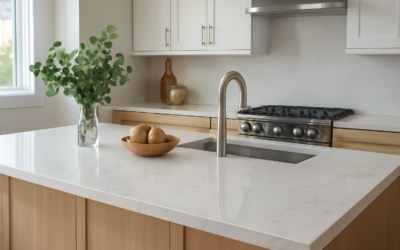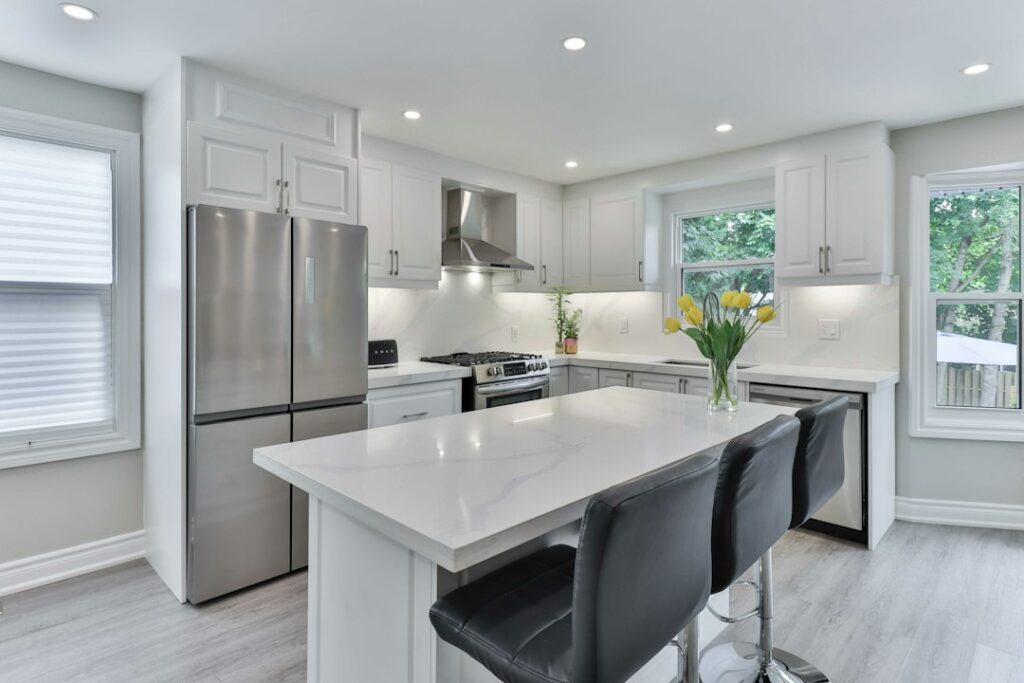
Many homeowners want the soft, flowing look of white marble without the constant worry about etching and scratches. Perla Venata quartzite is one of the natural stones people turn to for that look. It is generally sold as a light stone with a creamy white to pearl gray background and soft, wispy veins in gray and taupe, sometimes with hints of warmer beige. The name itself points to the look: “perla” suggests a pearly sheen and “venata” means veined.
Part of our Countertops guide — explore the full guide →
True quartzite is a metamorphic rock formed when sandstone is heated and compressed, which fuses the quartz grains into a dense, hard stone. That gives it better scratch and heat resistance than marble and makes it a strong choice for kitchen countertops, islands and bathroom vanities. Like every natural stone, though, it still needs sealing and sensible daily care.
- Perla Venata Quartzite at a Glance
- How It Looks in a Real Kitchen
- Cabinet and Backsplash Pairings
- Testing a Sample Before You Buy
- Daily Care and Sealing
- Cutting and Dust Safety
- Troubleshooting Common Problems
- General Cost Ranges
- Edge Profiles and Thickness
- When to Call a Pro
- Frequently Asked Questions
One caution up front: stone names are not standardized, and slabs sold under the same name can vary a lot from one quarry block to the next. Some slabs sold as quartzite behave more like marble. Always see the actual slab you will receive and test a sample before you commit.
Perla Venata Quartzite at a Glance
These are the traits most buyers ask about when they look at Perla Venata quartzite. Treat the numbers as typical for the stone type and confirm details for your specific slabs with the fabricator.
| Spec | Typical value | What it means |
|---|---|---|
| Stone type | Natural quartzite | Metamorphic stone made mostly of quartz |
| Background color | Creamy white to pearl gray | Bright, soft look that suits light kitchens |
| Veining | Soft gray and taupe, sometimes warm beige | Flowing, marble-like movement |
| Hardness | Around 7 on the Mohs scale for true quartzite | Resists scratches from knives and daily use better than marble |
| Common thickness | 2 cm or 3 cm slabs | 3 cm is common for kitchens without a buildup edge |
| Finishes | Polished, honed, leathered | Polished shows depth; honed and leathered hide smudges |
| Sealing | At install, then about every 1 to 2 years | Reduces staining risk; test with water drops |
| Installed cost | Mid to upper range for natural stone | Varies with slab quality, edge and region |
How It Looks in a Real Kitchen
On a full slab, the stone usually reads light and calm. The veins tend to drift across the surface rather than forming bold, high-contrast lines, which makes it easy to live with in a large kitchen. Under warm bulbs, the creamy tones and beige hints come forward. Under cool daylight, the gray veining becomes more visible and the stone looks cooler and crisper.
Because veining patterns differ between slabs, visit the stone yard and choose your own pieces. Ask the fabricator to lay out templates on the slab so you can see where the most attractive movement will land on the island, around the sink and along the backsplash. Bookmatching, where two adjacent slabs are mirrored, can create a dramatic look on an island waterfall or a full-height backsplash.
Cabinet and Backsplash Pairings
The soft palette of Perla Venata quartzite pairs with a wide range of cabinet colors. Choose based on how much you want the stone to blend in or stand out.
Cabinet Colors
- White and warm white cabinets: a bright, airy kitchen where the veining becomes the main pattern.
- Light gray or greige cabinets: a tonal look that picks up the gray veins.
- Navy or deep green cabinets: strong contrast that makes the stone look brighter.
- Natural oak or walnut: warm wood draws out the beige and taupe notes.
- Black or charcoal islands: a dramatic anchor when the perimeter stays light.
Backsplash Ideas
- Full slab backsplash: continues the stone up the wall for a high-end, uninterrupted look.
- White glossy subway or handmade-look tile: a classic pairing that lets the counter lead.
- Soft gray zellige-style tile: adds texture without fighting the veining.
- Small white or cream mosaic: works well in bathrooms with this stone on the vanity.
For hardware, brushed brass and warm gold pick up the beige tones, while polished nickel or matte black give a cleaner, cooler look. Bring a sample of your cabinet door and tile to the stone yard so you can see everything together.
Testing a Sample Before You Buy
Because names vary and some softer stones get sold as quartzite, a few simple tests on a sample piece help you know what you are buying.
- Scratch test: try to scratch an unpolished edge with a steel knife or a glass bottle edge. True quartzite resists scratching; a stone that scratches easily may be marble or dolomite.
- Etch test: place a few drops of lemon juice or vinegar on the sample for about 10 to 15 minutes, then wipe. A dull spot means the stone contains calcite and will etch.
- Absorption test: drip water on the surface and watch for 10 to 30 minutes. If it darkens quickly, the stone is porous and needs sealing.
- Light test: view the sample in your kitchen at different times of day to confirm the color works.
Daily Care and Sealing
Quartzite is tough, but it is still natural stone. Good habits keep it looking new for decades.
- Wipe daily with warm water and a mild dish soap or a pH-neutral stone cleaner.
- Blot spills quickly, especially oil, wine, coffee and tomato sauce.
- Avoid bleach, ammonia, vinegar and abrasive powders, which can dull the sealer and the finish.
- Use trivets for very hot pans and cutting boards for knife work to protect the finish.
- Do not stand or sit on unsupported overhangs or sink edges.
Seal the stone at installation and then reapply a granite and quartzite sealer as needed, often every 1 to 2 years. To check, drip water on the surface: if it beads, the seal is working; if it soaks in and darkens the stone within a few minutes, it is time to reseal.
How to Reseal
- Clean the surface and let it dry fully, ideally overnight.
- Ventilate the room and wear gloves as the sealer label directs.
- Apply sealer evenly with a clean cloth or foam applicator, working in sections.
- Let it penetrate for the time on the label, usually several minutes.
- Wipe away all excess before it dries to avoid a hazy film.
- Allow the cure time on the label before heavy use.
Cutting and Dust Safety
Quartzite contains a high level of crystalline silica. Cutting, grinding or polishing it creates fine dust that can cause serious lung disease when inhaled. Fabrication belongs in a shop with wet cutting tools and dust control. If you ever need to make a small cut or drill a faucet hole at home, use wet cutting methods, wear a properly fitted N95 or P100 respirator and eye protection, and clean up with a HEPA vacuum rather than sweeping. Never dry-cut the stone indoors.
Troubleshooting Common Problems
- Dark spots after spills: often oil absorption. A poultice made for stone can draw it out; reseal afterward.
- Dull or etched rings: suggests a stone with calcite content. A stone restoration pro can hone and polish the area.
- Hazy film: leftover sealer. Rub with a little more sealer to reactivate it, then buff dry.
- Chipped edge: keep the chip and call the fabricator; small repairs with color-matched resin are common.
General Cost Ranges
Perla Venata quartzite usually falls in the middle to upper range of natural stone pricing. The final installed cost depends on slab quality and size, thickness, edge profile, sink cutouts, backsplash height and local labor rates. Mitered edges, waterfall islands and full slab backsplashes add both material and fabrication time. Ask for an itemized quote that lists slab cost, fabrication, installation and sealing separately.
Edge Profiles and Thickness
The edge you choose changes both the look and the price. A simple eased or slightly rounded square edge suits modern and transitional kitchens and is the most chip resistant. A full bullnose or ogee gives a more traditional look but adds fabrication time. A mitered edge, where a strip of stone is joined at 45 degrees, makes a 3 cm slab look much thicker and is popular on islands. Choose 3 cm slabs for most kitchens and keep 2 cm material for vanities or projects with a built-up edge.
When to Call a Pro
Countertop fabrication and installation should always be done by an experienced stone fabricator. Slabs are heavy and fragile until installed, cutting requires wet saws and dust control, and seams need careful color matching. Call a stone restoration specialist for etch removal, deep stains or re-polishing.
Frequently Asked Questions
What does Perla Venata quartzite look like?
It typically has a creamy white to pearl gray background with soft gray and taupe veining, sometimes with warm beige hints. Slabs vary, so view the actual pieces.
Is Perla Venata quartzite good for kitchens?
Yes, true quartzite is hard and heat resistant, which suits kitchens. Seal it and wipe spills promptly to prevent stains.
Does Perla Venata quartzite etch?
True quartzite resists etching, but some slabs sold under quartzite names contain calcite. Do an acid test on a sample to be sure.
How often should I seal it?
Seal at installation and then about every 1 to 2 years, or whenever water stops beading on the surface.
What cabinet colors go with Perla Venata?
White, light gray, navy, deep green and natural wood all work well. Warm woods bring out the beige tones, while navy adds contrast.