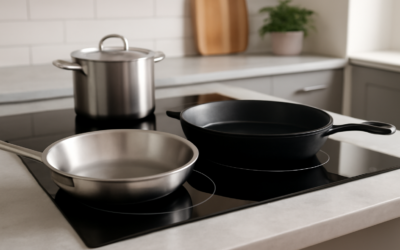
A Samsung induction cooktop is a built-in 240-volt glass cooking surface that heats magnetic cookware directly, giving you the speed of induction with brand-specific tricks like Virtual Flame lighting and Rapid Boil power boosting. Whether you are replacing a tired electric coil range or spec’ing a new kitchen, a Samsung induction cooktop delivers restaurant-fast boils, precise low simmers, and a wipe-clean surface that stays cool around the pan.
- The Two Sizes That Matter
- What the Signature Features Actually Do
- Understanding kW and Burner Power
- The Electrical Requirements
- Cookware: Magnetic or Nothing
- Installation and Fit
- Living With One Day to Day
- Flex Zone and Bridge Cooking
- Comparing Samsung to Other Brands
- Strengths and Trade-Offs
- Is It Right for You
The Two Sizes That Matter
Samsung’s built-in induction line centers on two footprints. The NZ30 series is the 30-inch cooktop, and the NZ36 series is the 36-inch. Both drop into a standard countertop cutout and connect to a 240-volt circuit. The 30-inch typically carries four burners; the 36-inch adds a fifth, usually a flexible center or bridge zone for a griddle.
NZ30K7880 and NZ30M9880 (30-inch)
These four-element models fit the most common cabinet opening. Cutout dimensions run roughly 28.75 inches wide by 19.4 inches deep. You will find a high-power boost burner around 3.2 to 3.6 kW alongside smaller 1.5 to 2.2 kW zones. Pricing lands around $1,600 to $2,200.
NZ36K7880 and NZ36M9880 (36-inch)
The 36-inch models give you five zones and a larger cooking area, useful for big pots and simultaneous cooking. The flex zone can pair two elements to power a bridge for a long griddle or fish pan. Expect $2,000 to $2,800, with cutouts near 34.9 inches wide.
What the Signature Features Actually Do
Virtual Flame
Induction gives no visible cue that a burner is on, which unsettles cooks used to gas. Samsung’s Virtual Flame projects LED lights up onto the base of the pan that brighten and dim with the power level, mimicking a gas flame. It is a genuine safety and intuition aid, not just a gimmick, because you can read at a glance how hard each zone is working.
Rapid Boil / Power Boost
Rapid Boil temporarily borrows extra wattage to a chosen burner, pushing it to its peak of around 3.3 to 3.6 kW so a large pot of water reaches a boil in a few minutes. This borrowing is why total connected load matters: the cooktop shares its overall power budget across zones, so running two boost burners at once may cap each below its solo maximum.
Wi-Fi and SmartThings
Higher trims connect to Samsung’s SmartThings app for timers, alerts, and remote status. It is convenient for monitoring a timer from another room, though the cooking still happens at the knob.
Understanding kW and Burner Power
Induction burners are rated in kilowatts, not BTU, and the number tells you the maximum heat delivered to the pan. A 3.6 kW boost element roughly equals a very strong 18,000 BTU gas burner in real-world boil speed, but with far less wasted heat because roughly 85 percent of the energy reaches the food. A 1.5 kW simmer zone holds chocolate or a delicate béarnaise without scorching. Match the burner to the pot: big pasta pot on the boost zone, small saucepan on a smaller element.
The Electrical Requirements
This is where induction differs sharply from a portable plug-in. A Samsung induction cooktop is hardwired or connected to a 240-volt circuit, typically requiring a 40-amp or 50-amp breaker depending on the model’s total connected load. The 36-inch units especially demand the larger circuit. Check the installation manual for the exact amperage and wire gauge; a 40-amp circuit needs 8-gauge copper, a 50-amp needs 6-gauge.
If you are converting from gas, you do not have this circuit and will need an electrician to run new wiring from the panel, plus panel capacity to support it. Budget $300 to $800 for the electrical work on top of the cooktop. Do not attempt to run one of these on a 30-amp dryer circuit; it will nuisance-trip or worse.
Cookware: Magnetic or Nothing
Every induction cooktop, Samsung included, only heats ferromagnetic pans. Test with a magnet: cast iron, enameled cast iron, carbon steel, and magnetic stainless work; aluminum, copper, and non-magnetic stainless do not. Flat-bottomed pans couple best. If your current set is aluminum or copper, factor new cookware into your budget. Samsung’s larger flex zones also want pans wide enough to be detected, so a tiny 4-inch butter warmer may not register.
Installation and Fit
Samsung induction cooktops are drop-in units that rest on the countertop over a cutout, sealed with a gasket. You need adequate depth in the cabinet below and, on many models, a minimum clearance to any drawer or oven beneath for ventilation of the cooling fans. Confirm the cutout dimensions against your specific model, because the 30-inch and 36-inch templates differ and there is little margin. A backsplash-to-front reach of about 21 inches of counter depth is typical.
Living With One Day to Day
- Cleaning: Spills land on cool glass around the pan and wipe off. Use a ceramic-cooktop cleaner for any burnt residue and a plastic scraper for stuck sugar. Never let sugary spills cool on a hot zone.
- Noise: Induction can hum or buzz at high power, especially with lighter pans, and the internal fan runs during and after cooking. Heavy cast iron is quieter than thin clad pans.
- Responsiveness: Turn it down and the heat drops instantly, like gas, unlike a slow electric coil.
- Pacemakers: Manufacturers advise anyone with an implanted medical device to check with a doctor, since induction generates a magnetic field.
Flex Zone and Bridge Cooking
The five-element NZ36 models include a flex or bridge zone, and it is worth understanding because it changes how you use the cooktop. Two adjacent elements electronically link to act as one long cooking area, sized for a rectangular griddle or a fish poacher that would straddle two separate burners on a conventional range. You control the linked pair from a single touch slider. This flexibility is a genuine advantage for anyone who cooks with oversized pans, and it is a feature gas ranges cannot easily match because gas burners are fixed in place.
On the four-burner NZ30 models you give up the bridge but keep the boost element, which for most households is the more useful of the two. Decide based on how often you actually cook with a griddle or an oversized roasting pan.
Comparing Samsung to Other Brands
Samsung competes against Bosch, GE Profile, and Frigidaire in the built-in induction space. Where Samsung differentiates is Virtual Flame and SmartThings integration, plus aggressive pricing on the mid-tier NZ30 relative to European brands. Bosch tends to run quieter and offers FlexInduction of its own; GE Profile pushes synchronized elements and strong service networks. Samsung’s value proposition is the feature set at the price, and if you already run a Samsung refrigerator or wall oven, the matching stainless finish and app ecosystem are a real convenience. None of that changes the physics: all induction heats magnetic pans fast and cleanly, so the decision often comes down to price, finish, and which brand your local servicer supports.
Strengths and Trade-Offs
The strengths are real: fast boils, precise instant control, a cool and easy-clean surface, and no combustion byproducts in the kitchen. The trade-offs are the upfront cost of the unit, the 240-volt wiring, and the need for magnetic cookware. The glass surface can also chip or crack if you drop a heavy pot, and a cracked induction top must be replaced, not repaired.
Is It Right for You
A Samsung induction cooktop makes sense if you want gas-like control without gas, value fast boiling and easy cleanup, and either already have or can add a proper 240-volt circuit. Pick the NZ30 for a standard four-burner kitchen or the NZ36 if you cook big and want a five-zone layout with a bridge. Verify your cutout, confirm the amperage with an electrician, check your cookware with a magnet, and you will have a cooktop that performs like professional equipment in a home kitchen.