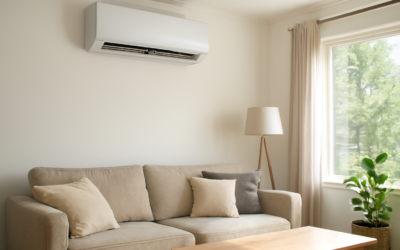
A 9000 BTU mini split is a compact three-quarter-ton ductless heat pump sized to heat and cool roughly 350 to 450 square feet, making it the go-to choice for bedrooms, home offices, small apartments, sunrooms, and garage workshops. It’s the most popular single-room capacity in the ductless world, and this guide covers exactly what it fits and how to install one.
- What 9,000 BTU Means
- What Size Space It Fits
- Perfect for Single Rooms
- Don’t Oversize a Small Room
- Inverter Efficiency and Quiet Operation
- Voltage and Electrical Needs
- Efficiency and Cold-Climate Ratings
- What It Costs
- Installation and Safety
- 9,000 BTU vs. a Window Air Conditioner
- Operating Costs and Efficiency
- Maintenance and Cleaning
- Is a 9,000 BTU Mini Split Right for You?
What 9,000 BTU Means
BTU (British Thermal Units per hour) measures how much heat the unit can move. At 9,000 BTU, this is a 0.75-ton system, since one ton equals 12,000 BTU. It sits at the small end of the residential ductless range, below the common 12,000 BTU (1-ton) and 24,000 BTU (2-ton) units. That modest capacity is exactly what makes it ideal for individual rooms, where a larger unit would be oversized and inefficient.
What Size Space It Fits
Using a guide of 20-30 BTU per square foot depending on climate and insulation, a 9,000 BTU unit fits:
- Well-insulated, mild climate: up to 450 square feet.
- Average room: 300-400 square feet.
- Poorly insulated or extreme climate: 250-350 square feet.
A typical bedroom (150-250 square feet) or a home office is comfortably within range, often with capacity to spare, which helps with humidity control and quiet part-load operation.
Perfect for Single Rooms
The 9,000 BTU size shines in additions and problem rooms that the central system can’t reach or that run hot or cold. Common applications include:
- A converted garage or bonus room over the garage.
- A sunroom that overheats in summer and chills in winter.
- A home office or nursery needing independent temperature control.
- A primary bedroom you like cooler than the rest of the house.
Because it’s ductless and zoned, you condition only the room you’re using, which saves energy versus running central air for the whole home.
Don’t Oversize a Small Room
Matching capacity to the room matters even more at small sizes. Putting a 12,000 or 18,000 BTU unit in a 250-square-foot bedroom causes short-cycling: it cools the air fast, shuts off before removing humidity, and leaves the space cold and damp while wearing out the compressor. A correctly sized 9,000 BTU unit runs longer at low inverter speed, staying quiet, efficient, and comfortable. For a genuinely small room, don’t reach for more BTU than the space needs.
Inverter Efficiency and Quiet Operation
Small mini splits benefit especially from inverter compressors, which vary their speed rather than cycling fully on and off. In a bedroom, this means the unit settles into a low, steady hum, often as quiet as 19-25 decibels on the indoor head, quiet enough to sleep through. The variable speed also holds the room temperature within a degree of your setpoint instead of swinging warm and cool. This precise, whisper-quiet comfort is a big reason homeowners choose a 9,000 BTU mini split over a noisy window air conditioner that cycles loudly all night.
Voltage and Electrical Needs
Many 9,000 BTU mini splits run on standard 120-volt power, which is a real advantage since a smaller room may already have a suitable circuit nearby, though the unit still needs its own dedicated circuit (typically 15 amps) and a disconnect within sight of the outdoor condenser. Some models use 240 volts. A licensed electrician should confirm the requirement, run the dedicated circuit, and install the disconnect, and most areas require a permit. Don’t share an existing circuit with other loads, since the compressor’s startup draw will trip breakers.
Efficiency and Cold-Climate Ratings
Check the SEER2 (cooling) and HSPF2 (heating) numbers. Quality 9,000 BTU inverter units range from about 19 to 25 SEER2, and small units often post the highest efficiency ratings in a brand’s lineup. If you’ll use it for winter heat, choose a cold-climate (hyper-heat) model that holds capacity down to 5 degrees Fahrenheit or lower. Mitsubishi, Daikin, Fujitsu, and LG lead on performance, while Senville, Pioneer, and MRCOOL offer strong value.
What It Costs
Pricing for a 9,000 BTU system:
- Equipment only: $700-$1,600 depending on brand and efficiency.
- Professional install: $3,000-$5,000 total installed.
- DIY pre-charged kit: $900-$1,800 plus electrician cost.
It’s the most affordable mini split capacity, and federal 25C tax credits and utility rebates can offset qualifying high-efficiency models.
Installation and Safety
Installation involves mounting the indoor head, a 3-inch wall penetration for the line set, siting the outdoor condenser, and the electrical work. The refrigerant line connection, vacuum, and charge legally require an EPA-608 certified technician unless you use a pre-charged DIY kit with quick-connect lines. Never open or charge the refrigerant circuit without certification; an improper charge or moisture in the lines is the top cause of premature compressor failure. Even with a DIY kit, have a licensed electrician handle the dedicated circuit and pull any required permit.
9,000 BTU vs. a Window Air Conditioner
Many buyers weigh a 9,000 BTU mini split against a cheaper window unit of similar capacity, and the differences are significant. A mini split heats as well as cools, runs far quieter, is more energy-efficient thanks to its inverter compressor, and doesn’t block a window or compromise security. It also looks cleaner and doesn’t drip or rattle. The trade-off is cost and installation: a window AC is a $250-$400 plug-and-play purchase, while the mini split runs several thousand dollars installed. If you want year-round comfort, quiet operation, and lower running costs in a room you use daily, the mini split wins; for a rarely used room or a short-term rental, a window unit may make more sense.
Operating Costs and Efficiency
A 9,000 BTU inverter mini split is one of the most efficient ways to condition a single room, and small units often post the highest SEER2 numbers in a brand’s lineup. Because it varies its output instead of cycling on and off, it avoids the energy spikes of a window unit and sips power once the room reaches setpoint. Actual cost depends on your electricity rate and runtime, but conditioning just one occupied room rather than the whole house through central air saves noticeably over a season. Using the unit’s scheduling or app controls to ease back the temperature when the room is empty trims the bill further without sacrificing comfort when you return.
Maintenance and Cleaning
A 9,000 BTU mini split is easy to maintain, which helps it reach 15-20 years of service. Pop out the washable indoor filters every few weeks during heavy use, rinse them, and let them dry fully before reinstalling, since a dirty filter is the top cause of weak airflow and lost efficiency. Once or twice a year, gently clean the indoor coil and blower wheel to head off mold and the musty smell it causes, and wipe down the housing. Outside, keep the small condenser clear of leaves, grass clippings, and snow drifts, and make sure the condensate drain line stays clear so it doesn’t back up. A quick professional check of the refrigerant charge every couple of years rounds out the routine and keeps the unit sipping power. Skipping filter cleaning is the number-one reason a mini split underperforms, so if the room stops cooling or heating as well as it used to, pull and rinse the filters first before assuming anything more serious is wrong with the unit.
Is a 9,000 BTU Mini Split Right for You?
If you need efficient, independent heating and cooling for a single room, bedroom, office, garage, or sunroom, up to about 450 square feet, a 9000 BTU mini split is the right-sized, budget-friendly choice. Size it to the room rather than oversizing, pick a high-SEER2 or cold-climate model to match your climate, and confirm the voltage and dedicated circuit with a licensed electrician. Installed correctly, a three-quarter-ton ductless unit delivers quiet, zoned comfort for 15-20 years at a low running cost.