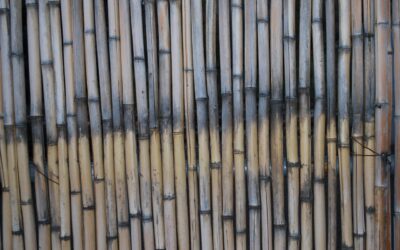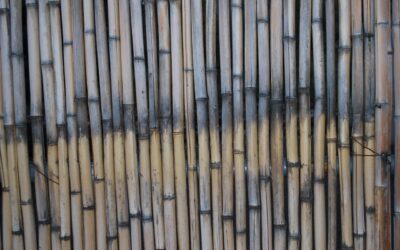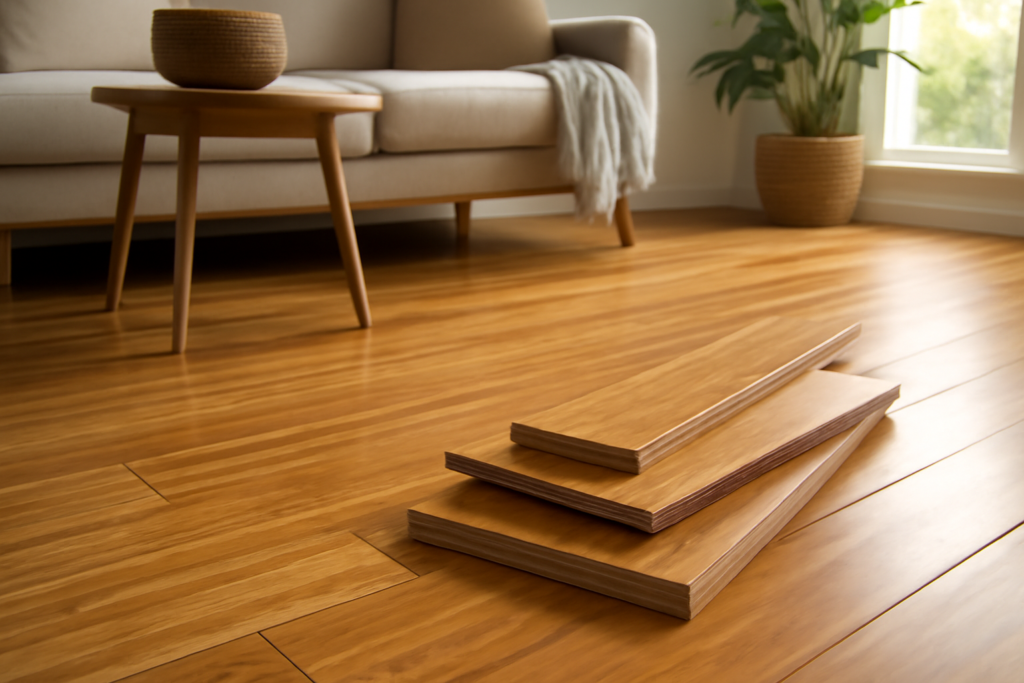
If you want the warmth of real wood with better dimensional stability than solid planks, bamboo engineered hardwood flooring deserves a hard look. It fuses a dense bamboo wear layer to a plywood or HDF core, giving you a floor that shrugs off the seasonal humidity swings that make solid hardwood cup and gap. It works in basements, over radiant heat, and in coastal homes where solid oak would telegraph every change in the weather.
That said, not all bamboo flooring is created equal, and the marketing rarely tells the whole story. Below is a breakdown of what you actually get for your money, where this material shines, and the failure modes that catch homeowners off guard.
What Engineered Bamboo Flooring Actually Is
Bamboo is technically a grass, not a hardwood, but strand-woven bamboo is denser than most true hardwoods. Manufacturers shred the bamboo stalks, saturate the fibers with resin, and compress them under roughly 3,000 pounds per square inch of pressure. The result is a wear layer that hits 3,000 to 5,000 on the Janka hardness scale, compared to about 1,290 for red oak and 1,820 for hard maple.
In an engineered product, that dense bamboo top is bonded to a multi-ply substrate, usually 3 to 7 plies of birch, poplar, or eucalyptus plywood. The cross-grain construction is what buys you stability. A typical plank runs 1/2 inch to 5/8 inch thick overall, with a bamboo wear layer of 2 to 4 millimeters. That wear layer thickness matters enormously, because it determines whether you can ever sand and refinish the floor.
The Real Advantages
Stability is the headline benefit. Because the core resists expansion and contraction, you can install engineered bamboo in below-grade basements and over concrete slabs where solid tongue-and-groove flooring is a bad bet. Most manufacturers also warranty their engineered lines for use over hydronic radiant heat as long as the surface temperature stays below 84°F, something almost no solid bamboo product allows.
Hardness is the second draw. A strand-woven wear layer at 3,000-plus Janka resists dog claws, dropped skillets, and dragged furniture far better than pine or walnut. In a busy household with kids and pets, that toughness translates to fewer dents over a 10-year window. Bamboo also matures in 5 to 7 years versus 40 to 60 for oak, so it carries a genuine sustainability story if the product is FSC-certified and uses low-emission adhesives.
Price rounds out the case. Quality engineered bamboo runs $3 to $6 per square foot for materials, with premium wide-plank and hand-scraped lines reaching $7 to $8. Installed, budget $6 to $11 per square foot including labor at $2 to $4. That undercuts most engineered oak of comparable thickness by roughly 15 to 25 percent.
The Drawbacks You Need to Weigh
Moisture is still the enemy. Engineered bamboo tolerates humidity swings, but it is not waterproof. Standing water from a dishwasher leak or an overflowing tub will swell the core and lift the finish if it sits for more than a few hours. In a full bathroom or laundry room, luxury vinyl or tile is the better choice.
Refinishing is limited. With only 2 to 4 millimeters of wear layer, you get at most one light sanding over the floor’s life, and many thin-veneer products can never be sanded at all. Once the aluminum-oxide factory finish wears through in a traffic lane, your only real fix is a screen-and-recoat or board replacement. Denting is also possible despite the hardness rating, because carbonized bamboo, which is heat-treated to a caramel color, loses 15 to 30 percent of its hardness during that darkening process.
Off-gassing deserves attention. Cheap imported bamboo has a history of formaldehyde emissions from the binding resins. Insist on products that meet CARB Phase 2 or TSCA Title VI standards, and look for FloorScore or GreenGuard Gold certification. Paying an extra 50 cents per square foot for a verified low-VOC line is cheap insurance for your indoor air quality.
Natural vs. Carbonized vs. Strand-Woven
Color and durability are linked in bamboo, and understanding the three main types prevents an expensive mismatch. Natural bamboo keeps its pale blond tone and retains full hardness because it skips the heat treatment. Carbonized bamboo is steamed to produce amber and coffee tones, but as noted, that heat softens the fibers, so it is better suited to bedrooms than entryways.
Strand-woven is the construction method rather than a color, and it is the type to choose for anything resembling a high-traffic area. Because the fibers are shredded and recompressed rather than laminated in horizontal or vertical strips, strand-woven planks hide their grain seams and resist splitting. If you see a bargain “horizontal grain” bamboo at $2 per square foot, know that it dents and delaminates far more readily than a strand-woven product.
Installation Methods and What They Cost
Engineered bamboo installs three ways, and the method affects both cost and feel underfoot. Floating installation with a click-lock profile is the fastest, requiring only a 6-mil vapor barrier or a combination underlayment. A confident DIYer can float 300 square feet in a weekend, saving the $2 to $4 per square foot in labor.
Glue-down over concrete gives the most solid, quiet result and is the better choice for large open-plan spaces where a floating floor can feel hollow. Budget an extra $40 to $60 per 4-gallon pail of moisture-barrier urethane adhesive, which covers roughly 200 square feet. Nail-down over plywood subfloors works with thicker 5/8-inch engineered planks using 18-gauge cleats every 6 to 8 inches. Whatever the method, let the flooring acclimate in the room for 72 hours at 60 to 80°F and 30 to 50 percent relative humidity before you lay a single board.
Maintenance and Long-Term Care
Living with an engineered bamboo floor is easy if you respect its moisture limits. Sweep or dust-mop a few times a week to keep grit from abrading the aluminum-oxide finish, and damp-mop with a pH-neutral wood cleaner rather than water, vinegar, or a steam mop. Never let a steamer touch the floor, because the 200°F-plus vapor drives moisture through the finish and swells the core, a mistake that voids most warranties and costs $4 to $8 per square foot to repair.
Protect the surface proactively. Felt pads under furniture legs, walk-off mats at every entry, and a no-shoes policy in the busiest rooms cut down the fine scratching that dulls any wood floor over time. Keep your indoor relative humidity between 30 and 50 percent year-round with a humidifier in winter and air conditioning or a dehumidifier in summer; that single habit prevents the small gapping and edge-lifting that plague floors in homes with wild humidity swings. Wipe spills within minutes rather than hours, and your floor will hold its factory look for well over a decade.
How Bamboo Compares to Engineered Oak
Buyers almost always cross-shop engineered bamboo against engineered oak, and the honest verdict is that each wins on different fronts. Bamboo is harder, cheaper by 15 to 25 percent, and matures far faster, so it carries the stronger sustainability and durability story on paper. Strand-woven bamboo at 3,000-plus Janka simply dents less than a 1,290-Janka oak veneer in a house full of dogs and children.
Oak, on the other hand, offers a broader palette of stains, a grain that most Americans instinctively read as “real wood,” and a deeper resale familiarity. If you want the widest design range and the most conventional look, oak edges ahead; if you prioritize hardness, price, and eco-credentials, bamboo pulls in front. Neither is objectively better, so let your room, budget, and taste settle it.
How to Shop Without Getting Burned
Focus on three numbers when comparing products. First, wear-layer thickness: 3 millimeters or more if you ever want the option to refinish. Second, the finish warranty, where 25 years residential is standard and anything under 15 signals a thin coating. Third, the total plank thickness, since a 1/2-inch plank over a proper core feels far more solid than a 3/8-inch budget board.
Order 8 to 10 percent extra to cover cutting waste and future repairs, and buy it all from the same production lot to avoid shade variation. Ask the retailer for the emissions certification in writing, and if they cannot produce it, walk away. A well-chosen strand-woven engineered floor will give you 20 to 25 years of service, and with the right product and prep, bamboo engineered hardwood flooring delivers most of the look and feel of premium oak at a meaningfully lower price.
For most homeowners weighing durability, sustainability, and budget together, engineered bamboo lands in a genuine sweet spot. Just match the product to the room, verify the certifications, and respect its one weakness, standing water, and it will reward you for two decades.
Prefer to explore on your own?
See how new flooring looks in your actual room in seconds — free, no signup.
Try the free Floor Studio →