Marble has been the symbol of luxury for millennia, but its price, softness, and staining make it a nervous choice for a busy home. Enter faux marble tile: porcelain and ceramic that captures the dramatic veining and cool elegance of Carrara or Calacatta while shrugging off the scratches, etching, and stains that plague the real stone. Modern printing technology has made the imitation astonishingly convincing, and it costs a fraction of quarried marble. This guide explores styles, applications, costs, and design ideas for bringing the marble look home.
Part of our Countertops guide — explore the full guide →
- What Faux Marble Tile Actually Is
- Popular Marble Looks to Choose From
- Where to Use Faux Marble Tile
- Faux Marble vs. Real Marble
- What Faux Marble Tile Costs
- Design Ideas for a Convincing Look
- Care and Maintenance
- Faux Marble Room by Room
- How to Spot a Quality Faux Marble Tile
- Grout and Finish Choices That Elevate the Look
- Common Faux Marble Questions
- Is Faux Marble Right for You?
What Faux Marble Tile Actually Is
Faux marble tile is manufactured tile, usually porcelain, printed with high-resolution images of natural marble and finished with a protective glaze. The best products use multiple pattern variations and inkjet technology so no two tiles look identical, mimicking the random veining of real stone. Some include textured or polished surfaces that echo marble’s finish. Because the color and pattern are baked into a durable, low-absorption body, the tile resists the very problems that make natural marble high-maintenance.
Popular Marble Looks to Choose From
Faux marble comes in versions of every famous quarry:
- Carrara: Soft white-gray field with fine, feathery gray veining. Classic and understated.
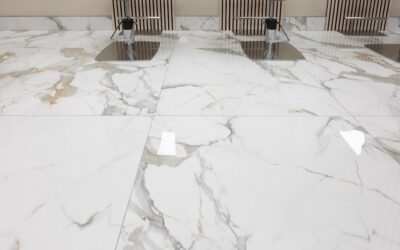
- Calacatta: Bright white with bold, dramatic gray-and-gold veins. Luxurious and high-contrast.
- Statuario: White with striking, clean veining, a designer favorite.
- Emperador: Rich brown marble look for warm, traditional spaces.
- Nero Marquina: Dramatic black with sharp white veins for bold, modern rooms.
Where to Use Faux Marble Tile
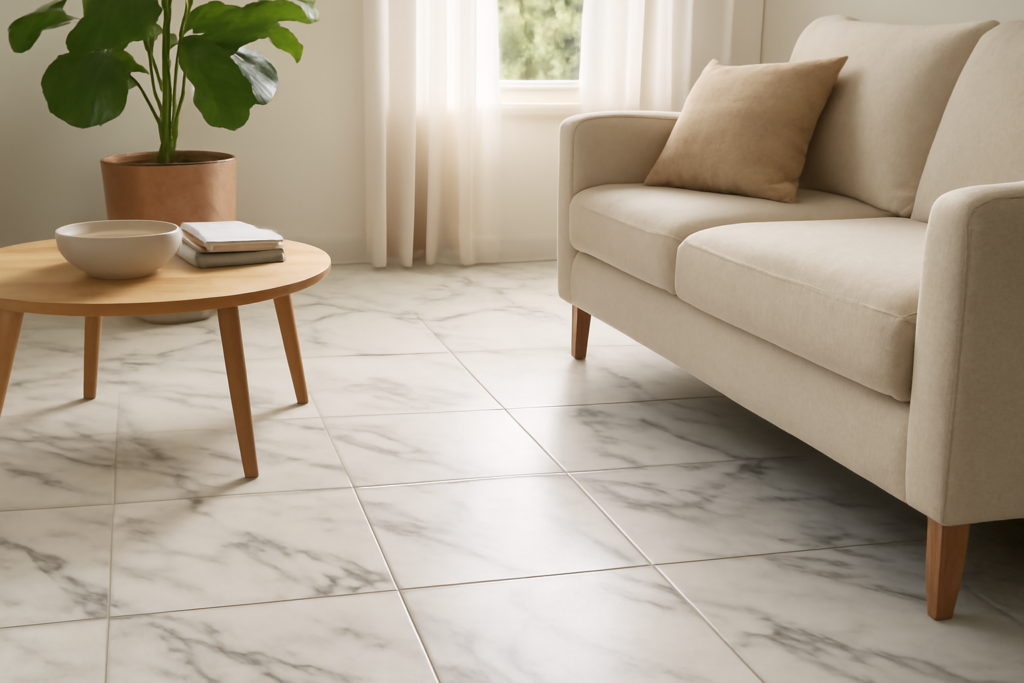
Because it is durable and water-resistant, faux marble goes almost anywhere real marble cannot safely live. It is spectacular on bathroom floors and shower walls, where genuine marble would etch from soap and shampoo. It makes a low-maintenance kitchen backsplash or floor that will not stain from lemon juice or wine. Large-format faux marble slabs create seamless feature walls and fireplace surrounds, and slip-rated versions handle entryways and high-traffic living areas. Unlike real marble, it is also frost-resistant enough for many covered outdoor uses.
Faux Marble vs. Real Marble
The comparison is where faux marble truly wins for most homeowners:
- Durability: Porcelain resists scratches and chips; marble is soft and shows wear.
- Staining and etching: Faux marble is impervious; real marble etches from acids and stains from oil and wine.
- Maintenance: Faux needs no sealing; marble needs regular sealing and careful cleaning.
- Cost: Faux runs a fraction of natural marble’s price, installed.
- Authenticity: Real marble has genuine depth and cool heft; faux is convincing but a reproduction.
What Faux Marble Tile Costs
Pricing is one of its biggest draws:
- Standard faux marble ceramic: $2 to $5 per square foot.
- Quality faux marble porcelain: $4 to $9 per square foot.
- Large-format polished porcelain slabs: $8 to $18 per square foot.
- Installation: $7 to $14 per square foot, more for large-format slabs and book-matched layouts.
By contrast, genuine marble tile often runs $10 to $40 per square foot for material alone, plus sealing costs over its life. The savings are substantial, especially across a whole floor.
Design Ideas for a Convincing Look
A few choices make faux marble read as the real thing. Use large-format tiles to minimize grout lines, since expanses of continuous veining look more like slab marble. Choose a grout color that matches the tile’s background so joints nearly disappear. For a designer touch, seek out book-matched or “vein-matched” collections where adjacent tiles mirror each other like cut stone. A polished finish amplifies the luxe, reflective quality of marble, while a honed matte finish gives a softer, more contemporary feel and better traction on floors.
Care and Maintenance
This is where faux marble almost feels like cheating. There is no sealing, no special stone cleaner, and no panic over a spilled glass of red wine. Simply sweep or vacuum grit and damp-mop with a neutral cleaner. The glazed porcelain surface resists stains, moisture, and everyday chemicals. The only real maintenance is grout care; choosing a stain-resistant grout, or epoxy grout in wet areas, keeps the joints looking as clean as the tile. Expect decades of service with essentially no upkeep.
Faux Marble Room by Room
Because it removes marble’s fragility, faux marble unlocks the look in places real stone should never go. In a kitchen, it makes a backsplash or floor that laughs off lemon juice, vinegar, and wine, the very acids that etch genuine marble within minutes. In a bathroom, faux marble shower walls and floors deliver the spa-like elegance homeowners want without the endless sealing and the water spotting that plague real marble in a wet environment. In an entryway, slip-rated faux marble greets guests with luxury while standing up to grit and moisture. Even a fireplace surround or a feature wall gains drama from large-format faux marble slabs, which would be enormously heavy and costly in real stone. The material lets you put the marble look exactly where marble is least practical.
How to Spot a Quality Faux Marble Tile
Not all faux marble is equally convincing, so know what separates premium tile from a flat imitation:
- Pattern variation: Look for collections with many different tile faces so the veining does not obviously repeat across the floor.
- Vein depth: The best tiles have veining that looks like it runs into the body, not a shallow printed line sitting on top.
- Edge quality: Rectified edges allow tight grout lines that make the marble look continuous.
- Finish realism: A polished tile should have marble’s soft glow, not a plasticky sheen; a honed tile should feel like smooth stone.
- Large formats: Bigger tiles read more like slab marble and hide the repeat.
Ordering a sample and viewing it under your own lighting is the surest way to judge how believable a product will look installed.
Grout and Finish Choices That Elevate the Look
Two decisions make the difference between faux marble that looks luxurious and faux marble that looks flat. The first is grout: matching the grout color to the tile’s background makes the joints nearly disappear, so expanses of veining read as continuous slab rather than a grid of tiles. In wet areas, a stain-resistant epoxy grout keeps those thin joints from yellowing over time. The second is finish. A polished surface gives marble’s signature luminous glow and reflects light, ideal for walls, fireplaces, and low-traffic floors, while a honed matte finish offers a softer, more contemporary feel and safer traction underfoot in bathrooms and entries. Choosing large-format, rectified tiles amplifies both effects by minimizing grout lines and letting the veining flow.
Common Faux Marble Questions
A few points come up again and again when homeowners consider the material:
- Does it need sealing? No; glazed porcelain is impervious, unlike real marble, which must be sealed regularly.
- Will it scratch? Porcelain is far harder than marble and resists everyday scratching well.
- Is it slippery? Polished versions can be; choose honed or textured finishes for wet floors.
- Can it go outside? Frost-rated porcelain versions work in many covered outdoor settings.
- Does the pattern repeat? Quality collections use many tile faces to disguise the repeat.
Knowing the answers helps set realistic expectations and steer you toward the right product for each room.
Is Faux Marble Right for You?
Choose faux marble tile when you crave the elegance and drama of veined marble but want a surface that stands up to real life. It delivers the Carrara or Calacatta look on floors, walls, backsplashes, and showers without the sealing, staining, and etching that make natural marble a constant worry, and it does so at a fraction of the cost. If you want authentic stone and are prepared to baby it, real marble still has a soul that print cannot fully capture. But for the vast majority of homeowners, faux marble is the smart, beautiful, worry-free way to live with the marble look every day.
Prefer to explore on your own?
See how new flooring looks in your actual room in seconds — free, no signup.
Try the free Floor Studio →