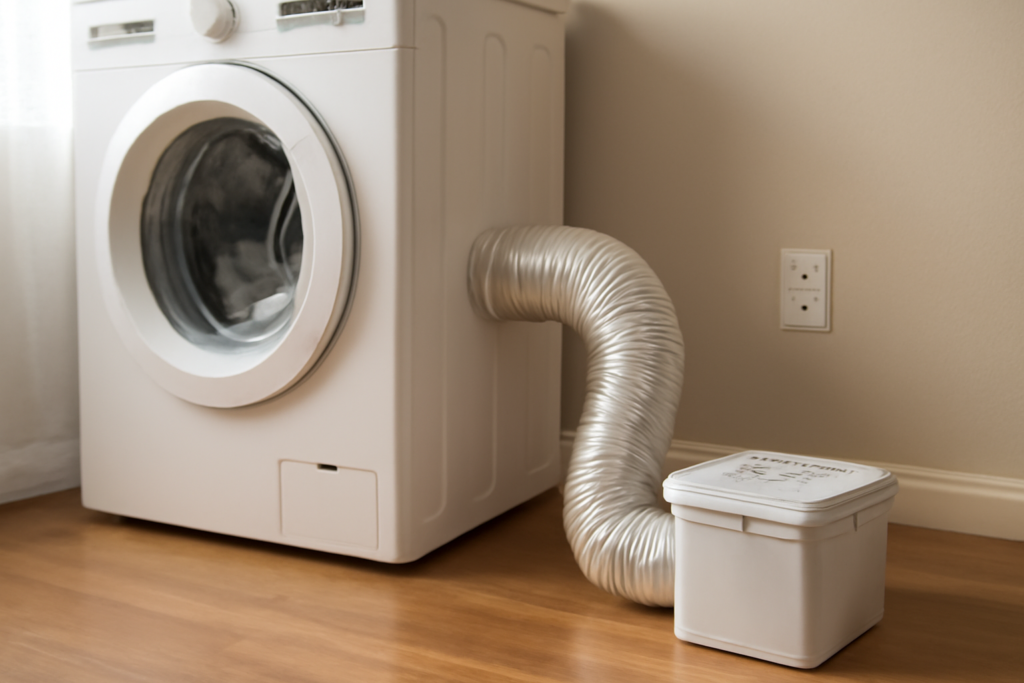
An indoor dryer vent looks like the perfect fix when your laundry room sits far from an exterior wall, and the little lint-trap boxes sold for $15 to $30 make it seem sanctioned. It is not that simple. Venting a clothes dryer back into your living space introduces moisture, lint, and — with a gas dryer — deadly carbon monoxide. Before you buy that bucket kit, understand exactly what you are trading away.
- What an Indoor Dryer Vent Actually Is
- Never Vent a Gas Dryer Indoors
- The Moisture Problem With Electric Dryers
- What the Building Codes Say
- The Fire Hazard Nobody Mentions
- Better Alternatives to Venting Indoors
- Route a proper duct to the nearest exterior wall
- Install a ventless (condenser or heat-pump) dryer
- Add a booster fan for a long run
- If You Absolutely Must Vent Indoors Temporarily
- How Much Heat Are You Actually Saving?
- Signs Your Indoor Venting Is Already Causing Damage
- The Bottom Line
What an Indoor Dryer Vent Actually Is
An indoor dryer vent is any setup that discharges dryer exhaust inside the home instead of routing it outdoors through a wall or roof. The most common product is a lint-trap bucket: a plastic box you fill partway with water, connected to the dryer’s 4-inch duct. The water is supposed to catch lint while warm, damp air escapes into the room. Some versions use a dry nylon-stocking filter instead of water.
The appeal is obvious. You skip cutting a hole through siding, you avoid a 15-to-25-foot duct run, and in winter you keep the warm air inside instead of blowing heated air outside. That last point is why people in cold climates reach for these. The physics that makes it tempting is also exactly what makes it a problem.
Never Vent a Gas Dryer Indoors
This is the non-negotiable rule. A gas dryer burns natural gas or propane, and its exhaust contains carbon monoxide (CO), an odorless, colorless gas that kills. Venting that exhaust into your home can raise CO to lethal levels, especially in a closed laundry closet or basement. No lint-trap bucket removes carbon monoxide. Water and mesh catch particles, not gas.
If you have a gas dryer, it must vent to the outdoors, full stop. Every manufacturer, the International Residential Code, and CPSC safety guidance agree. If you are not certain whether your dryer is gas or electric, check the back: a gas dryer has a black iron or flexible gas supply line and a shutoff valve. When in doubt, treat it as gas and vent outside.
The Moisture Problem With Electric Dryers
Even a pure electric dryer creates trouble indoors. A single load of laundry releases roughly half a gallon to a full gallon of water as vapor. Dump that into a closed room, load after load, and you are running a humidifier you never wanted. Relative humidity climbs, and the consequences follow:
- Condensation on windows, cold walls, and inside exterior wall cavities.
- Mold and mildew growth on drywall, framing, and stored items — mold can take hold in 24 to 48 hours on damp surfaces.
- Peeling paint and swollen trim as wood absorbs moisture.
- Musty odor that permeates laundry and adjacent rooms.
- Dust mites and allergen aggravation in the humid air.
Fine lint also gets past every filter eventually. That airborne lint settles on surfaces and, more importantly, can irritate lungs. People with asthma or allergies notice it fast.
What the Building Codes Say
Model code is blunt about this. The International Residential Code (IRC M1502) and International Mechanical Code require that dryer exhaust be conveyed to the outdoors and terminate outside the building with a backdraft damper. They prohibit terminating a dryer duct inside an attic, crawlspace, or any concealed or occupied space. Many state and local codes adopt this language directly.
The practical takeaway: an indoor dryer vent violates code in most U.S. jurisdictions for both gas and electric dryers. If you rent, indoor venting may also breach your lease and your landlord’s insurance requirements. If you own and later sell, a home inspector will flag it, and a flagged item becomes a negotiation point or a required repair.
The Fire Hazard Nobody Mentions
Lint is highly flammable, and dryers are a leading cause of home fires — the U.S. Fire Administration attributes roughly 2,900 dryer fires a year, most tied to failure to clean lint. Indoor venting makes lint accumulation worse because the bucket or mesh filter collects it right at the appliance, and any lint that escapes drifts around the room and settles near the dryer’s heat.
Do this the right way for any vented dryer:
- Use rigid or semi-rigid metal duct, never plastic or thin foil accordion hose. Foil and plastic sag, trap lint in their ridges, and can melt or ignite.
- Do not use sheet-metal screws at the joints. Screw tips poke into the airflow and snag lint, building a clog. Use foil UL-181 tape or clamps instead.
- Keep the run short and straight — codes generally cap it at 35 feet, minus 5 feet for each 90-degree elbow.
- Terminate outdoors with a proper vent hood that has a backdraft damper and no screen (screens clog with lint).
- Clean the lint trap every load and the full duct at least once a year.
Better Alternatives to Venting Indoors
If the reason you want an indoor vent is that there is no easy path outside, you have real options:
Route a proper duct to the nearest exterior wall
A handyman or HVAC tech can usually run a 4-inch rigid metal duct through a wall or up through the roof for $150 to $600 depending on distance and finishes. This is the correct fix and the one that protects your home’s value.
Install a ventless (condenser or heat-pump) dryer
Ventless dryers need no duct at all. A condenser model cools the moist air and drains the water to a reservoir or drain line. A heat-pump dryer does the same while using 20 to 50 percent less energy. Expect to pay $800 to $1,800, but you eliminate the venting problem entirely — ideal for apartments, condos, and interior closets. These are electric only.
Add a booster fan for a long run
If your only issue is a duct run over 35 feet, a UL-listed dryer duct booster fan (roughly $150 to $300) lets you vent outdoors properly without airflow loss.
If You Absolutely Must Vent Indoors Temporarily
There are narrow, short-term cases — an electric dryer in a rental with no exterior access, used briefly while you arrange a real fix. If that is you, minimize the risk:
- Confirm the dryer is 100 percent electric, never gas.
- Run a dehumidifier in the same room and monitor humidity with a $10 hygrometer; keep it under 50 percent.
- Crack a window or run an exhaust fan while the dryer operates.
- Empty and clean the lint filter and water bucket after every single load.
- Install a CO detector nearby anyway, in case a gas appliance is closer than you think.
- Treat it as a stopgap of weeks, not a permanent arrangement.
How Much Heat Are You Actually Saving?
The whole argument for indoor venting is keeping warm air inside during winter. Run the numbers and the case gets weaker. A dryer exhausts roughly 150 to 200 cubic feet of air per minute. Over a one-hour cycle that is a meaningful volume of heated house air pushed outdoors — but your furnace reheats replacement air for pennies, and the dryer only runs a few hours a week. Weigh that tiny saving against a dehumidifier running to fight the moisture you just added indoors, plus the mold remediation, ruined drywall, and failed home inspection an indoor vent invites. The math almost always favors venting outside. In genuinely cold climates, a heat-pump dryer captures far more of that energy than any lint bucket, because it recycles the heat internally instead of dumping warm, wet air into your living space.
Signs Your Indoor Venting Is Already Causing Damage
If a previous owner or a temporary setup has been venting indoors, look for the warning signs before they become expensive problems:
- Condensation or frost on the nearest windows during a drying cycle.
- Peeling paint, bubbling drywall, or soft baseboards in the laundry area.
- Black mold spots on the ceiling, walls, or behind the dryer.
- A persistent musty smell that clings to clean laundry.
- Fine lint dust settling on shelves and surfaces around the machine.
- Rising indoor humidity on a hygrometer during and after cycles.
Catch these early, switch to proper exterior venting, and address any mold before it spreads into wall cavities where remediation runs into the thousands.
The Bottom Line
An indoor dryer vent trades a few dollars of saved heat for moisture damage, mold, code violations, and — with gas — a genuine risk of carbon monoxide poisoning. For a gas dryer, indoor venting is never acceptable. For an electric dryer, it is a poor substitute for a short metal duct to the outside or a ventless machine. Spend the $150 to $600 on a real exterior vent, or buy a heat-pump dryer, and you solve the problem once instead of managing a hazard every laundry day.