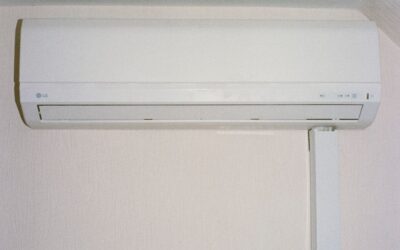
Heating and cooling a single room, home office, garage, or addition doesn’t require a whole central system. A small mini split delivers efficient, ductless comfort to one space with a compact indoor head and an outdoor condenser. This guide explains BTU sizing, efficiency ratings, installation, and costs so you can pick the right compact ductless system.
- What a Mini Split Is
- Why Choose a Small Mini Split
- Sizing by BTU
- Factors That Change Sizing
- Understanding Efficiency Ratings
- Popular Brands
- Typical Costs
- Installation Overview
- Maintenance
- Common Questions
- Pros and Cons
- Indoor Head Styles
- Operating Costs and Savings
- Common Installation Mistakes
- Single-Zone vs. Adding More Zones Later
- Rebates and Incentives
- Final Takeaway
What a Mini Split Is
A ductless mini split is a heat pump system with two main parts: an outdoor compressor/condenser and one or more indoor air-handling heads connected by a thin conduit of refrigerant lines, wiring, and a drain. Because it needs no ductwork, it’s ideal for rooms that central systems can’t reach efficiently. A small single-zone mini split pairs one outdoor unit with one indoor head.
Why Choose a Small Mini Split
Compact mini splits solve specific problems well:
- Additions and conversions: Heating and cooling a new room without extending ductwork.
- Home offices and bedrooms: Zone comfort so you condition only the space you use.
- Garages and workshops: Efficient climate control in unconditioned spaces.
- Hot or cold rooms: Fixing a space the central system can’t keep comfortable.
- Efficiency: Inverter-driven heat pumps use far less energy than window units or space heaters.
Sizing by BTU
Correct sizing is the most important decision. Capacity is measured in BTU per hour. A rough guide for a well-insulated room:
- 150-350 sq ft: 6,000-9,000 BTU (a common small mini split size).
- 350-550 sq ft: 12,000 BTU (1 ton).
- 550-800 sq ft: 18,000 BTU (1.5 tons).
Most single-room applications land at 9,000 or 12,000 BTU. Oversizing wastes money and hurts humidity control by short-cycling, while undersizing leaves the room uncomfortable in extreme weather.
Factors That Change Sizing
Square footage alone isn’t the whole story. Adjust up for:
- Rooms with lots of windows or western sun exposure.
- High ceilings above 8 feet.
- Poor insulation or older construction.
- Kitchens or rooms with heat-producing equipment.
- Very hot or very cold climate zones.
A load calculation gives the most accurate result, but the guidelines above work for typical rooms.
Understanding Efficiency Ratings
Mini splits are rated by SEER2 (cooling efficiency) and HSPF2 (heating efficiency). Higher numbers mean lower operating costs. Budget units start around 16-19 SEER2, while premium models reach 20-30-plus SEER2. For heating in cold climates, look for a “hyper heat” or cold-climate rating that maintains capacity down to 5°F or lower. Higher efficiency costs more upfront but saves on energy over the unit’s life.
Popular Brands
Reputable options for a small mini split include Mitsubishi and Fujitsu at the premium end, Daikin and LG in the mid-range, and Mr. Cool, Cooper & Hunter, Pioneer, and Senville at the value end. Mr. Cool’s DIY line is notable because it ships with pre-charged, quick-connect line sets that let homeowners install without a refrigerant license.
Typical Costs
Pricing for a single-zone small mini split:
- Equipment only (9,000-12,000 BTU): about $700-$2,000.
- Professional installation: about $1,300-$2,000 additional.
- Total installed: about $2,000-$4,500 depending on brand and complexity.
- DIY kits: about $900-$1,600 total if you install it yourself.
Installation Overview
A professional installation generally involves:
- Mounting the indoor head high on an exterior wall.
- Drilling a 3-inch pass-through for the line set.
- Setting the outdoor condenser on a pad or wall bracket.
- Running and connecting refrigerant lines, wiring, and the condensate drain.
- Pulling a vacuum on the lines and releasing the factory refrigerant charge.
- Testing operation in both heating and cooling.
Refrigerant work requires EPA-608 certification, which is why standard systems need a pro; DIY kits avoid this with sealed pre-charged lines.
Maintenance
Mini splits are low-maintenance but not maintenance-free:
- Clean the washable filters in the indoor head every 2-4 weeks.
- Keep the outdoor unit clear of leaves, snow, and debris.
- Rinse the outdoor coil gently each season.
- Have a pro clean the indoor coil and check refrigerant every year or two to prevent musty odors and maintain efficiency.
- Keep the condensate drain clear to avoid leaks.
Common Questions
Homeowners often ask whether one small mini split can heat a whole house — it can’t; it’s designed for a single zone, and multiple heads or a multi-zone system are needed for more rooms. Another common question is noise: mini splits are quiet, with indoor heads running around 25-40 decibels, quieter than a window unit. They also dehumidify as they cool, improving comfort.
Pros and Cons
Weigh the trade-offs:
- Pros: High efficiency, no ductwork, quiet, precise single-room control, heating and cooling in one unit.
- Cons: Higher upfront cost than a window unit, the indoor head is visible on the wall, and professional installation is usually required.
Indoor Head Styles
Even small single-zone systems offer a choice of indoor unit styles. The wall-mounted head is by far the most common — mounted high on a wall, affordable, and easy to install. Ceiling cassettes recess into a dropped ceiling for a discreet look and even air distribution, but cost more and need ceiling space. Floor-mounted (console) units sit low on the wall like a radiator, useful in rooms with no suitable high wall space or under large windows. Concealed-duct heads hide in a ceiling or closet and feed a short run of duct, offering the cleanest look at the highest price. For most single rooms, the wall-mounted head is the practical choice.
Operating Costs and Savings
A small mini split is inexpensive to run because inverter heat pumps are highly efficient. Cooling a single room with a 9,000 or 12,000 BTU unit typically costs far less than a window air conditioner of similar capacity, and in heating mode a heat pump delivers two to three times more heat per unit of electricity than resistance heaters. Actual costs depend on your electricity rate, climate, and how much you run it, but many owners spend just a few dollars a month to keep a single room comfortable. Choosing a higher SEER2 and HSPF2 model lowers those costs further over the system’s life.
Common Installation Mistakes
To get the most from a small mini split, avoid these frequent errors:
- Oversizing the unit, which causes short-cycling and poor humidity control.
- Poor line-set routing with kinks or excessive length that reduces efficiency.
- Skipping the vacuum step on standard systems, leaving moisture that damages the compressor.
- Bad drain slope, causing condensate to back up and leak indoors.
- Placing the indoor head where furniture or curtains block airflow.
Whether you hire a pro or use a DIY kit, getting these details right ensures years of efficient, trouble-free operation.
Single-Zone vs. Adding More Zones Later
Many homeowners start with a small single-zone mini split for one problem room and later wish they could add more. It’s worth planning ahead. A single-zone outdoor unit serves only one indoor head and can’t be expanded, so if you think you’ll want to condition additional rooms, a multi-zone-capable outdoor unit lets you add heads later. That said, single-zone systems are more efficient per room and cheaper upfront, so if you truly only need one room conditioned, don’t overspend on multi-zone capacity you won’t use. Weigh your likely future needs against the extra cost when deciding between a dedicated single-zone unit and an expandable system.
Rebates and Incentives
Because mini splits are highly efficient heat pumps, they often qualify for financial incentives that lower the real cost. Federal tax credits under recent energy legislation can cover a percentage of the cost of qualifying high-efficiency heat pump systems, up to annual limits. Many states and utilities add rebates for ENERGY STAR-certified units, sometimes several hundred to over a thousand dollars. To qualify, the unit usually must meet minimum SEER2 and HSPF2 thresholds and often requires professional installation. Before buying, check the current federal credit, your state energy office, and your utility’s rebate programs — these incentives can meaningfully offset the price of an efficient small mini split.
Final Takeaway
A small mini split is the efficient, quiet answer for conditioning a single room, addition, office, or garage without extending ductwork. Size it correctly — usually 9,000 or 12,000 BTU for a typical room — choose an efficiency and cold-climate rating that matches your area, and keep the filters clean. Whether professionally installed or a DIY kit, a well-chosen mini split delivers comfortable, low-cost heating and cooling for well over a decade.