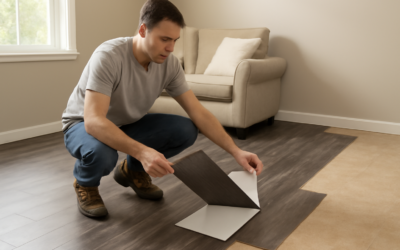
The Saturday-afternoon flooring fix has its own product category, and peel-and-stick wood-look planks are at the top of it. Done right, stick on wood tiles can transform a rental kitchen, a basement office, or a guest bedroom in under six hours for less than $300. Done wrong, they curl, gap, and grab dirt at every seam by month three. The difference is product selection and subfloor prep, not luck.
Part of our Tile & Grout guide — explore the full guide →
What You Are Actually Buying
Stick on wood tiles fall under the LVT umbrella (luxury vinyl tile), specifically the dry-back format. The plank is rigid vinyl with a printed wood image, a clear wear layer, and a factory-applied pressure-sensitive adhesive backing. Strip the release film, press the plank to the floor, and you are installed. Most are 6 by 36 inches or 9 by 48 inches, with wear layers from 2 mil (cheap) to 20 mil (commercial). Armstrong Flexstep, Achim Nexus, and TrafficMaster Allure Ultra are the names you will see at Home Depot and Lowes.
Honest Pricing Tiers
- Bargain (2-6 mil wear): $0.79 to $1.49 per sq ft. Achim Nexus, Floor Pops. Renters and short-term fixes only.
- Mid-grade (12 mil wear): $1.79 to $2.99 per sq ft. TrafficMaster Allure, Lucida USA SmartCore Naturals self-stick line.
- Pro-grade dry-back LVT (20+ mil wear): $3.50 to $5.50 per sq ft. Armstrong Lucent, Mannington Adura Dockside.
Add another $0.40 to $0.60 per sq ft for the trowel-applied pressure-sensitive primer the better products require for warranty coverage.
Where They Work and Where They Fail
Bedrooms, home offices, and dry hallways are the sweet spot. The factory adhesive performs well between 60 and 85 degrees F at relative humidity under 65 percent. Bathrooms, full kitchens, and basements without dehumidification will eat these planks alive. Standing water at the seams releases the adhesive, and seasonal RH swings above 70 percent cause the planks to expand and butt-tent at edges.
One trick: in laundry rooms, install around the appliances rather than under them. Foot traffic compresses the adhesive over time, but a stationary 200 lb washer creates a permanent compression dimple.
Subfloor Prep Decides the Job
The factory adhesive is unforgiving. Any divot deeper than 1/16 inch will telegraph through within 30 days. Run a 6-foot straightedge in two directions and patch low spots with Ardex Feather Finish at $35 a bag (60 sq ft coverage at 1/16 inch). Sweep, vacuum with a HEPA filter, then wipe with a microfiber damp with denatured alcohol. Any dust on the slab acts as a release agent.
On concrete, run an ASTM F1869 calcium chloride test or an F2170 RH test. Most peel-and-stick products max out at 3 lb per 1,000 sq ft per 24 hours, or 75 percent RH. Higher than that and you need a moisture mitigation coating like Ardex MC Rapid before you start.
Install Step-By-Step
- Acclimate the boxes flat in the room for 48 hours, never stacked vertically.
- Snap a chalk line down the middle of the longest wall. Dry-lay the first three rows to confirm the layout.
- Peel and place starting at the chalk line. Press each plank from the center outward, then roll with a 100 lb floor roller within 30 minutes.
- Stagger end joints by at least 8 inches. Random patterns look better; never align seams in a brick pattern.
- Cut perimeter pieces with a utility knife and steel rule. Leave a 1/4 inch expansion gap at walls; cover with shoe molding.
- Avoid heavy traffic for the first 24 hours so the adhesive can fully bond.
The Wear Layer Conversation
Wear layer mil thickness is the single most important spec. Below 6 mil, you will see scuffs from a dog’s nails within a month. The 12 mil mid-grade products survive normal family traffic for 5 to 8 years. The 20 mil commercial-grade planks carry residential warranties of 15 to 25 years. Mil is not the same as mm. A 20 mil wear layer equals 0.5 mm, which is still thinner than a credit card.
Removal Without Wrecking the Subfloor
One of the underrated wins: most stick on wood tiles peel up in seconds when warmed. A hair dryer or heat gun at low setting softens the adhesive in 20 seconds per plank. Pull at a 30-degree angle. Cheaper products leave a gummy residue that lifts with Goo Gone or denatured alcohol. Better products leave the subfloor near-pristine, which is why landlords increasingly approve them for tenant remodels.
Top Picks Worth Buying
For high-traffic homes, Armstrong Lucent Dry Back at $4.29 per sq ft delivers a 22 mil wear layer and a 20-year residential warranty. Renters and tight budgets should look at TrafficMaster Allure Ultra at $2.19 per sq ft; the 6 mil wear holds up if expectations are realistic. Mannington Adura Dockside leans high-design with hand-scraped textures at $4.99 per sq ft and a Diamond 10 wear layer that resists chair-leg scratches.
The Five-Year Reality Check
Walk through a home where peel-and-stick planks were installed five years ago and you will see one of two outcomes. Either the floor still looks 90 percent of its install-day appearance (good product, dry room, prepped subfloor), or there are 12 to 20 lifted edges, dirt-blackened seams, and chair-leg punctures (cheap product, wet area, or no prep). The product cost difference between those two outcomes is roughly $1.50 per sq ft, often less than the cost of replacing the floor.
Bottom Line
Stick on wood tiles are a legitimate flooring choice when you respect their limits. Buy the 12 mil minimum wear layer, prep the subfloor flat and dry, install in a dry room, and you will get a decade of solid service for a fraction of true hardwood or click-LVP pricing.
Prefer to explore on your own?
See how new flooring looks in your actual room in seconds — free, no signup.
Try the free Floor Studio →