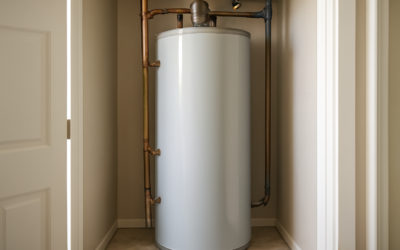
“What size water heater do I need” is the first question to answer before you spend a dime, and getting it wrong cuts both ways: too small and you run out of hot water mid-shower, too big and you pay to heat gallons you never use. The right size depends on how many people live in your home, how many bathrooms you have, and whether you choose a tank or a tankless unit. If you have ever wondered what size water heater do I need for your family, this guide walks through the numbers a plumber actually uses.
- Tank Size by Household — The Quick Chart
- First Hour Rating Beats Raw Gallons
- Sizing a Tankless Unit
- Bathrooms as a Shortcut
- Fuel Type Changes the Math
- Real-World Sizing Examples
- Don’t Forget Water Pressure and Climate
- Common Sizing Mistakes
- What About Hybrid Heat Pump Sizing?
- Quick Self-Check Before You Buy
- Cost by Size
- The Bottom Line
Tank Size by Household — The Quick Chart
For a standard storage tank, start with the number of people in the home:
- 1–2 people: 30–40 gallons
- 2–3 people: 40–50 gallons
- 3–4 people: 50–60 gallons
- 5+ people: 60–80 gallons
Gas tanks recover faster than electric, so a gas unit can run a size smaller than electric for the same household. A family of four is often fine with a 50-gallon gas tank but happier with a 60- to 80-gallon electric because electric reheats slower.
First Hour Rating Beats Raw Gallons
Gallons alone don’t tell you how much hot water you actually get during a busy morning. The number that matters is the first hour rating (FHR) — the gallons of hot water a tank delivers in one hour of heavy use, combining stored water plus what it reheats in that hour. Every tank lists it on the EnergyGuide label.
To size by FHR, figure your household’s peak-hour demand. Estimate the busiest hour — say two showers, running the dishwasher, and washing hands — and add up the gallons:
- Shower: ~10–20 gallons each
- Bath: ~20 gallons
- Shaving/washing hands: ~2 gallons
- Dishwasher: ~6 gallons
- Kitchen/food prep: ~5 gallons
Total your peak hour and buy a tank whose FHR meets or slightly exceeds it. A family whose morning peak hits 60 gallons should look for a tank rated 60-plus FHR — which might be a 50-gallon gas unit (fast recovery pushes FHR above the stored volume) or a 60- to 66-gallon electric.
Sizing a Tankless Unit
Tankless heaters never “run out,” so you don’t size them by storage. Instead you size by flow rate (gallons per minute) at your required temperature rise. Two steps:
Step 1 — Add up simultaneous flow. Decide how many fixtures might run at once and total their GPM: a shower is about 2.0 GPM, a kitchen faucet 1.5, a bathroom faucet 1.0. Two showers and a sink is roughly 5.5 GPM.
Step 2 — Figure temperature rise. Subtract your incoming groundwater temperature from your target (usually 120°F). In the cold North, water enters near 40°F, so you need an 80°F rise. In the warm South it may enter at 65°F, only a 55°F rise. A tankless unit delivers fewer GPM the bigger the rise, so a northern home needs a higher-BTU unit to hit the same flow as a southern one.
Match a unit rated to deliver your total GPM at your rise. Most whole-home gas tankless units cover 5 to 10 GPM; undersizing for cold winter water is the most common mistake.
Bathrooms as a Shortcut
If counting gallons feels fussy, use bathrooms as a rough guide:
- 1 bathroom: 30–40 gallon tank, or 6–7 GPM tankless
- 2 bathrooms: 40–50 gallon tank, or 7–9 GPM tankless
- 3+ bathrooms: 50–80 gallon tank, or 9–11 GPM tankless
Bump up a size if you have a large soaking tub, a rain shower head, or teenagers who take long showers back to back.
Fuel Type Changes the Math
Recovery rate — gallons reheated per hour — shifts your target size. A 40,000 BTU gas tank recovers 40-plus gallons an hour; a standard electric tank recovers about 20. That is why a gas 40-gallon and an electric 50-gallon can serve the same family. Propane recovers as fast as natural gas. Hybrid heat-pump electric units recover slowly, so they are usually sold in larger 50-, 66-, and 80-gallon sizes to compensate with extra storage.
Real-World Sizing Examples
Numbers make more sense with examples. Here are three typical households:
- Couple in a one-bath condo, gas: Peak hour is two morning showers back to back, maybe 35 gallons. A 40-gallon gas tank with a 40-plus FHR handles it comfortably, or a 6 GPM gas tankless.
- Family of four, two baths, electric: Peak hour hits around 60 gallons — two showers, a load of laundry, and the dishwasher. Because electric recovers slowly, go with a 66- to 80-gallon electric tank, or an 8 to 9 GPM gas tankless if gas is available.
- Family of five, three baths, big soaking tub: Peak demand can top 80 gallons. An 80-gallon tank (gas or hybrid electric) or a high-output 10 GPM condensing tankless keeps everyone in hot water.
Notice how fuel type shifts the answer even when the household is identical — the slower an appliance recovers, the more storage it needs.
Don’t Forget Water Pressure and Climate
Two factors quietly change your sizing. First, low-flow fixtures reduce your GPM needs — a modern 1.5 GPM shower head means a tankless can serve more simultaneous showers than the old 2.5 GPM heads would allow. Second, climate drives incoming water temperature, and that swings a tankless unit’s real output dramatically. The same 199,000 BTU tankless that pushes 9 GPM in Florida might only manage 5 GPM in Michigan in January. If you live in a cold-winter state, always size a tankless for your coldest groundwater month, never the annual average, or you’ll be shocked the first hard freeze.
Common Sizing Mistakes
- Buying the same size you had without checking: Households grow. If you added a bathroom or people, your old size may fall short.
- Ignoring incoming water temperature on tankless: A unit that’s perfect in Texas underperforms in Minnesota.
- Oversizing a tank “to be safe”: A too-big tank wastes energy on standby heat you never use, month after month.
- Forgetting future demand: Planning a hot tub, a bigger tub, or a growing family? Size up now.
What About Hybrid Heat Pump Sizing?
Hybrid heat-pump water heaters have their own sizing quirk. Because they heat slowly in efficient heat-pump mode, manufacturers recommend going one size larger than you would with a gas tank. A family that would run a 50-gallon gas tank should look at a 66- or 80-gallon hybrid so the extra storage covers the slower recovery. Most hybrids also have a high-demand or “electric” mode that fires the resistance backup during peak use, but leaning on that mode erases the efficiency savings — so buy enough storage to stay in heat-pump mode most of the time. If your household regularly slams the hot water, size the hybrid generously rather than counting on the backup elements.
Quick Self-Check Before You Buy
Run through this short list and you’ll land on the right size:
- How many people live here, and is the household likely to grow?
- How many bathrooms, and could two showers run at once?
- Any large soaking tub, rain shower, or big appliances that pull hot water?
- What’s your fuel — gas, propane, or electric — since recovery speed changes the size?
- For tankless, what’s your coldest-month incoming water temperature?
- What’s the busiest single hour of hot-water use in your home?
Answer those honestly and match the result to the charts above. Slightly generous beats slightly short — but don’t oversize a tank so far that you pay to heat water you never touch.
Cost by Size
Bigger tanks cost more to buy and run. A 40-gallon tank runs $500 to $1,000 installed, a 50-gallon $700 to $1,400, and a 75- to 80-gallon $1,200 to $2,000-plus. Tankless units land higher at $2,500 to $4,500 installed but never run dry and last longer. Factor operating cost too — an oversized electric tank can add $100-plus a year in wasted standby heat.
The Bottom Line
So, what size water heater do I need? For a tank, match the first hour rating to your household’s peak-hour demand — roughly 40 gallons for a couple, 50 for a family of four on gas, and 66 to 80 for a big household or electric. For tankless, size by GPM at your local temperature rise, not by gallons. When in doubt, have a plumber run a peak-demand calculation for your home before you buy — it costs nothing and prevents years of cold showers or wasted energy. Gas and propane sizing also involves venting and combustion air, so bring in a licensed pro for the install and permit.