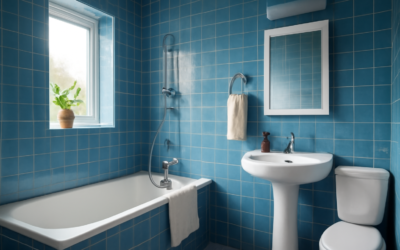
Walk into any high-end bathroom remodel from the past three years and you will see one trend repeating — blue floor tile paired with warm brass fixtures and white-oak vanities. Blue tile flooring spans navy porcelain at $4.99 per sq ft to hand-painted Spanish encaustic at $28 per sq ft, and the right shade transforms a space in ways that gray or beige tile cannot. The challenge is that blue is the most context-sensitive color on the floor — a navy that looks rich and grounded under warm lighting can read cold and institutional under cool LEDs. Picking the right tile means understanding which blues belong in which rooms.
Part of our Tile & Grout guide — explore the full guide →
Where Blue Floor Tile Works Best
Bathrooms are the natural home for blue tile flooring because the color reinforces the room’s association with water and cleanliness. A 6 by 8 powder room with a navy hex floor and white walls reads as crisp and intentional rather than busy. Primary bathrooms tolerate larger-scale patterns — 12 by 24 navy porcelain or 8 by 8 Moroccan zellige tile fits well in 80 to 120 sq ft floor areas.
Kitchens work too, but with caveats. Blue tile pairs naturally with white shaker cabinets, butcher block counters, and unlacquered brass hardware. It clashes with cherry cabinets, beige granite, and oil-rubbed bronze fixtures. Test a sample box on the actual floor before committing to a 200 sq ft kitchen install — color reads completely differently at full scale than on a 4 by 4 sample.
The Five Blue Families to Choose Between
- Navy: deep, near-black tones that read as classic and traditional
- Cobalt: saturated mid-blue with a slight purple lean, vibrant under daylight
- Slate or denim: muted gray-blue, the most versatile shade for whole-floor use
- Aqua and teal: green-leaning blues, refreshing in bathrooms and beach houses
- Powder or sky: pale washed blues, ideal for small spaces and traditional homes
Material Choices Within Each Shade
Porcelain is the workhorse for blue floor tile because the color is fired into the body of the tile, not just printed on the surface. Brands like Daltile Color Wheel, Florida Tile Cobalt, and TileBar produce porcelain in navy, cobalt, and slate at $3.99 to $7.99 per sq ft. The tiles handle daily wet mopping, chair scrapes, and dropped pans without showing wear because the color extends through the full 9mm thickness.
Encaustic cement tile takes the look in a more handmade direction. Hand-poured tiles from Granada Tile, Cement Tile Shop, and Zia Tile feature blue patterns at $12 to $22 per sq ft. The tradeoff is maintenance — encaustic tile needs sealing every 12 to 24 months and is more prone to staining from acidic spills like lemon juice or red wine.
Pattern and Layout Options
The pattern you choose interacts with the blue tone in ways that affect the whole room. A monochrome navy 12 by 24 porcelain laid in a one-third offset creates a calm, sophisticated backdrop. The same navy in a 4 inch hex pattern reads more playful and traditional. Hand-painted Moroccan patterns in cobalt and white feel either bohemian or formal depending on the cabinet style they pair with.
Avoid mixing more than three blue tones in a single floor. The color is strong enough that a busy multi-blue pattern overwhelms most rooms. Stick to one dominant blue plus a neutral (white, cream, or pale gray) as the contrasting tone in any pattern.
The Grout Color Decision
Grout selection on blue tile changes the floor more than most homeowners expect. White grout with navy tile produces high contrast that emphasizes the geometry of the pattern — strong and modern. Light gray grout (Mapei Frost or Pearl Gray) blends with the tile body and creates a softer, more cohesive look. Dark gray or charcoal grout disappears into the tile entirely, making the floor read as one continuous surface.
- White grout — high contrast, modern, shows soil faster, plan for sealing
- Light gray grout — balanced contrast, most forgiving on cleaning
- Dark gray grout — minimal contrast, hides soil, looks intentional
- Navy or blue grout — monolithic look, specialty product, $0.85 more per ft
Cost Breakdown for a Typical Bathroom
A 60 sq ft primary bathroom floor in navy porcelain runs $300 to $480 in tile material. Add thinset mortar at $0.45 per sq ft ($27), epoxy grout at $0.85 per sq ft ($51), backer board at $0.75 per sq ft ($45), and crack-isolation membrane if needed at $1.25 per sq ft ($75). DIY-friendly tools (notched trowel, score-and-snap cutter, mixing paddle, sponges) add $85 to $140 if not already owned.
Professional tile installation labor runs $7 to $14 per sq ft for floor work depending on tile size, pattern complexity, and regional rates. The same 60 sq ft bathroom installed turnkey comes in at $920 to $1,400. Encaustic cement tile installs cost 25% to 40% more because the tiles are heavier, more fragile, and require careful color-lot management.
Installation Considerations
Wet rooms need a waterproof membrane system, not just thinset. Schluter Kerdi-Band or Mapei Mapeguard 2 applied between the backer board and the tile prevents water from migrating into the subfloor. For showers specifically, the entire floor and 6 inches up every wall must be membraned before tile sets.
Subfloor flatness is more critical with larger tile formats. A 24 by 24 navy porcelain installed over a subfloor with 1/4 inch deviation across 10 feet will show lippage at every joint. Self-leveling compound under any tile larger than 12 by 12 is non-negotiable for a quality finished result.
Maintenance and Long-Term Care
Sealed porcelain blue tile needs almost no special maintenance. Sweep daily, wet-mop weekly with a pH-neutral cleaner like Bona Stone Tile and Laminate Floor Cleaner or a 1:160 dilution of dish soap in warm water. Avoid ammonia, vinegar, and bleach on grout — all three degrade the polymer additives and cause grout to crumble within a few years.
Reseal grout joints every 18 to 24 months with a penetrating sealer such as Aqua Mix Sealer’s Choice Gold or Miracle 511. Encaustic cement tile needs more frequent sealing — every 12 months minimum — and should be sealed before grouting to prevent grout haze from staining the tile body. A well-installed blue tile flooring project rewards the upfront investment with two decades or more of dramatic, design-forward floor performance in spaces where standard neutrals would feel forgettable.
Prefer to explore on your own?
See how new flooring looks in your actual room in seconds — free, no signup.
Try the free Floor Studio →