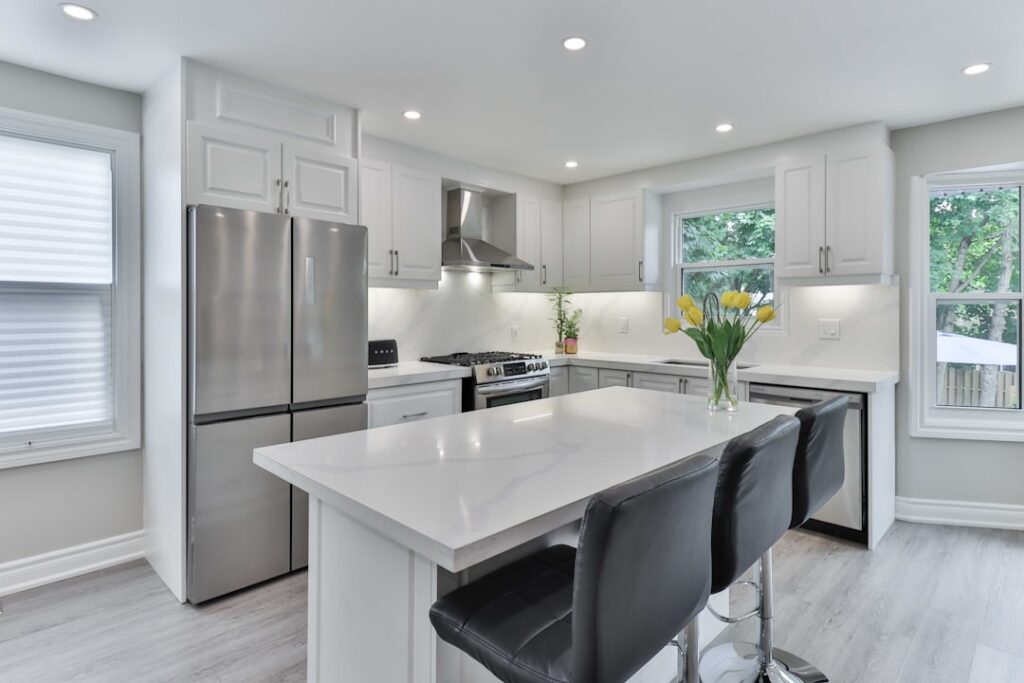
Real estate data shows kitchens designed in the modern traditional style hold their visual appeal 12 to 15 years before reading as dated, compared to 5 to 8 years for purely contemporary designs. A modern traditional kitchen blends classic shaker cabinetry, paneled appliances, and stone counters with cleaner profiles, hidden hardware, and modern lighting — giving you the warmth of a traditional kitchen without the fussiness. This guide breaks down the design rules, costs, and product picks that make the style work.
Part of our Kitchen Remodeling guide — explore the full guide →
What Defines the Style
The look pulls from three eras simultaneously:
- Traditional foundation: Shaker doors, raised panel ends, paneled appliances, painted wood
- Modern execution: Slimmer profiles, taller wall cabinets, undermount sinks, sleek hardware
- Transitional materials: Quartz instead of marble, matte finishes, mixed metals
The style avoids the rustic excess of farmhouse kitchens and the cold austerity of European modern. Think of it as a 2026 update on a 1925 Craftsman bungalow kitchen.
Cabinets: Shaker With Modern Adjustments
Five-piece shaker doors are the foundation. To keep them current:
- Choose 3-inch stiles instead of the wider 4-inch traditional
- Skip face-frame construction in favor of full-overlay or inset for a cleaner look
- Paint in deep colors: forest green, navy, charcoal, or a creamy off-white instead of pure white
- Mix two cabinet finishes — painted upper, stained walnut island, for example
- Run wall cabinets to the ceiling (no soffit gap)
Cost: $400 to $900 per linear foot for semi-custom (KraftMaid, Diamond, Decora), $1,000 to $2,000 per linear foot for fully custom millwork.
Hardware: The Quickest Style Indicator
Hardware finish drives the read more than any other detail. Modern traditional pulls these directions:
- Unlacquered brass: Patinas naturally over time, adds warmth
- Polished nickel: Brighter than chrome, softer than stainless
- Aged bronze: Reads heavier and older
- Matte black: Modern accent, use sparingly to avoid reading as too contemporary
Mix two metals max — typically a warm tone for cabinet pulls and a cooler tone for the faucet, or vice versa. Mixing three finishes looks accidental rather than designed.
Countertops
Three materials carry the look:
- Quartz (Caesarstone, Cambria, Silestone): $80 to $140 per sq ft installed. Patterns like Calacatta Nuvo or White Attica replicate marble without staining
- Honed marble: $90 to $200 per sq ft. Authentic but requires sealing every 6 months and stains
- Soapstone: $110 to $180 per sq ft. Develops dark patina, no sealing
Avoid heavy veining or busy patterns — they read trendy and date faster. Subtle gray or warm-white quartz reads modern traditional better than aggressive marble looks.
Backsplash
Subway tile in 3×6 or 4×12 stretched is the safe choice. To elevate:
- Pick handmade or imperfect-glaze tiles ($8 to $20 per sq ft) over machine-perfect
- Use 3×9 or 2×8 unusual proportions for a fresh take
- Run backsplash to the ceiling above the range hood
- Use a grout color within 1 to 2 shades of the tile (skip the high-contrast charcoal grout)
- Consider zellige tile ($25 to $50 per sq ft) for handmade character
Appliances
Modern traditional kitchens favor either:
- Panel-ready appliances: Refrigerator, dishwasher, and microwave hidden behind cabinet panels. Sub-Zero, Bosch, Fisher & Paykel all offer panel kits. Adds $1,500 to $4,000 over standard finishes
- Pro-style range as focal point: Wolf, Thermador, BlueStar 36 to 48-inch dual-fuel ranges centered on the back wall. $7,000 to $14,000 but anchors the whole kitchen
Skip mixed brushed steel and panel — pick one strategy and commit.
Sink and Faucet
Two looks dominate:
- Apron-front (farmhouse) sink: White fireclay or stainless steel. 30 to 36-inch single bowl. Reads slightly more traditional
- Undermount stainless: 16-gauge with sound dampening. Reads slightly more modern
Pair with a bridge faucet (two handles connected by horizontal bar) for traditional, or a single-lever modern faucet in unlacquered brass for the hybrid look. Brizo, Kohler Artifacts, and Waterstone all make quality bridge faucets in the $700 to $1,800 range.
Lighting Layers
A modern traditional kitchen uses four lighting layers:
- Recessed cans: 4-inch LED on a dimmer, 4 to 6 ft spacing
- Pendant lights over island: 24 to 32 inches above counter, two or three pendants depending on island length
- Undercabinet LED strips: 90+ CRI for accurate task lighting
- Decorative wall sconces or above-cabinet uplighting
Pendant choice signals the style hardest. Schoolhouse Electric, Cedar & Moss, and Visual Comfort all make fixtures that read modern traditional. Avoid massive industrial pendants — they tip the kitchen into farmhouse territory.
Flooring
White oak hardwood — 5 to 7-inch wide planks — is the gold standard. $9 to $15 per sq ft installed in solid; $7 to $12 in engineered. Stain in light to medium natural tones. Avoid:
- Very dark stains (read 2010s)
- Pure white or gray washes (read 2017-2019)
- Distressed or hand-scraped textures (read farmhouse)
If a wood floor is impractical (basement kitchen, vacation rental), large-format porcelain that reads as limestone or matte concrete works without dating quickly.
Range Hood
The range hood is the easiest detail to get wrong. Three approaches that work:
- Plaster-finished custom hood: Drywall and skim-coated plaster, painted to match the wall. Reads architectural, $800 to $2,000 in materials
- Wood-paneled hood: Custom millwork to match cabinets, with a stainless insert (Best, Zephyr) inside. $1,800 to $4,000
- Slim chimney style: Stainless or matte black 30 to 36-inch chimney. $400 to $1,200
Avoid copper or hammered metal hoods — too rustic.
Total Cost
A modern traditional kitchen runs:
- Mid-range: $35,000 to $55,000 for a 12×14 ft footprint
- Mid-high: $55,000 to $90,000
- High-end: $90,000 to $180,000+ with full custom millwork and pro-grade appliances
Cabinets and appliances eat 55 to 70 percent of the budget. Spend there, save on backsplash and lighting where catalog products perform as well as custom.
What Keeps the Look Timeless
The modern traditional kitchen ages best when it commits to:
- Real materials over imitations (wood, stone, ceramic, brass)
- Restraint with color and pattern
- Symmetry and proportion (range centered, sink under window, balanced upper cabinets)
- Quality construction (inset cabinet doors, soft-close everything, dovetail drawers)
Get those four right and the kitchen photographs well in 2026 and again in 2038. That is what makes the modern traditional kitchen the most reliable choice for homeowners who plan to stay 10+ years.