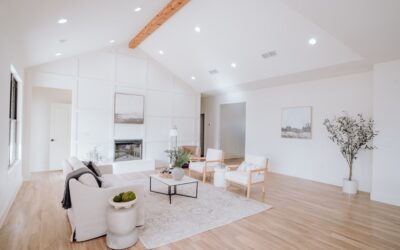
The living room is the most-photographed room in any house, which means paint choices matter more here than anywhere else. Pinterest is full of moody navy walls and creamy white-on-white spaces, but most of those rooms have professional lighting, 12-foot ceilings, and stylists hiding the chaos. Real paint ideas for living room projects need to work in 8-foot-ceiling rooms with mismatched furniture and afternoon glare. This guide covers proven palettes, exact paint codes, and the trade-offs nobody mentions in the showroom.
Part of our Paint & Walls guide — explore the full guide →
- How to Pick a Living Room Paint Color
- Top Paint Schemes for 2026
- Sheen Selection Matters
- Trim and Ceiling Pairings
- Accent Wall Placement
- Specific Pairings That Work
- Considering Existing Floors and Furniture
- Living Room Paint Mistakes
- Two Coats vs. Three Coats
- Cost Estimate for a Living Room Paint Project
- Frequently Asked Questions
How to Pick a Living Room Paint Color
Start with three constraints: how much natural light the room gets, the dominant colors of furniture you’re keeping, and the floor color. North-facing rooms need warmer colors to compensate for cool light. South-facing rooms can handle cooler colors without going icy. Choose paint after these constraints — never before.
Top Paint Schemes for 2026
1. Warm Greige Neutral (Most Versatile)
Sherwin-Williams Accessible Beige SW 7036 or Benjamin Moore Edgecomb Gray HC-173. Reads beige in warm light, gray in cool light. Pairs with everything. Best for resale and people who change accent colors seasonally.
2. Soft White (Light and Modern)
Benjamin Moore Simply White OC-117 or Sherwin-Williams Alabaster SW 7008. Reflects light, makes rooms feel larger. Show every smudge and require touch-ups every 18 months in heavy-traffic areas.
3. Sage Green (Calm and Organic)
Farrow & Ball Mizzle No. 266, Sherwin-Williams Evergreen Fog SW 9130, or Benjamin Moore Saybrook Sage HC-114. Pairs beautifully with natural wood and brass. Works in both modern and traditional rooms.
4. Moody Navy (Dramatic Anchor)
Benjamin Moore Hale Navy HC-154 or Sherwin-Williams Naval SW 6244. Best in rooms with abundant natural light and high ceilings. Limit to one accent wall in small spaces.
5. Soft Blue (Coastal and Calm)
Benjamin Moore Quiet Moments 1563 or Sherwin-Williams Sea Salt SW 6204. Reads coastal without being theme-y. Pairs with cream, brass, and natural fiber rugs.
6. Terracotta and Warm Earth (On-Trend)
Sherwin-Williams Cavern Clay SW 7701 or Benjamin Moore Persimmon 2088-40. Adds warmth, photographs well, energizes the space. Best as accent rather than full room.
Sheen Selection Matters
- Flat/Matte: Hides wall imperfections best, hardest to clean. Good for accent walls and adult living rooms.
- Eggshell: Slight sheen, reasonably washable. The default for living rooms.
- Satin: More washable, more visible imperfections. Good for high-traffic rooms with kids.
- Semi-gloss/Gloss: Skip on living room walls. Reserve for trim and doors.
Trim and Ceiling Pairings
Trim color creates the frame around your wall color. Crisp white trim (Benjamin Moore Chantilly Lace OC-65 or Sherwin-Williams Pure White SW 7005) is the safest universal pick. For warmer-toned walls, switch to a creamy white like Benjamin Moore White Dove OC-17 to avoid jarring contrast.
Ceilings traditionally read flat white (Benjamin Moore Decorator’s White OC-149) but consider painting the ceiling 25 percent lighter than walls for a continuous-color effect, or even matching the wall color in dramatic rooms.
Accent Wall Placement
The fireplace wall is the strongest accent-wall candidate because it’s already the visual focus. The wall behind a sofa works if the sofa is centered and the room is symmetrical. Avoid accenting the wall with the most windows — paint disappears around glass and looks accidental.
Skip accent walls entirely in rooms under 12 by 12 ft; they make tight spaces feel chopped up.
Specific Pairings That Work
- Walls SW Accessible Beige + Trim BM White Dove + Ceiling BM Decorator’s White — Warm, neutral, timeless
- Walls BM Hale Navy + Trim BM Simply White + Ceiling BM Simply White — Dramatic, sophisticated
- Walls BM Edgecomb Gray + Trim BM Simply White + Accent SW Cavern Clay — Modern, warm, photographs well
- Walls SW Sea Salt + Trim SW Pure White + Accent BM Hale Navy — Coastal, layered
- Walls SW Evergreen Fog + Trim SW Alabaster + Ceiling SW Alabaster — Organic, calm
Considering Existing Floors and Furniture
Honey-toned hardwood floors fight cool gray walls and pair beautifully with warm greige and sage. Gray-stained floors prefer cool whites and soft blues. Tile floors with strong veining work best with quiet wall colors that don’t compete. Beige carpet calls for warm whites or soft greens — gray walls over beige carpet read dated.
Living Room Paint Mistakes
- Choosing colors based on tiny chips. Buy a sample, paint a 2 by 2 ft swatch, live with it for 48 hours.
- Forgetting natural light direction. North-light kills cool colors; south-light intensifies them.
- Painting trim a different white than the ceiling — the mismatch reads sloppy in photos.
- Going dark in small rooms with low ceilings. The drama in design photos requires height.
- Skipping primer over old colors more than two shades darker than the new color.
Two Coats vs. Three Coats
Most quality paints (Benjamin Moore Regal Select, Sherwin-Williams Emerald, Behr Marquee) cover in two coats. Going from a dark wall to white usually requires a tinted primer plus two finish coats. Plan for one full day per coat including dry time, so a typical 14 by 16 ft room takes a weekend including prep.
Cost Estimate for a Living Room Paint Project
- Premium paint (2 gallons walls + 1 gallon trim): $140 to $190
- Brushes, rollers, painter’s tape, drop cloths, primer: $80 to $120
- DIY total: roughly $220 to $310
- Professional repaint (mid-range): $1,500 to $3,500 for typical 14 by 18 ft living room with two-tone walls and trim
Frequently Asked Questions
What’s the safest living room paint color for resale?
Warm greige (SW Accessible Beige or BM Edgecomb Gray) appeals to the broadest buyer pool. Soft whites also work well.
Should the living room be a different color than the dining room?
Open-concept floor plans benefit from a single color or two closely related shades. Closed-off rooms can handle different colors without visual conflict.
How many gallons do I need for a living room?
A 14 by 18 ft room with 9-foot ceilings needs roughly 2 gallons for walls (two coats) and 1 quart for trim.
Can I paint over dark walls without primer?
Use a high-hide tinted primer or expect to need 3 to 4 finish coats. A primer step saves time and ensures even coverage.