If your house already has a boiler for hydronic heat, an indirect water heater is often the cheapest and fastest way to make domestic hot water — and most homeowners have never heard of it. Instead of burning its own fuel, an indirect tank borrows heat from your existing boiler, storing hot water so you get quick recovery without a second burner or flue. This guide covers how the system works, whether it fits your home, real-world costs, sizing, and where a boiler tech has to take over from you.
- How an indirect water heater works
- The advantages that make it worth considering
- The trade-offs to know first
- What it costs
- Sizing an indirect water heater
- Installation and code requirements
- Maintenance
- When to call a professional
- Indirect vs. tankless coil vs. standalone tank
- Is an indirect water heater right for you?
How an indirect water heater works
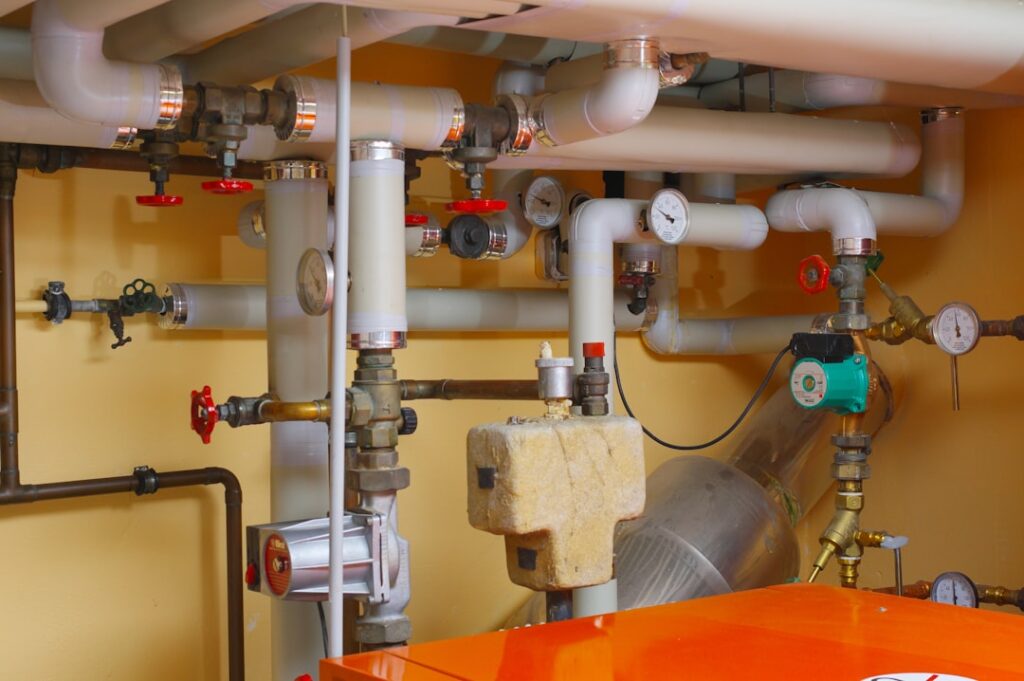
Picture an insulated storage tank with a heat exchanger — usually a coil of pipe or a tank-in-tank design — running through it. Your boiler heats water and pumps it through that exchanger. The boiler water never mixes with your drinking water; it just gives up its heat through the metal wall of the coil, warming the potable water around it. When you draw a shower, cold water enters the tank, the boiler fires, a small circulator pump moves hot boiler water through the coil, and the tank recovers quickly.
The boiler treats the water heater as another “zone,” just like a loop of baseboard radiators. An aquastat on the tank calls for heat when the stored water drops below the setpoint, the boiler fires, and the zone valve or circulator does its job. Because a residential boiler puts out far more BTUs than a standalone water heater’s burner, recovery is fast — a properly matched setup can deliver a first-hour rating well above a same-size standalone tank.
The advantages that make it worth considering
- Fast recovery. A 40-gallon indirect tank paired with a decent boiler can act like a much larger unit because the boiler reheats it so quickly.
- No second flue or fuel line. You’re using combustion equipment you already own, so there’s no new gas run, no extra venting, and no second appliance to inspect for carbon monoxide.
- Long tank life. With no burner flame corroding the bottom and no internal combustion, indirect tanks are simple and often carry warranties of 10 to 15 years — some lifetime-warranted stainless models exist.
- Efficient in winter. When the boiler is already hot for space heating, making domestic hot water costs very little extra.
- Quiet and clean. No burner cycling inside the tank itself.
The trade-offs to know first
An indirect system isn’t automatically the right call. Weigh these honestly.
- You need a boiler. No boiler, no indirect tank — this is the hard requirement. If you have a forced-air furnace, this isn’t your product.
- Summer short-cycling. In warm months the boiler fires only to make hot water. A big, inefficient boiler cycling on and off just for showers wastes some standby energy, though modern boilers handle this well.
- Higher upfront cost than a plain tank. You’re buying the tank plus a zone valve or circulator, an aquastat, and the plumbing to tie into the boiler.
- Single point of failure. If the boiler goes down, you lose both heat and hot water.
What it costs
Pricing depends on tank size, material, and how much boiler-side plumbing your installer has to add.
- Indirect tank, unit only: roughly $900 to $2,500. Stainless steel tank-in-tank models sit at the top; glass-lined coil models are cheaper.
- Professional installation: typically $1,500 to $3,500 including the tank, a new zone valve or circulator, near-boiler piping, an expansion tank if needed, and the control wiring.
- Total installed: plan on $2,500 to $5,500 for most retrofits tied into an existing boiler.
It’s more than dropping in a standard $1,200 gas tank, but the operating savings and long tank life often pay it back — especially in cold climates where the boiler runs hard all winter anyway.
Sizing an indirect water heater
Size by two numbers together: tank capacity and the boiler’s output. A 40-gallon indirect with a strong boiler can outperform a 50-gallon standalone because recovery is so fast. Match it to your household and your peak draw.
- 1 to 3 people, one bath: a 30 to 40-gallon indirect.
- 3 to 4 people, two baths: a 40 to 50-gallon tank.
- Large family or a soaking tub: 50 to 80 gallons, and confirm the boiler has the BTU output to keep up.
The installer should check the boiler’s net output against the tank’s coil rating. An undersized boiler paired with a big tank recovers slowly; an oversized boiler on a small tank short-cycles. The manufacturer’s spec sheet lists a first-hour and continuous-draw rating at a given boiler water temperature — usually 180°F supply. Have your installer run that math rather than guessing.
Installation and code requirements
An indirect tank ties directly into your boiler’s near-boiler piping, so this is a hydronic job, not a simple water-heater swap. Expect the installer to address:
- A dedicated zone. The tank gets its own zone valve or circulator plus an aquastat, and it’s usually given priority so hot-water demand interrupts space heating briefly.
- A temperature-and-pressure (T&P) relief valve. Required on the domestic side, with a proper discharge pipe run down near the floor — same code as any tank.
- A thermal expansion tank. On a closed system with a backflow preventer or pressure-reducing valve, you need one to absorb expansion.
- A mixing valve. Many setups store water hot and use a thermostatic mixing valve to deliver a safe 120°F at the tap while keeping storage temperature higher for capacity.
- Permit and inspection. Most jurisdictions require both for work on a boiler system.
Maintenance
Indirect tanks are low-fuss because there’s no burner. Still, don’t skip these.
- Flush sediment yearly through the drain valve, especially on hard water.
- Check the anode rod every few years on glass-lined models; stainless tank-in-tank units don’t use one.
- Test the T&P valve annually — lift the lever, confirm it discharges and reseats.
- Have the boiler serviced yearly. Since your hot water depends on it, an annual boiler tune-up protects both systems.
- Verify the aquastat setpoint and the mixing valve output so you’re delivering roughly 120°F at fixtures.
When to call a professional
This is not a weekend DIY swap. Tying a tank into live boiler piping means cutting into a pressurized hydronic loop, adding a zone, wiring an aquastat into the boiler controls, and balancing priority so space heat and hot water play nicely. Get it wrong and you’ll air-lock the loop, short-cycle the boiler, or scald someone. A licensed heating contractor or plumber sizes the tank to the boiler, sets the priority logic, installs the expansion tank and mixing valve, and pulls the permit. You can absolutely handle the yearly flush and T&P test yourself, but the install belongs to a pro. If your boiler burns oil or gas, any work near its combustion and venting is licensed territory for carbon-monoxide safety.
Indirect vs. tankless coil vs. standalone tank
If you have a boiler, you actually have three ways to make hot water, and homeowners mix them up constantly.
- Indirect tank: stores hot water and reheats from the boiler on demand. Fast recovery, steady supply, and the boiler only fires when the tank needs it. This is the modern, efficient choice for most boiler homes.
- Tankless coil (in-boiler coil): an older approach where a coil inside the boiler makes hot water instantly, but only while the boiler stays hot year-round. It wastes fuel keeping the boiler warm all summer and delivers weak flow. Most pros replace these with indirects.
- Standalone tank: its own burner and flue, fully independent of the boiler. Simpler if your boiler is failing, but you give up the efficiency of shared combustion equipment.
For a healthy boiler, the indirect wins on almost every axis — efficiency, recovery, and tank life. The tankless coil only makes sense if it’s already installed and working and you’re not ready to re-plumb.
Is an indirect water heater right for you?
If you own a boiler and it’s in decent shape, an indirect water heater is one of the smartest hot-water upgrades available: fast recovery, long tank life, no second appliance, and cheap operation through a long heating season. If you don’t have a boiler — or your boiler is on its last legs — a standalone tank, tankless, or heat-pump unit makes more sense. Match the tank to your boiler’s output, have a pro do the hydronic tie-in, and you’ll get years of quiet, quick hot water riding on equipment you already own.