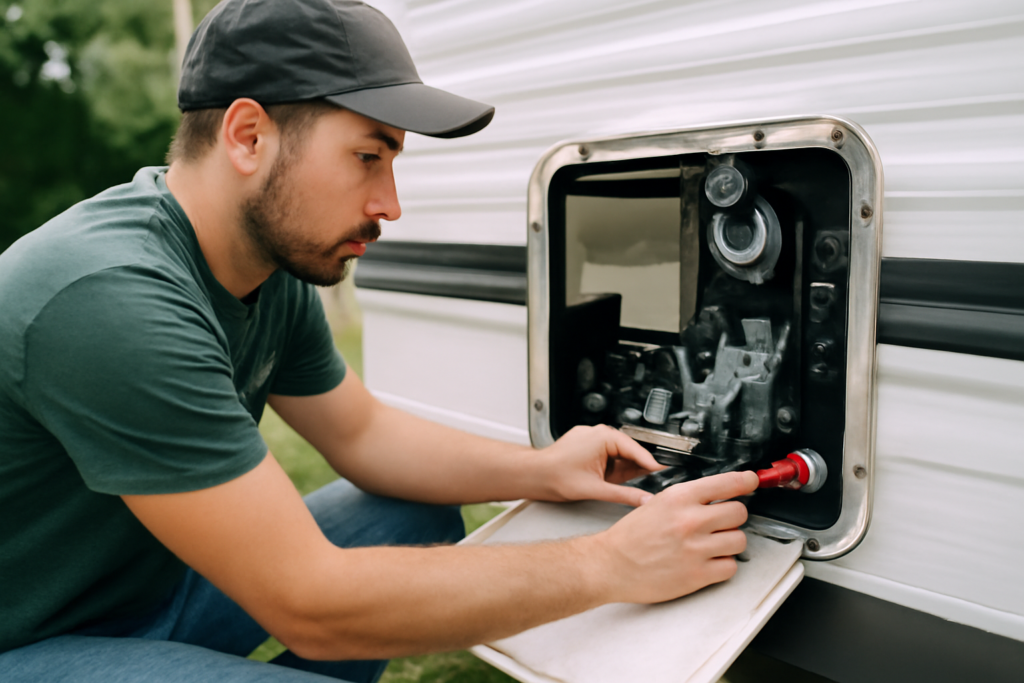
If your rig runs a steel tank, you almost certainly have a Suburban RV water heater tucked behind that access door on the sidewall. Suburban is one of the two big names in RV hot water — the other being the old Atwood, now Dometic — and the two are built differently enough that owning a Suburban means learning a couple of habits, especially around the anode rod. I’ve serviced plenty of these in the field, and most problems come down to maintenance nobody told the owner about.
- Suburban vs. Atwood: The Steel Tank Difference
- How It Heats: LP Gas and Electric
- Firing It Up the First Time
- The Anode Rod: Your Most Important Maintenance
- Winterizing With the Bypass Valve
- Common Problems and Fixes
- Sizing and Upgrades
- Annual Maintenance Checklist
- Reading the Model Number
- Bottom Line
Suburban vs. Atwood: The Steel Tank Difference
The single most important thing to know: Suburban tanks are made of porcelain-lined steel, and they use a sacrificial anode rod to protect that steel from corrosion. Atwood tanks are aluminum and don’t use an anode rod at all. If you ever hear someone say “RV water heaters don’t need an anode,” they own an Atwood. You own a Suburban, and skipping the anode will rot your tank out early.
You’ll find Suburban models in 6, 10, 12, and 16-gallon sizes. The 6-gallon SW6 and 10-gallon SW10 are the most common in travel trailers and mid-size motorhomes.
How It Heats: LP Gas and Electric
Most Suburban units run on LP (propane) gas, and many mid-tier and up models add a 120-volt AC electric element too — the DE (“direct electric”) and DEL series. Understanding the electrical side saves a lot of confusion:
- LP gas mode: A 12-volt DC circuit from your battery powers the control board, spark igniter, and gas valve. So even in “gas” mode, you need battery power for the electronics to light the burner. The propane does the actual heating.
- Electric mode (120V AC): On DE/DEL models a 1,440-watt element heats the water when you’re plugged into shore power. It’s slower than gas but silent and free of propane use at a full-hookup site.
- Both at once: Many owners run gas and electric together for faster recovery on the SW10DE — a 10-gallon tank recovers in roughly 20 to 40 minutes depending on mode.
Recovery rate on gas is strong: the SW6 puts out around 8,800 to 12,000 BTU and recovers a 6-gallon tank in about 20 minutes. That BTU output is why gas heats noticeably faster than the electric element.
Firing It Up the First Time
Before you ever light a Suburban, the tank must be full of water. Running the burner or the electric element on a dry or bypassed tank is the fastest way to destroy it. Open a hot tap, run water until it flows steady with no sputtering air, then close the tap and switch on the heater. Confirm the bypass valves are set to normal operation first (more on that below).
The Anode Rod: Your Most Important Maintenance
The anode rod is a magnesium or aluminum rod threaded into the tank. It corrodes on purpose so the steel tank doesn’t. On Suburban units the anode also doubles as the drain plug — it’s a 1-1/16-inch hex head on the outside of the tank.
- Inspect every season, or every few months of full-timing. Pull it and look. When it’s chewed down to roughly the core wire or under about 1/2 inch of material, replace it.
- Magnesium rods protect better but sacrifice faster. Aluminum/zinc rods last longer and help with sulfur “rotten egg” smell in some water.
- Replacement cost is cheap — $10 to $20 for the rod. A new tank is $300 to $500 plus labor. This is the best maintenance dollar you’ll spend on the rig.
To swap it: turn off the heater (both gas and electric), let the tank cool, turn off the water pump and relieve pressure at a hot tap, then unthread the anode with a 1-1/16-inch socket and breaker bar. Wrap the new rod’s threads with Teflon tape, thread it in, refill, and check for leaks before firing up.
Winterizing With the Bypass Valve
Come freezing weather you must protect the tank, and Suburban owners have a shortcut Atwood owners share: the bypass valve kit. Most RVs plumb one or two (sometimes three) valves near the back of the heater that let you route water around the tank instead of through it.
- Drain the tank first. Remove the anode/drain plug and let all 6 or 10 gallons out. Never pump antifreeze into a full water heater — you’d waste gallons of pink RV antifreeze filling a tank you don’t need to protect.
- Set the valves to bypass. This isolates the empty tank so your antifreeze flows straight to the faucets and lines.
- Reinstall the drain plug or anode (a fresh one if it’s due) so the empty tank isn’t left open.
- De-winterize in spring: return the valves to normal, refill the tank completely, and only then power the heater.
Forgetting to reset the bypass in spring is the classic mistake — you turn on the heater, the tank is still empty, and you cook the element or burner tube dry.
Common Problems and Fixes
These units are simple, so troubleshooting is usually quick:
- No hot water on gas, clicks but won’t light: Check propane supply and that the 12V battery has charge. Low battery voltage is a top cause. Then check for spider webs or mud daubers in the burner tube and orifice — a classic RV gremlin.
- No hot water on electric: Reset the ECO/high-limit thermostat behind the access panel (press the little red button). If it trips again, suspect a failed element or thermostat.
- Rotten-egg smell: Sulfur reacting with the anode. Sanitize the tank with a diluted bleach or vinegar flush and consider an aluminum/zinc anode.
- Sputtering, milky hot water: Air in the tank — normal after refilling; run the tap until steady.
- Weak flow and sediment: Flush the tank annually with a wand through the anode port.
Sizing and Upgrades
A 6-gallon tank is fine for a couple who showers efficiently; a family of four is happier with a 10 or 12-gallon. If you frequently boondock and want faster recovery, a DE model with the electric element gives you options at shore-power sites. Some owners add an aftermarket tankless RV unit for endless hot water, but the Suburban’s simplicity and field-serviceability are hard to beat when you’re 40 miles from the nearest parts store.
Annual Maintenance Checklist
Treat the Suburban to a short service every camping season and it’ll rarely leave you cold. Here’s the routine I run on every unit I touch:
- Pull and inspect the anode rod. Replace if it’s more than half consumed. Keep a spare 1-1/16-inch anode in your parts bin — they’re cheap and you don’t want to hunt for one on the road.
- Flush the tank. With the anode out and the tank drained, run a flexible flush wand or a short garden hose in to blast out the sediment that settles at the bottom. Sediment insulates the burner tube from the water and slows recovery.
- Clean the burner tube and orifice. Check the LP burner area for insect nests, soot, and rust flakes. A can of compressed air and a small brush clears most of it. This is the number-one cause of a gas unit that clicks but won’t light.
- Test both heat sources. Run the gas mode and, on DE models, the electric element. Confirm the water actually reaches temperature and the burner cycles off.
- Check the pressure-relief valve and the door seal. A weeping T&P valve or a cracked gasket lets weather into the compartment.
The whole service takes under an hour and costs almost nothing beyond a fresh anode rod.
Reading the Model Number
Suburban stamps a lot into the model designation, and decoding it helps when you order parts. “SW” means Suburban water heater; the number is the gallon capacity, so an SW6 is 6 gallons and an SW10 is 10. A “P” suffix indicates a pilotless direct spark ignition (DSI) unit that lights electronically off the 12V system instead of a standing pilot. “DE” adds the 120V electric element, and “DEL” adds electronic ignition to the electric-plus-gas package. Match that model number exactly when buying a control board, gas valve, thermostat, or door — the parts are not universal across the lineup.
Bottom Line
A Suburban RV water heater is a durable, straightforward appliance — as long as you respect two rules: never fire it dry, and keep that anode rod fresh. Check the anode every season, drain and bypass before the first freeze, keep the burner tube clear of insects, and your Suburban will deliver hot showers for a decade or more. Neglect the anode and you’ll be shopping for a $400 replacement tank far sooner than you should.